Quick Links: Talumpati | Licensed Librarians | Filipiniana Online | Stereotypes | Leadership | The Philippines

Showing posts with label The Philippines. Show all posts

Rebuilding Libraries After Typhoon Haiyan/Yolanda


I still get asked if my family and I were among those severely affected by Typhoon Haiyan/Yolanda. Thankfully, we were spared, along with the library where I work. Others, however, were not as lucky.

The before-and-after photos above were taken from the Facebook account of the ESSU Guiuan University Library. The municipality of Guiuan, Samar, was one of the first to be savaged by the typhoon. (I have not asked for permission to reproduce the photos, but I hope no one will mind. Click on the photos above to see other before-and-after photos.)

I have not found any other photos of libraries that were destroyed (but I will add them to this post if they are brought to my attention). There is, however, a video of a library that survived the typhoon, but has now been turned into an evacuation center, and will probably also need rehabilitation later on. (See "Tacloban library turns into an evacuation center").

If you would like to help rebuild libraries destroyed by Typhoon Haiyan/Yolanda, please consider making donations through the Philippine Librarians Association, Inc. (PLAI) or, if you would like to make a donation using your credit card, through the American Library Association, which is helping PLAI raise funds.

If you would like to send books for a specific library, the Rizal Library (of which I am the Director) is collecting books for Sacred Heart College in Tacloban, Leyte. (Although this high school was 5 kilometers away from the shore, the storm surges still reached the second floor of their building. Unfortunately, their library was on the first floor.) We are looking for for high school reference books (e.g., dictionaries, encyclopedia, atlases), recreational reading for young adults (e.g., Harry Potter, romances), and whatever you may have found useful when you were in high school. Please send an email to rizalDOTlibraryATadmuDOTeduDOTph.

Read More...

Rizal's Noli, Fili and "Mi Ultimo Adios"


Photos of front and back of what is perhaps the best-known and most-translated document written by a Filipino. Note that it does not have a title. Click photos to enlarge.


Jose Rizal's original, handwritten manuscripts of Noli Me Tangere and El Filibusterismo will be exhibited at the National Library of the Philippines on 17 June 2011 [UPDATE JUN 15: Extended to June 18] as part of its "Exhibit of Original Rizaliana Materials." It is unclear from the announcement whether the "Mi Ultimo Adios" will also be on display, but I certainly hope it will also be shown to visitors. [UPDATE JUN 15: According to its caretaker, the "Mi Ultimo Adios" is "too delicate and too faded to be exhibited."]

I just happened to be around on 12 May 2011, when the Noli, Filiand "Mi Ultimo Adios" were officially turned over to the directors of the National Library and the National Archives by the German conservators who undertook the repair of Rizal's best-known works. It was interesting to learn that Rizal himself had bound the manuscripts of his novels, and that the Noli had been so tightly bound, according to the conservators who reconstructed Rizal's binding, that it is practically impossible to open the manuscript without breaking its spine (see photo below).

The conservator shows just how far the Noli manuscript
can be opened without damaging its spine.


The Fili manuscript, unlike the Noli, can be opened easily,
but it does not have a cover like the one Rizal designed for the Noli.


What struck me most, however, was the the size of the "Mi Ultimo Adios," which was only slightly larger than an iPhone. But even more remarkable is the fact that all these were written in Spanish, and that somehow—despite the reality that very few Filipinos were fluent in Spanish during the late nineteenth century AND even fewer copies were available—Rizal's words and ideas inspired his countrymen to fight both their Spanish and American colonizers in pursuit of the establishment of an independent Philippines.


Thanks to Director Antonio Santos of the National Library, Director Ino Manalo of the National Archives, and Anne Rosette G. Crelencia (head of the Rare Books and Manuscripts section of the National Library) for letting me—perhaps the only last-minute guest at the turnover—join the exclusive event and blog about it, too!

Read More...

Overseas Absentee Voting

Overseas Absentee VotingClick on the image above to learn more about how you can vote from overseas in the 2010 elections. But all you really need to do is bring your passport to the nearest Philippine embassy or consulate. The deadline for registration is 31 August 2009. If you're curious to know why I'm blogging about this, read on...

In "Why few Filipinos abroad register for 2010," it is suggested that Filipinos overseas do not bother to register for the 2010 elections because they are worried that their votes won’t be counted properly anyway. I don't agree.

The two main reasons overseas Filipinos like me do not register is that they do not know that they can, or even if they know that they can, sometimes they just can't.

For instance, I was unable to vote in the 2007 elections because by the time I learned that I could vote from overseas, the deadline had passed. This year, even though I had not seen any notices, I took it upon myself to find out more about the process for registering as an overseas absentee voter for next year's elections. This is what I discovered:

1. The Philippine Consulate in Toronto has no information about overseas absentee voting. There is an image with the phrase "Learn More About Overseas Absentee Voting," but clicking on it leads to a dead link.

2. The Comelec and DFA websites are either down or load very slowly, and are not always the the easiest to navigate, read or understand. I was able to download the Overseas Absentee Voting Form, but when I tried doing it again just now, I couldn't. So I uploaded it to Scribd, and if you click on the link above, you can download the form there.

3. I finally learned that the deadline for registration was 31 August 2009, and that all I had to do was bring my passport to the consulate, fill up the form and have my biometrics taken. Thankfully, I had been to the consulate before and knew where to go. And I was surprised to learn that it was so easy. I was in and out in less than five minutes. I was also told that my voter's ID and ballot would be mailed to me, so there's no need to go back to the consulate. My conclusion? The people in charge of the process know what they're doing, it's the people in charge of the websites who need to attend sessions on web design and usability.

4. Finally, there's the fact that the consulate is not easily accessible in terms of its location and office hours. Unlike most overseas Filipinos who would most likely be interested in registering for the 2010 elections, I am a student and can make the trip to register on just about any day. The majority, however, will very likely have to take a day off from work. And that's not counting those who do not live within a few hours of the consulate.
My suggestion: Set up shop at malls or churches during the weekends. There will be problems and costs involved, of course, but are they or are they not serious about this? I'm sure solutions and funding can be found. Kung gusto, maraming paraan; kung ayaw, maraming dahilan.

Read More...

Filipino Identity and the Non-Filipino

Once again, we celebrate the declaration of Philippine independence. It might be good to reflect on the fact that this declaration was written in Spanish, and that the document indicates that independence was obtained "under the protection of the Powerful and Humanitarian Nation, the United States of America." With a little more digging, I’m sure it can be established that some of the signatories were of Chinese descent.

I bring up these details because it is not just where we were born that makes us Filipino. A Filipino is someone who bears traces of the non-Filipinos who occupied or visited—whether welcome or not—the group of islands now known as the Philippines. These traces are embedded in our language, history, food, habits, dreams, prejudices, etc. Whether these "souvenirs" from the Spaniards, Americans, and Chinese were good or bad for Filipinos is debatable. And while there are those who will blame non-Filipinos for everything that is wrong with the Philippines today, I think it's time to accept that this is who we are, that we each have the freedom to make our own decisions, and ultimately we are responsible—and not the non-Filipinos—for who we have become.

Read More...

Christmas 2008

I wouldn't dream of trading Christmas in the Philippines for a white Christmas. And that's why I made sure I'd be home this Christmas. I was hoping to get some work done before the new year, but I was being optimistic. As I wrote before, "schedules, eating habits and exercise routines are thrown out the window" in December.

The video below provides a glimpse of what I mean. Note that "Pasko = Christmas" and "Pinas" is short for "Pilipinas," the Filipino word for "Philippines." I've also reproduced the lyrics, and added my own English translation. Merry Christmas!


Pasko sa Pinas
Artist: Yeng Constantino

Nadarama ko na ang lamig ng hangin
Naririnig ko pa ang maliliit na tinig
May dalang tansang pinagsama-sama’t
Ginawang tambourine
Ang mga parol ng bawat tahana’y
Nagniningning
Ibang mukha ng saya
Himig ng Pasko’y nadarama ko na

May tatalo pa ba sa Pasko ng Pinas
Ang kaligayahan nati’y walang kupas
Di alintana kung walang pera
Basta’t tayo’y magkakasama

Ibang-iba talaga
Ang Pasko sa Pinas
Ang Pasko sa Pinas

Christmas in Pinas
Artist: Yeng Constantino
I can already feel the coolness of the wind
I can still hear the children's voices
Carrying bottle caps strung together
Made into a tambourine

The lanterns in each home
Shimmer and shine
The look of happiness is different
I can already feel the spirit of Christmas

Can anything beat Christmas in Pinas
The joy we feel is incomparable
We don't really care if we don't have money
As long as we're all together

It's really different
Christmas in Pinas
Christmas in Pinas

Read More...

"iamninoy"

Today, August 21, is the 25th death anniversary of Ninoy Aquino. The video above shows Bam Aquino, his nephew, inviting librarians to encourage students to take part in the iamninoy campaign. It seeks to remind all Filipinos not only of Ninoy's heroism but also of each Filipino's capacity to be a hero in his/her own way, wherever they are, whatever age they may be. Visit iamninoy.com for more information.

The video was taken at the Filipinas Heritage Library.

Read More...

Carlos Celdran—Filipino Performance Artist

The video above was taken at the Ortigas Foundation Library, where I listened to Carlos Celdran talk about how he came to do what he does. In case you didn't know, Celdran is probably the best known "tour guide" in the Philippines. The phrase is in quotes because Celdran does not think of himself as a tour guide, but as a performance artist.

Celdran has been featured in international and local publications (see "Small Change," where you will see how this blog's "mission" came to be). He appeared in a Nescafe commercial last year, but this, I believe, is the first time part of his performance has been captured on video.

Read More...

Proudly Filipino in Vancouver


This is a bit late for Independence Day, but it's finally here =)

The photos above include some of the evidence that I saw of the growing influence of the Filipino community in Vancouver. The photos of the restaurant and remittance centers were taken not in some suburb, but on one of the busiest streets in Vancouver.

Two non-Filipinos are included in the album for reasons that will be made clear below. And just in case you're wondering, I did meet Filipino librarians in Vancouver, but you won't see them here because I'll be devoting a separate post to them.

Ayeza is the pseudonym of a Filipina who migrated to Canada with her parents in the 1990s and got her nursing degree here. She is the owner of Balikbayan Box and was one of my very first friends in the Pinoy blogosphere. One of the most remarkable things I learned about her when we finally met in person was that she usually doesn't bring much with her when she goes to the Philippines, but she does bring a balikbayan box full of Filipino goods with her when she goes back to Vancouver. Yan ang Filipina!

Pamela Dent is Canadian, not Filipino, but she enjoyed working so much as an intern at a Davao school library a few years ago that she went back recently and visited other libraries, too (see her photos here). We began corresponding via email last year while she was doing her masters and thinking of going back to the Philippines. The most memorable thing she said to me was, "I love the Philippines," which is not really something Filipinos normally say. It helped, I think, that she met the man who's now her boyfriend when she was in the Philippines =)

Edgar Wickberg is best known today as the American who rescued the Chinese in the Philippines from the relative obscurity to which they had been relegated by historians before he came along in the 1960s. I thought he turned his back on the Philippines afterward and moved on to doing research on the Chinese in Canada, but I was pleasantly surprised to learn that he merely "took a holiday for twenty years," and still knows what's going on in the Philippines. He's now 81 years old, retired, and is dealing with prostate cancer, but still strong enough to drive his car to meet with a PhD student who wants to talk to him about his work on the Philippines.

Read More...

The Philippines: Singular and Plural

Today is the anniversary of the final day of the 1986 EDSA Revolution.

And since I've been reading too many Philippine history books lately—even though I'm not doing my PhD on Philippine history—I thought I'd share two of the best paragraphs written about the Philippines by non-Filipino historians.

The first, from David Joel Steinberg's The Philippines: A Singular and a Plural Place, reminded me of "The Philippines are or is?" and is probably the best description I have ever read of the Philippines:

The Philippines is a singular and plural noun. The name Philippines refers both to an island archipelago and to a country of over 75 million people. It identifies a unified nation with a single people, the Filipinos, and also a highly fragmented, plural society divided between Muslims and Christians, peasants and city dwellers, uplanders and lowlanders, rich and poor, and between the people of one ethnic, linguistic, or geographic region and those of another. To understand the Philippines, one must understand the conflict between the centripetal force of consensus and national identity and the centrifugal force of division and instability (4th ed., 2000, p. xiii).
The second, from Stanley Karnow's In Our Image: America's Empire in the Philippines, makes a very important point usually forgotten amid all the political and personal "issues" that plague Philippine society:
Filipinos readily accepted American styles and institutions. They learned to behave, dress and eat like Americans, sing American songs and speak Americanized English. Their lawyers familiarized themselves with American jurisprudence, and their politicians absorbed American democratic procedures, displaying unique skills in American parliamentary practices. But they never became the Americans that Americans sought to make them. To this day, they are trying to define their national identity (1989, p. 198).
While some will probably argue that the authors are guilty of oversimplifying, it cannot be denied that there is a lot of truth in what they write. Ours is, in fact, a nation divided. We have an official national language that nobody really speaks (see "Buwan ng Wika 2007"), and students are forced to memorize countless "national" odds and ends (e.g., national bird, national tree), but what is it exactly that makes inhabitants of the Philippines truly Filipino? I would say that my identity as a Filipino lies in the numerous political, religious, and cultural influences that have shaped our history. Then again, I'm sure many other Filipinos will disagree.

Read More...

English is the De Facto National Language

Today is the first day of National Book Week. It is also the first day of the Librarians' Licensure Examination.
From "English and the nation’s memory" by Jonathan Best (Philippine Daily Inquirer, 26 November 2007):
Sitting at my desk at the Ortigas Foundation Library in Pasig, surrounded by 16,000 books and periodicals relating to Philippine history, culture and the arts, I realize over 90 percent are in English, with maybe another 500 vintage titles in Spanish and very few in Filipino. This breakdown is probably not unlike many other major reference libraries in Manila.
What Best fails to mention is that the Ortigas Foundation Library (OFL), which has a new website, is primarily a Filipiniana library. This means that, compared to other reference libraries, the percentage of books written in Philippine languages in the OFL collection is probably higher. And that other libraries very likely have even smaller percentages of books written in languages indigenous to the Philippines.

So? Put this reality together with the fact that English is the language most often used in official functions by members of the executive, legislative and judicial branches of government, and what we have is a de facto national language. Never mind that we're supposed to have a Buwan ng Wika that celebrates our many languages, but very few of which can be understood by Filipinos across the nation. Those who subscribe to conspiracy theories might even think that those pushing for the adoption of Filipino as the medium of instruction just want to make it even more difficult for the poor to understand what's going on in our government right now, and even what happened in the past.

Best is right. We need English.

Read More...

Did Erap Deserve His Pardon?

I am not against the granting of a pardon to persons who deserve it. However, people who have refused to accept their guilt and have shown no contrition for the crime they committed do not deserve pardon (source).
Nope, Senator Noynoy Aquino was not referring to former President Joseph "Erap" Estrada, but to Pablo Martinez, one of those convicted for the assassination of Ninoy Aquino, the senator's father.

Maybe Martinez truly does not deserve to be pardoned, but I wonder if the conditions Noynoy thinks of as making a person worthy of being pardoned are applicable to the man with whom he has jumped into bed. After all, here's what Erap's wife (or one of them, anyway) says: "He never stole from the country, we would fight for it if we have to" (source).

After the "Cory and Loi" show, I guess I shouldn't be surprised.

Like mother, like son.

Read More...

When was Martial Law "Declared"?

Many history books state that martial law was declared by Ferdinand Marcos on 21 September 1972, the date that appears on Proclamation 1081. Those who lived through those times (not me!) will say, however, that the anniversary of martial law falls on September 22, if they were arrested on that day; or September 23, the day when Marcos appeared on TV to announce the imposition of martial law.

To complicate matters further, two months later, Marcos claimed to have signed Proclamation 1081 on September 17. So was it postdated or antedated? Or do we just rely on the date on the document? Fortunately, we have Manolo Quezon, who seems to have encoded Marcos's diary entries from January 1971 to September 1973 all by himself. [Aside: Why are these entries not available on the Marcos, NHI or RMAO websites?] Here's an excerpt from Marcos's entry for September 21:

Delayed by the hurried visit of Joe Aspiras and Nating Barbers who came from the Northern bloc of congressmen and senators who want to know if there is going to be Martial Law in 48 hours as predicted by Ninoy Aquino.

Of course Imelda and I denied it.

But Johnny Ponce Enrile, Gen. Paz, Gen. Nanadiego, Kits Tatad and I with Piciong Tagmani doing the typing finished all the papers (the proclamation and the orders) today at 8:00 pm.
This seems to imply that Proclamation 1081 was finalized on September 21, and must only have been signed afterward. But why would Marcos later claim that he signed it on September 17?

Anyway, assuming Proclamation 1081 was signed on September 21, should that be equated with "declaring" martial law? If perhaps all we had was the official document, and everyone who lived through those times were dead, then maybe we would have to settle for what was written on the document. But lots of books and articles are available attesting to the fact that people were arrested on the evening of September 22, and that Marcos announced the imposition of martial law on September 23. What exactly should be given more weight, the official document or other written and oral sources?

But the weirdest thing, though, is that I attended the Philippine Historical Association's National Conference last Saturday, 21 September 2007, which had as its theme "Controversies and Fallacies in Philippine History," and not once was any reference to the declaration of martial law made during the day-long event. The conference itself was quite enlightening about matters that occurred more than a century ago. But I wonder whether the absence of references to more recent events (aside from the extended discussion of textbook errors) was done intentionally.

Read More...

Danton Remoto for Congress

In "Danton Remoto: A fabulous run for Congress" by Ricky Gallardo (Sunday Times Magazine, 6 May 2007), Remoto explains why he is entering the world of politics:

Because you cannot just complain and do nothing concrete. We are great talkers but bad workers. Because government gives you access to resources that can be used to change people’s lives. Like in District 3, there are health centers, but why do the doctors work only half-day, if at all? Why are there no medicines readily available? Why do five students share one textbook? Why do the barangay libraries exist when the shelves have no books? Why are the day-care centers closed? Why are the informal settlers mired in poverty and hopelessness? (emphasis added)
The answers to his questions, if you read the article, are clearly not just due to lack of money. After all, Remoto has gained the lead in his district—and even national recognition—without spending millions on advertising that other candidates have thrown at the TV networks.

But I've written about money and leadership before, so I'll just ask a question: If a library has no books, is it really a library? Remember, though, that the libraries Remoto refers to do not have electronic subscriptions or collections; they would be lucky to have even one computer. Perhaps someone like Remoto—who writes books, teaches literature, uses libraries and has worked as a publisher—can make a difference. I wish I were home so I could vote for him.

Read More...

Magellan Did Not Discover the Philippines

According to Wow Philippines, the official Philippine tourism website, Limasawa Island was "the site of the celebration of the first Christian mass in the Orient, following the discovery of the Philippines by Ferdinand Magellan in 1521." There may be some doubt whether the first mass was held in Limasawa or Masawa, but there can be no doubt that Magellan did not discover the Philippines.

As Teodoro Agoncillo wrote almost fifty years ago in "A Reinterpretation of Our History Under Spain" (Sunday Times Magazine, 21 September 1958),

There are misconceptions in the treatment of our history that should be exposed and corrected for the intellectual health of our students and general readers. Foremost among them is the belief, so current even today, that Magellan discovered the Philippines. This belief originated from the Spaniard chroniclers whose purpose was to put into as wide a circulation as possible the greatness of Spain. This is natural and should not be counted against Spain or Spaniards, for indeed Spain was great and wealthy at the time Magellan reached the Philippines. The statement, however, becomes funny when Filipinos repeat such obvious prevarication of truth, for our country already had commercial relations with her Asian neighbors hundreds of years before Magellan was born.
So who discovered the Philippines? As far as I'm concerned, it's an irrelevant question to Filipinos because it is essentially a foreigner's question. I suppose someone before Magellan could lay claim to have discovered the Philippines, but from the point of view of the Filipino who was already there, s/he would not have thought that the foreigner discovered her/him. If s/he had a diary, it would probably have said something about foreigners arriving; no mention would have been made of being "discovered." And that's what looking at Philippine history from the Filipino point of view is all about.

Then there's the fact that references are made to the Philippines and Filipinos as if what exists today has been around since time immemorial. But that will have to wait for another post =)

Read More...

Magellan Did Not Circumnavigate the World

Over the Edge of the World by Laurence Bergreen
What is wrong with the book cover above?

Ferdinand Magellan sailed from Spain on 10 August 1519 to circumnavigate the world, but died in what is now known as the Philippines on 27 April 1521. He, of course, did not make it around the world =)

Read More...

Edsa 20/20: One Year Later

Archie IntenganThe Philippine Center for Investigative Journalism (PCIJ) has made available the text of the special issue of iReport commemorating the 20th anniversary of the Edsa Revolution. Interviews with twenty individuals, such as Cory Aquino, Imelda Marcos, and other major players and representatives from all walks of life, indicate how much—or how little—has changed twenty years after that historic event.

One year later, the economy seems to be better, but politicians are as disappointing as ever. And the Aquinos just seem to be sinking to new depths all the time. The "Kris and Borgy" billboards weren't exactly Kris Aquino's fault, but was there any excuse for the "Cory and Loi" show? Read "The Aquinos Today: What would Ninoy say?" (Philippine News, 28 February 2007), and see for yourself how Ninoy's family seems to have all the bases covered when it comes to political scandals—from showbiz intrigue to sibling rivalry to turncoatism.

On a personal note, last year, all I could do was link to the podcast and share the "outtakes" from the article that I contributed to the special issue (see "Fr. Archie Intengan on the Church Today"). Well, you may now read "Romeo J. Intengan" by Vernon R. Totanes =) Please note that it has a page 2.

Read More...

Conrado de Quiros and Christ

From "'Losers'" by Conrado de Quiros (Philippine Daily Inquirer, 8 March 2007):

"'T---na, tapang lang 'yan" ["Christ, all it takes is heart"].
The quote above is from a column on senatorial bets who are not expected to win. I don't know whether de Quiros himself provided the translation, but equating a word that needs to be bleeped out with "Christ" seems to be just plain wrong. And I'm not even thinking about this in religious terms. What's ironic is that the column ends with a reference to Christ's apostles.

Read More...

9/11 Obituaries

In "Ground Zero 9/11," I linked to pages devoted to the 15 individuals from the Philippines or of Filipino descent who died at the World Trade Center towers on 11 September 2001. The pages on September 11, 2001 Victims, however, were limited to a few sentences about the deceased and some comments from relatives and friends.

Now, a few days before the fifth anniversary of the tragedy that has become known as 9/11, it is perhaps appropriate to link directly to the obituaries published in the New York Times and other newspapers, as reproduced on Legacy.com.
Grace Alegre-Cua, 40
Cesar A. Alviar, 60
Marlyn C. Bautista, 46
Cecile M. Caguicla, 55
Jayceryll M. de Chavez, 24

Benilda P. Domingo, 37
Ramon Grijalvo, 58
Frederick Kuo, 53
Arnold A. Lim, 28
Manuel L. Lopez, 54

Carl Allen Peralta, 37
Roy F. Santos, 37
David Marc Sullins, 30
Larry Sumaya, 42
Hector Tamayo, 51
The movie World Trade Center helped me appreciate what it must have been like for those who were at the towers on that day. It will probably be nominated for a few Oscars, but it's a feel-good movie that felt bad most of the time.

You may wish to remember 9/11 in a different way by participating in the September Project, a library-based "grassroots effort to get people together on September 11th to talk about issues that matter." There does not seem to be an equivalent effort in the Philippines, but last year I was able to join an online event organized in Singapore, which is having a multimedia non-contest this year.

If you would like to revisit 9/11 coverage in print, on TV and online during and immediately after the attacks, check out Newspaper Archive and September11news.com


Category: Events

Read More...

HIV/AIDS in the World and the Philippines

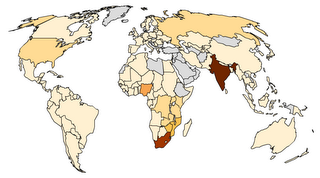
number of people living with HIV/AIDS worldwide"AIDS 2006," the XVI International AIDS Conference organized by the International AIDS Society, began here in Toronto, Canada, last night. It's a serious conference, of course, but the power of celebrity cannot be denied. And so, among the speakers are Bill Clinton, Bill Gates and Richard Gere. (Aside: Guess which one hasn't had his private parts discussed in public?)

Digital coverage is available via Kaisernetwork.org, Clinical Care Options and, of course, the blogosphere. To appreciate the extent of the problem that is HIV/AIDS, take a look at the UNAIDS 2006 Report on the global AIDS epidemic. There is also a map on Globalhealthfacts.org that shows the number of people living with HIV/AIDS worldwide.

Globalhealthreporting.org has a map and a table that puts data for HIV/AIDS, tuberculosis and malaria side-by-side. Pointing your mouse at the Philippines on the map shows that HIV/AIDS is not as big a problem in my home country as tuberculosis and malaria. Clicking on the Philippines will lead to a page on Globalhealthfacts.org that provides the numbers, additional information and sources.

The Philippine National AIDS Council has some useful information and downloadable files, including Republic Act No. 8504 (pdf), but it is the Remedios AIDS Foundation, with its graphs and tables (as of April 2006), that is more helpful for those looking for statistics. The AIDS Society of the Philippines is practically useless because it was last updated in 2004!

The most famous AIDS victims in the Philippines were Dolzura Cortez and Sarah Jane Salazar, primarily because movies were made about their lives. Both are now dead. Read "Health care personnel's critique on the Philippines' first movie on AIDS" by S.B. Zaldivar (AIDS Care, 1 February 1995) to see what Filipinos learned from the movie about Dolzura Cortez. See also the abstract of "Bridging the gaps in HIV/AIDS education through films" by N.P. Simbulan, a conference paper presented in 2000.

Finally, there's "Exploring the realities of HIV/AIDS-related discrimination in Manila, Philippines" by N.L. Ortega, et al. (AIDS Care, July 2005), which only confirms what many Filipinos already know: the existence of a law does not and cannot eradicate discrimination by itself.


Categories: Events, The Philippines

Read More...

Will Mayon Volcano Erupt?

Mayon VolcanoLet's hope that it doesn't erupt, but if you'd like to know the latest updates, check out the following: Google News, Yahoo! News (see also images), and Topix.net.

You may also wish to keep your eyes on the websites of the National Disaster Coordinating Council (NDCC) and Philippine Institute of Volcanology and Seismology (PHIVOLCS), which includes information on the physical characteristics of Mayon Volcano and even the populations of the municipalities around it. There is also a list of all active volcanoes in the Philippines.

Finally, try to remember that there are human beings around the volcano, who may not necessarily flee for various reasons. Some have actually traveled to Albay because of Mayon's impending eruption. As Minette of A Wonderful Life says, "It's really such a spectacular sight when you get to see it up close especially at night. I watched, just like the other locals and tourists, mesmerized by its beauty and oblivious to the danger it poses."


Category: The Philippines

Read More...

Related Posts Plugin for WordPress, Blogger...