Quick Links: Talumpati | Licensed Librarians | Filipiniana Online | Stereotypes | Leadership | The Philippines

Showing posts with label About Vonjobi. Show all posts

The Philippines for Beginners: Book Recommendations


I was recently asked to make some book recommendations. The books, preferably available in bookstores and "easily digestible," were to answer the question: What should I read if I want to learn more about the Philippines and Philippine culture?

Smile, Cebu Pacific's inflight magazine, is probably one of the most widely-circulated (if not most widely-read) magazines in the Philippines AND I had long wondered why the few books featured in its pages were mostly foreign books, so even though my mom was in the hospital when the request came and I was quite busy at work, I set aside some time thinking about which books about the Philippines would be helpful for foreigners and Filipinos alike.

Below is the introduction I sent (which was not published huhu), as well as the full text of the article. You can download "The Philippines for Beginners," the entire June 2015 issue, and even previous issues on the Smile website.

THE PHILIPPINES FOR BEGINNERS
These recommendations from book historian and librarian Dr Vernon R Totanes are sure to add to your knowledge of the nation

"What’s the best history book on the Philippines?" That's a question I usually get asked when people find out that my PhD dissertation was on the history of the Filipino history book. My answer is often another question—"What are you interested in?"—because there is no book that is suitable for all readers, and scholarly monographs or school textbooks are not necessarily appropriate for the needs of those who wish to know more about Filipinos and the Philippines.

1 Learn Tagalog — the fun way
ALAMAT NG AMPALAYA BY AUGIE RIVERA
The song "Bahay Kubo" enumerates the many vegetables grown in neighborhood gardens with one exception — ampalaya (bitter gourd). The omission inspired this children's book. The Tagalog and English texts are sure to prove useful for those aiming to study one or both languages.

2 Get to know a national hero
RIZAL WITHOUT THE OVERCOAT BY AMBETH R OCAMPO
Jose Rizal, considered the national hero of the Philippines, was more man than Superman. This book uses humor and interesting trivia to (re)introduce Rizal as a mere mortal who loved women, was stingy with money and liked to eat tuyo for breakfast.

3 Be one with the locals
PACIFIC RIMS: BEERMEN BALLIN’ IN FLIP-FLOPS AND THE PHILIPPINES' UNLIKELY LOVE AFFAIR WITH BASKETBALL BY RAFE BARTHOLOMEW
Ever wondered why Filipinos — most of whom aren't that tall — love basketball? Find the answer in this book, which the author has described as his love letter to the Philippines.

4 Appreciate the nation's cuisine
MEMORIES OF PHILIPPINE KITCHENS BY AMY BESA AND ROMY DOROTAN
Learn how to cook lumpiang Shanghai, adobo and kinilaw and get better acquainted with the origins of Philippine cuisine with this cookbook by the duo behind Purple Yam. It features stunning photographs, too.

i DR VERNON R TOTANES, LICENSED LIBRARIAN AND BOOK HISTORIAN, IS THE DIRECTOR OF THE RIZAL LIBRARY, ATENEO DE MANILA UNIVERSITY. HE BLOGS AT FILIPINOLIBRARIAN.BLOGSPOT.COM

Read More...

Book-lat: Reading in the Philippines


In case you missed it last week, the video of a TV5 documentary on reading in the Philippines is now available online. The documentary's title, "Book-lat," references the Tagalog word "buklat" (in English, to open like a book). The question it seeks to answer is "Kaya ba nating makalikha ng isang nasyon ng mga mambabasa?" (Can we create a nation of readers?) Watch the entire documentary below.

Part 1


Part 2


Part 3


Part 4


Disclosure: I was interviewed for the show, and I appear as early as 1:11 in the first segment. Note that I am not identified as a librarian, but as a book historian. Also, the Rizal Library is featured prominently in the host's spiels and my interview, and several librarians and staff are clearly identifiable in the background and walking through the stacks.

Read More...

Why Did I Become a Librarian?


Photo by Daniel Tan

Last month, I was asked to write a short essay on my favorite place in Ateneo. I ended up writing not so much about the Ateneo libraries I used to frequent when I was growing up, but how my favorite places influenced my own journey to becoming a librarian (see "Laman ng Lib"). I am reproducing the essay below, with links to posts I've written in the past, to (re-)introduce myself to the old and new readers of this blog. Feel free to leave comments on Facebook.


Laman ng Lib


Grade 2 pa lang ako, laman na ako ng library.

The first book I ever borrowed at the Grade School library was The Melted Coins, a Hardy Boys mystery (see "Five Things About Vonjobi"). After finishing the entire series sometime in Grade 6, I was allowed to borrow a few books, including Robert Ludlum's The Scarlatti Inheritance, from the restricted faculty collection by appealing to Ms. Grace Valente, the first librarian I asked to bend a rule for me.

At the High School library, I never had to ask for special permission to borrow books, but it probably wouldn't have been difficult because Mrs. Inday Lara, the librarian, was my father's childhood playmate. One book that I will never forget is William Goldman’s Adventures in the Screen Trade, which introduced me to the practical aspects of filmmaking in an engaging, non-technical manner (see "Meme: Books I Own and Love"). I liked it so much that I borrowed and reread it every year. If the yellow borrower's card at the back is still there, you'll see that I signed my name consecutively.

When I moved on to the College, I was happy to finally become a legitimate user of the Rizal Library. I had been able to use it a few times as a high school senior, but I always felt like a guest afraid to overstay his welcome. This time, however, I could browse the books without having to sign in and indicate what my research topic was. In particular, I liked looking at books that had just been returned, which I took as an indicator that they were worth reading. That's how I found Ogilvy on Advertising, which opened my eyes to the realities of communicating with potential customers, even before we had to discuss the subject in class.

After graduating from the College in 1995, I still had no idea what I wanted to become. But I knew that it had to be something I enjoyed doing and it had to be meaningful. For a while, I found meaning in my job as a service quality officer in a bank, but after four years I decided to move on. Then, I considered the possibility of becoming a Jesuit. I lived for a year in Arvisu House, a place where young men stayed while thinking about joining the Society of Jesus, and took subjects once again at the College, and at the Loyola School of Theology. At the end of the year, however, it became clear that the Jesuits and I were better off as friends, not “married” =)

It was then that the period I call my "wandering in the desert" years began. I taught high school religion at the Jesuit-run Sacred Heart School for Boys in Cebu for a year, joined the Social Security System for a few months as a consultant (and vowed to avoid government jobs forever), worked as a quality supervisor in a call center for an even shorter period, edited books for publication as a sideline, and explored the possibility of getting an MA in Theology or an MBA. The last option got me thinking about what I really wanted to do with my life.

Further discernment led me to ask two questions: "What do I really like doing?" and "What can I see myself doing 10 years from now?" The answer to the first question was "I love reading books," but it was obvious that there was no career in reading for me. Then I remembered my library experiences as a student, and I wondered if there was such a thing as a master's degree for librarians. Google told me there was such a thing, so I enrolled in 2002, finished my graduate degree in library and information science by 2004, took the PRC Board Exam for librarians, got my license to practice, and eventually left for Canada to study for a PhD in book history (see "In My Life, 1999-2009").

A few relatives and friends urged me to stay in Canada after obtaining my degree, but I knew that I wanted to work in the Philippines. But where? My doctorate rendered me overqualified for most librarian jobs, except for the largest universities. However, as a blue-blooded Atenean, former Jesuit wannabe, and government-averse Filipino, I could not imagine working for De La Salle University, University of Santo Tomas, or University of the Philippines. There was really only one option: Ateneo de Manila University.

Fortuitously, Mrs. Lourdes David, the Rizal Library's Director, was retiring soon, and a search committee had been formed to look for her replacement, preferably someone with a PhD. In my application, I emphasized that I was an Ateneo alumnus along with my other qualifications, and hoped for the best. And so it happened that 30 years after I borrowed my first library book, almost 20 years after graduation, and exactly 10 years after asking my second question, I was hired to do something meaningful that I enjoyed doing.

I've been asked, "Bakit mo iniwan yung magandang trabaho mo sa Makati?" (Why did you leave your nice job in Makati?) and "ME ka, bakit mo gustong mag-pari (or mag-librarian)?" (You're a Management Engineering graduate, why do you want to become a priest (or a librarian)?) and "Nasa Canada ka na, bakit bumalik ka pa ng Pilipinas?” (You were already in Canada, why did you return to the Philippines?) The answers to each of these questions can be the subject of separate articles, but they are all essentially products of the process of discernment that I learned as an Atenean and as a Jesuit wannabe.

Over the years, I've identified with Joseph, who was sold into slavery in Egypt, but eventually found his way back to Israel. I tell people that I've gotten lost and taken some wrong turns over the years, but somehow, for some unknown reason, God takes care of me... whether I deserve it or not. And this is how I know that God does, in fact, write straight with crooked lines, with long detours, and with borrowers' cards.

St. Ignatius was right. We can, in fact, find God in all things. Even in the library.


Vernon Totanes is the Director of the Rizal Library. He obtained his PhD degree at the University of Toronto, and his master's degree in library and information science at the University of the Philippines. He is an alumnus of the Ateneo de Manila University (GS 1987, HS 1991, BSME 1995).

Read More...

Preparing to Become a Leader

Did you assume a managerial or supervisory position recently? Or maybe you'd like to know what I did to prepare for my job as "Director, Rizal Library"? If so, you may want to read the article I wrote for The Manila Review:


So You Think You Can Be the Boss
by Vernon R. Totanes

"I am pleased to inform you that the search committee tasked to recommend the next Rizal Library director has recommended that you be appointed director beginning April 1, 2013."

This message appeared in my inbox more than a year ago, as I was finishing my dissertation in Canada. By the time you read this, I will have been Director of Ateneo de Manila University's Rizal Library for more than 90 days.

Read More...

Read More...

The Future of Book History

I am a book historian. The biggest gathering of book historians takes place every year at the annual conference of the Society for the History of Authorship, Reading, and Publishing (SHARP), which was held this year at University of Pennsylvania in Philadelphia from 18-21 July 2013. The theme was "Geographies of the Book," which was interpreted both literally (e.g., "circulation... within cities, countries, and across continents") and figuratively (e.g., "imaginative topographies or journeys within fictional works").

In addition to presenting a paper at this year's conference, I was also invited to be one of 12 speakers at the closing plenary session. Each of us was either a PhD student or an early scholar—participants whose voices are rarely heard at plenary sessions. We were given five minutes each, but we were also instructed not to tell anyone about what we were going to do because we were supposed to listen to our colleagues' comments and share their feedback during our reports. (For photos of the closing plenary session, as well as some of the heartening reactions on Twitter to my contribution, see my Facebook post.)

Some speakers spoke extemporaneously, but like a few others, I wrote down my contribution. Here's most of what I said...

First, I will state the obvious, just to get it out of the way. Second, I will state what is not so obvious, just so you know where I'm coming from. And finally, I will state what I am currently doing to promote book history in Asia, as well as what I intend to do in the next few years, which I suspect many of you have already done in the past.

First, despite its global ambitions, it is obvious—based on my own observations, comments whispered in my ear, and tweets posted online, with someone actually using the word "angry" in my presence in relation to yesterday's supposedly global session—that SHARP remains predominantly white, Anglo-American. This reality is reflected in the sites chosen for its annual conferences, as well as the large percentage of papers presented on the book in the West.

Please don't get me wrong. I'm not criticizing anyone for a state of affairs that is not unique to SHARP. I'm also not blaming anyone for not addressing questions they never sought to answer. SHARP's focus on the book in the West is not new. In 2001, Amadio Arboleda, who is based in Japan and could not make it here this year, wrote about what he called the "Gutenberg Syndrome," in which the history of the book is viewed in terms of Western principles and practices. I suspect that his sentiments were not entirely new then, and they're certainly not new now. But I suppose it's worth asking, "How much have things changed since then?" I have a suggestion to address this later.

Moving on. What is not so obvious, perhaps, is that while I am clearly representing Asia today, I am not—in many ways—entirely representative of most Asians, the great majority of whom probably have very little time to think about books because they are more concerned about finding food and work. I have been very privileged. It was as a PhD student that I was able to present papers at SHARP's annual conferences in Oxford, Helsinki, and Toronto. I received most of my travel funding from University of Toronto, but the discounted student membership and conference registration rates were very helpful, and for this I am grateful to SHARP.

I am here this year because I received a scholarship from SHARP—and for this I would like to thank the generous donors who contribute to the travel fund, as well as those who administer the fund. The scholarship I received, however, was sufficient to cover only half of my airfare from halfway across the world, so thankfully again, I am gainfully employed and privileged enough that Ateneo de Manila University has given me enough to pay for most of the other costs of going to Philadelphia.

For the final part of this short report I ran out of time to write it out, so I hope you'll pardon me for relying on bullet points to describe what I hope can be done at future conferences:
  • nice to have this year because of the theme, but can still be done next year: GIS map of book historians, book history prizes, not just place, but also over time
  • immediately: talk to someone i don't know, talk to the person sitting next to me
  • next conference: badge for "first timer"; session for first-timers; mentors for first-timers
Because of my own privileged status as the director of a university library with its own budget, I plan to do the following things to promote book history in Asia:
  • collect public school textbooks for research purposes, and if possible, publishers' archives, in addition to the documents we already collect
  • organize a book history panel for a conference in the Philippines
  • 3 to 5 years: organize a book history conference for Southeast Asia in the Philippines; participate in planning to bring annual conference to Asia, specifically Japan
  • 5 to 8 years: organize annual conference in the Philippines
Thank you very much.

Read More...

UPLSAA Young Achievers Awards 2013

From left: Carina Samaniego, Reysa Alenzuela, me, Rina Diaron, Rhea Apolinario, Chito Angeles, Troy Lacsamana, representative of Joseph Yap, and Marvin Vergara. Not in photo: Marian Ramos Eclevia.
Thanks to the UP Library Science Alumni Association, I—along with nine other alumni—can now claim to be among the first ever recipients of the "Young Achievers Award." Please note that "young," in this case, is defined as "under 40 years old" =)

The awards were presented at the 63rd General Assembly and Homecoming last 25 May 2013. For more photos, see my Facebook album.

Read More...

Board Games, Libraries, and Breaking the Rules


Board Game Day was held at Matteo Ricci Hall of the Rizal Library last Friday. I was asked to deliver the opening remarks, which I wrote in a hurry that same morning, and literally finished at the last minute. It's not as polished as I would have hoped, but if any of you have been wondering what kind of library director I hope to be, you're going to get more than a few clues here.


Opening Remarks
Board Game Day
25 January 2012


Good morning! And thank you for joining us today for Board Game Day.

Earlier this year, the Wall Street Journal published an article about events being held in public libraries in the United States that are designed to encourage people to check out what's new at the library. The events mentioned included Zumba classes, seminars on landscaping, and even hog-butchering, blacksmithing and fly fishing.

Some have questioned the relevance of such events to the mission of libraries. I would not be surprised if some in the Ateneo community are also wondering, "What do board games have to do with the mission of the Rizal Library?" The best answer I have for this question is to state that our mission is not limited to providing access to books, journal articles, and the Internet. We are here to facilitate learning.

We do this not only by continuing what has already been done in the past, but also by exploring newer, proven ways of enhancing the educational experience. Today, we hope to identify board games that will not only be fun to play and build community, but can also help our university achieve its mission of producing men and women for others. Now, that's a big leap in logic, but let me explain by discussing just one reason I think playing board games can help facilitate learning.

One thing common to all board games is that there are rules. And each game has its own rules. You have several choices. Most play the game according to the rules. Some try to change the rules and see if their fellow players will continue to play with them or throw them out of the game. Some choose not play at all. But you cannot play one game using the rules for another. You cannot play chess, for example, using the rules of Monopoly.

Here at Matteo Ricci and the library, we have lots of rules. For example, you can eat on the second floor, but not the first floor. Most students abide by the rules, but a few try to get away with eating their merienda or lunch, and risk getting reprimanded with a warning or even an official sanction. Some might ask, "How come we can eat on the second floor, but not the first floor?" And there is a good reason for that—ask me later—but the point I'm making is that there are different rules for different places, and different occasions. In the real world, unlike board games, some rules are written, many are not.

The same is true for Ateneo, the companies you hope to work for, the businesses you'll be setting up, Philippine society in general. But the rules are not always the same. As you very well know, sometimes the rules that are announced in public are not followed in private. You can choose to abide by the rules, break the rules, or refuse to play the game. But first you need to know the rules, and that the rules change depending on the game you're playing. I'm not sure if this makes sense, but when I started working after graduating from Ateneo, I learned that what I got used to in school is not necessarily also what happens outside. Or, as Dorothy told Toto in The Wizard of Oz, "We’re not in Kansas anymore."

This is probably getting too heavy for the opening remarks at Board Game Day, so allow me to just thank a few people, and share a little prayer. I’d like to thank:
Karryl Sagun, who organized this event,
Hans Fernandez and Adrian Manahan of Gaming Library, who provided all the games,
Diane Santos of Book Bench, who designed the poster for this event,
The various librarians and staff who helped Karryl prepare for Board Game Day, especially Manny Concepcion, who is the person in charge of Matteo Ricci Hall,
The volunteers, who will be helping you learn all the rules later, and
Mrs. Lourdes David, Director of the Rizal Library, who approved the proposal and made this day possible.

Finally, allow me to end with a familiar prayer with a few amendments…

Lord, grant me the serenity to accept the rules I cannot change,
The courage to break the rules that should be broken and deal with the consequences,
And the wisdom to know the difference.

Read More...

What was the first book printed in the Philippines?


Click on the photos above to learn more about each book
and/or download their digital versions.


Earlier this week, I received a text message asking if the essay mentioned by Ambeth Ocampo in his latest column was posted on my blog. Since I had no idea that any publication of mine had been cited in a newspaper recently, I checked out the column. And there it was at the very end of a discussion on "First book(s)" (Philippine Daily Inquirer, 16 January 2013): "For a more recent take on the old issue see Vernon Totanes’ 2009 essay 'What was the first book printed in the Philippines?'"

Since I've never actually posted a link to the journal article on my blog, I thought I'd share it now, along with the abstract, in case someone wants to read it. Click on the title to download the pdf =)

Note, however, that the title is misleading because the article is essentially an introduction to the discipline of book history, and asserts that the two books printed in the Philippines in 1593 are significant in ways that have yet to be fully appreciated.


"What was the first book printed in the Philippines?"
Vernon R. Totanes
Journal of Philippine Librarianship 28:1 (2008), 21-31.

This paper will show that the importance of the imprints lies in the fact that they effectively communicate the idea that printing in the Philippines—and Philippine history—is inextricably linked with the non-Filipino. The first books printed in the Philippines, though not strictly "Filipino," are a physical reminder of the plurality of the nature and culture of the Filipino and the Philippines.

Read More...

Director, Rizal Library

One more post. This one is for those who are wondering what I plan to do now that I'm done with my PhD. The memo below also reveals a little about my background and why blue is my favorite color =)

Director, Rizal Library


Again, for those who have difficulty reading the document above, I am reproducing its text below:


Ateneo de Manila University
Office of the President


12 November 2012

Memo to: The University Community

Subject: Director, Rizal Library


Upon the recommendation of the Search Committee headed by Dr Maria Luz Vilches, and endorsed by Dr John Paul Vergara, I am appointing Dr Vernon “Von” R Totanes as Director of the Rizal Library effective 1 April 2013. He succeeds Mrs Lourdes T David whose term ends on 31 March 2013. As part of the transition process, Dr Totanes will assume the position of Assistant Director beginning 16 November 2012.

Dr Totanes holds a PhD in Information from the University of Toronto, and a Master of Library and Information Science from UP. He obtained his license as professional librarian in 2004, topping the licensure exam. As a researcher, he has published in books and journals locally and internationally.

Von is no stranger to our school, having graduated from the Ateneo de Manila with a degree in Management Engineering (1995), High School (1991) and Grade School (1987). From 2003 to 2004 he did volunteer work at the Rizal Library and at the Gehring Library of the Loyola School of Theology.

His career history includes working as a librarian for the Philippine Center for Investigative Journalism and the Asian Development Bank as well as teaching in Sacred Heart School in Cebu, the UP Institute of information and Library Science, and the University of Toronto. Immediately after college, he was employed as Service Quality Officer for CityTrust Banking Corporation and as Assistant Manager for the Total Quality Office of the Bank of the Philippine Islands.

I thank Dr Vilches and the members of the Search Committee for their commitment and generosity in conducting the search process. The members of the Committee are: Dr Filomeno V Aguilar, Mr Eduardo Jose E Calasanz, Dr Jonathan O Chua, Dr Edna P Franco, Dr Ma Celeste E Gonzalez, and Dr Ma Louise Antonette N de las PeƱas.

Let us welcome and support Dr Totanes as he assumes this new assignment.

On behalf of the Ateneo de Manila, I would like to express our profound gratitude to Mrs Lourdes David who has led Rizal Library to where it is now. By her vision and dedicated work, Rizal Library's dynamism has been exemplary in terms of infrastructure, resources, and its networking relationships with our academic community and outside. Mrs David shall continue to serve as Consultant for the Rizal Library beyond her term.


Jose Ramon T Villarin SJ
President

Read More...

History of the Filipino History Book

In case you haven't heard, I successfully defended my dissertation last 22 June 2012. And now I'd like to share its abstract, acknowledgments, and table of contents here on my blog to publicly thank everyone who helped me get to this point, and perhaps inspire other Filipino librarians to obtain their own PhDs.

History of the Filipino History Book


For those who have difficulty reading the document above, I am reproducing the abstract and acknowledgments below:


History of the Filipino History Book
Vernon del Rosario Totanes

Doctor of Philosophy

Faculty of Information
University of Toronto

2012


Abstract

Studies of Philippine historiography often trace the emergence of history books written by Filipinos—or, more simply, Filipino history books—to the influence of Spanish and American colonialism, and the rise of Filipino nationalism. In most cases, the names of historians and the titles of their works figure prominently in discussions devoted primarily to texts and/or their authors' backgrounds, while the names of their publishers and other bibliographical details are either relegated to the footnotes or dispensed with altogether. This study proposes an alternative, complementary approach that seeks to enrich the study of Philippine historiography by reconstructing the history of the Filipino history book using the framework of the discipline known as "book history," and Pierre Bourdieu's theory of the field of cultural production.

The histories of three books, namely, Jose Rizal's annotated edition of Sucesos de las Islas Filipinas (1890), Leandro Fernandez's A Brief History of the Philippines (1919), and what is now commonly known as Teodoro Agoncillo's History of the Filipino People (1960), are presented as case studies through which the evolution of the Filipino history book as a material object and commodity, and not merely as a text to be read or interpreted, may be better understood. Each book represents a different period in the evolution of the study of Philippine history by Filipinos, and was published in multiple editions over several decades.

By examining the prevailing conditions throughout each book's life cycle, the contributions of agents other than their authors, the struggles that accompanied their publication and distribution, and the evidence that may be gleaned from the books themselves, this dissertation shows that Spanish and American colonialism, and Filipino nationalism, did shape the development of Philippine historiography from the late nineteenth century to the twentieth century, but it also reveals that the Catholic Church played an important role in the production and circulation of books regardless of who was in power, and that struggles between agents involved in the historical field have affected the history of the discipline in ways that have yet to be fully acknowledged.


Acknowledgments

Dissertations, like books, are usually credited to their authors alone, but such works often also benefit directly and indirectly from the efforts of family and friends, librarians and archivists, publishers and professors, and many others. This dissertation is no exception. Hence, I would like to express my gratitude and appreciation to those who have contributed in various ways to the writing of this work:

Patricia Fleming, for agreeing to be my adviser even though she had just retired, and for her kindness, patience, and support as I wrote and rewrote numerous drafts over the years; Alan Galey and Malavika Kasturi, the members of my committee, for challenging me to complicate my analysis using methods and approaches I had not previously considered; and Vyva Victoria Aguirre, Roland Sintos Coloma, Gordon Davies, Leland de la Cruz, Tarleton Gillespie, Greta Golick, Christine Lao, Thomas Kessler, Susan MacDonald, Scott McLaren, Ari Ngaseo, Fr. John Schumacher, Brian Cantwell Smith, Karen Smith, and Ethel Tungohan, for asking questions, answering queries, giving feedback, and suggesting improvements.

Sharon Henry, for encouraging me to apply for the travel grant that brought me to Toronto; Lourdes David, for planting the seed that led me to contemplate the pursuit of a doctorate; Patricia May Jurilla, for introducing the study of book history as an academic discipline to Philippine studies; Leslie Howsam, for showing that history books are material objects and commodities with their own histories; Ambeth Ocampo, for suggesting that I look into the history of what is now commonly known as Teodoro Agoncillo's History of the Filipino People; and Filomeno Aguilar Jr., Bernardita Churchill, Natalie Zemon Davis, Milagros Guerrero, Reynaldo Ileto, Gregory Pfitzer, Vicente Rafael, and Edgar Wickberg, for showing interest in my research and encouraging me to continue.

Salvacion Arlante, for granting access to the Teodoro A. Agoncillo Papers and other resources at the Main Library of the University of the Philippines; the librarians and archivists at Ateneo de Manila's Rizal Library, Biblioteca Nacional de España, Biblioteca del Ateneo de Madrid, Bibliotecas AECID, Bibliothèque nationale de France, British Library, Columbia University, Lopez Museum and Library, Newberry Library, New York Public Library, Philippine National Library, US Library of Congress, US National Archives, University of California Berkeley, and University of Michigan, for not only preserving the primary sources I needed for my dissertation, but also for organizing them so that necessary materials could be easily found; and the visionaries behind Google Books, Internet Archive, and Hathitrust, for digitizing books and documents, and making them freely available online.

Teodoro V. Agoncillo III, for answering my questions and generously sharing documents I could not find elsewhere; Elvie Lapuz, Grace Tabiendo, and Ricky Punzalan, for their help in obtaining copies of library and archival materials that I was unable to physically examine; and Jonathan Balsamo, Maricor Baytion, Jonathan Best, Karina Bolasco, Mario Feir, Stephen Feldman, Caroline Garcia, Susan Go, Caroline Hau, Chas Navarro, John Silva, and Gas Vibal, for welcoming me into their offices and homes, translating documents, and/or assisting with the collection of data.

The University of Toronto, for providing the fellowship that made it financially possible for me to study in Canada; the Doctoral Thesis Completion Grant, as well as the Ethel Auster Bursary, for additional funding; Bonnie McElhinny, for the research assistantship that allowed me to visit UC Berkeley's Bancroft Library and the US National Archives; and the Faculty of Information, the School of Graduate Studies, the Asian Institute, and the Doctoral Students' Association, as well as the University of Michigan's Bentley Historical Library, for grants and awards that facilitated research trips and conference-related travel outside Toronto.

Bro. James Dunne, Onofre Pagsanghan, and Fr. Victor Salanga, for being good teachers and advisers inside and outside the classroom, and for being even better friends after I finished high school and college; Dulce Abad and Donna Shotwell, for being my mentors in and out of the corporate world even after we set off in different directions; Jim Arshem and Raphael Gancayco, for befriending a stranger like me and letting me stay with them on research trips to Washington, D.C., and New York, respectively; and Vanny Bicomong, Bong Buenaventura, Rene Cruz, Tom Frias, Ed Gulane, Cheche Soberano-Kau, Tony Liam, Malix Huidem, and Rancy Recato-Buenafe, for their friendship and support as I traveled between Toronto and Manila over the past six years.

My aunts and uncles in Canada and the United States—namely, Fe and Ben DueƱas, Tessie and Rudy Escribano, Aida Geronimo, Cora and Dick Macalinao, Gee and Bill Orr, Ernie and Mae Totanes, and especially Lory and Phil Mancini, and Stan and Rose Totanes—for welcoming me into their homes, and essentially treating me as one of their children; my cousins and their husbands or wives (if any)—Ben and Emily, Edgar and Teena, Erwin and Lyn, Eugene, James, Joey and Weng, Maris, Mike and Priscilla, PJ, Rachel, Rhia and Mike, Tony and Chiqui, and Vi and Ronnie—for going out of their way to spend time with me; and my siblings, Veraflor and Verchie, for helping me in countless ways over the years.

And finally, my parents, Ver and Flor, for teaching me to read and to write, to live and to love. This dissertation is dedicated to them.

Read More...

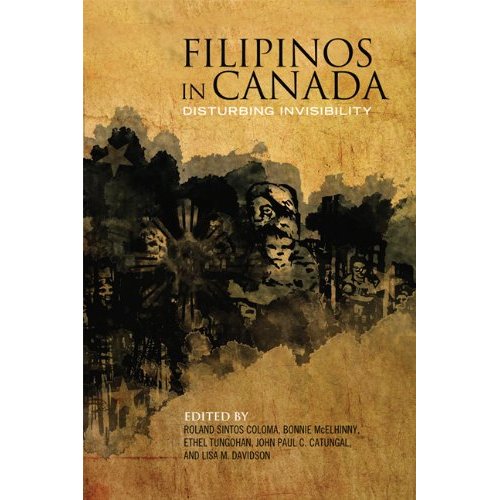
Filipinos in Canada: Disturbing Invisibility


Filipinos in Canada: Disturbing Invisibility
Edited by Roland Sintos Coloma, Bonnie McElhinny, Ethel Tungohan, John Paul C. Catungal, and Lisa M. Davidson
Toronto: University of Toronto Press

The book is available in hardcover and paperback on Amazon.ca and the University of Toronto Press website.

Composed of papers presented at “Spectres of In/Visibility: Filipina/o Lives in Canada” in Toronto, Ontario, Canada, on 23 October 2009 (plus a few more added after the conference), this book is the first academic publication to bring together the works of Filipino, Canadian, and Filipino-Canadian scholars about the experiences of Filipinos in Canada.

[Disclosure: One of its chapters, "Borrowing Privileges: Tagalog, Filipinos, and the Toronto Public Library," is a paper I wrote not because it was directly related to the dissertation I was writing at that time, but because I wanted the field of library and information science (LIS) represented in this groundbreaking work.]

Below are some of the articles about the book and its launching that have appeared in print and online, followed by the press release about the book, and its table of contents.

"Prof. Roland Sintos Coloma on disrupting invisibility of Filipino-Canadians" by Dyan Ruiz
"Big crowd welcomes book on Filipinos" by Hermie Garcia
"Academia and Activism" by Ethel Tungohan
"The invisible Pinoy" by Joe Rivera


Filipinos in Canada: Disturbing Invisibility

The Philippines became Canada’s largest source of short- and long-term migrants in 2010, surpassing China and India, both of which are more than ten times larger. The fourth-largest racialized minority group in the country, the Filipino community is frequently understood by such figures as the victimized nanny, the selfless nurse, and the gangster youth. On one hand, these narratives concentrate attention, in narrow and stereotypical ways, on critical issues. On the other, they render other problems facing Filipino communities invisible.

This landmark book, the first wide-ranging edited collection on Filipinos in Canada, explores gender, migration and labour, youth spaces and subjectivities, representation and community resistance to certain representations. Looking at these from the vantage points of anthropology, cultural studies, education, geography, history, information science, literature, political science, sociology, and women and gender studies, Filipinos in Canada provides a strong foundation for future work in this area.


Part I
Difference and Recognition


Chapter 1
Spectres of In/visibility: Filipina/o Labour, Culture, and Youth in Canada
Bonnie McElhinny (University of Toronto), Lisa M. Davidson (University of Toronto), John Paul C. Catungal (University of Toronto), Ethel Tungohan (University of Toronto), and Roland Sintos Coloma (University of Toronto)

Chapter 2
Filipino Canadians in the Twenty-First Century: The Politics of Recognition in a Transnational Affect Economy
Eleanor Ty (Wilfrid Laurier University)

Chapter 3
Filipino Immigrants in the Toronto Labour Market: Towards a Qualitative Understanding of Deprofessionalization
Philip F. Kelly (York University), Mila Astorga-Garcia (Community Alliance for Social Justice), Enrico F. Esguerra (Community Alliance for Social Justice), and the Community Alliance for Social Justice, Toronto

My Folks
Carlo Sayo (Sinag Bayan (Light of the Nation) Cultural Arts Collective) and Jean Marc Daga (SIKLAB Ontario)

Part II
Gender, Migration, and Labour


SCRAP
Reuben Sarumugam (Magkaisa Centre) and Bryan Taguba

Chapter 4
The Recruitment of Philippine-trained Healthcare Professionals to Canada in the 1960s
Valerie G. Damasco (University of Toronto)

Chapter 5
The Rites of Passage of Filipinas in Canada: Two Migration Cohorts
Josephine Eric (Migrant Workers Family Resource Centre)

Chapter 6
(Res)sentiment and Practices of Hope: The Labours of Filipina Live-in Caregivers in Filipino Canadian Families
Lisa M. Davidson

Chapter 7
Debunking Notions of Migrant “Victimhood”: A Critical Assessment of Temporary Labour Migration Programs and Filipina Migrant Activism in Canada
Ethel Tungohan (University of Toronto)

Chapter 8
Toronto Filipino Businesses, Ethnic Identity, and Place Making in the Diaspora
Cesar Polvorosa, Jr. (York University)

Chapter 9
Between Society and Individual, Structure and Agency, Optimism and Pessimism: New Directions for Philippine Diasporic and Transnational Studies
Leonora C. Angeles (University of British Columbia )

Part III
Representation and Its Discontents


Balikbayan Express
Celia Correa (University of Toronto)

Chapter 10
Meet Me in Toronto: The Re-Exhibition of Artifacts from the 1904 Louisiana Purchase Exposition at the Royal Ontario Museum
Bonnie McElhinny

Chapter 11
From the Pearl of the Orient to Uptown: A Collaborative Arts-Based Inquiry with Filipino Youth Activists in MontrƩal
Marissa Largo (University of Toronto)

Chapter 12
Borrowing Privileges: Tagalog, Filipinos, and the Toronto Public Library
Vernon R. Totanes (University of Toronto)

Chapter 13
Abject Beings: Filipina/os in Canadian Historical Narrations
Roland Sintos Coloma

Chapter 14
Between the Sheets
Geraldine Pratt (University of British Columbia)

Part IV
Youth Spaces and Subjectivities


Colour Correction
Eric Tigley (Youth Education through Interactive Arts)

Chapter 15
Scales of Violence from the Body to the Globe: Slain Filipino Youth in Canadian Cities
John Paul C. Catungal

Chapter 16
Kapisanan: Resignifying Diasporic Post/colonial Art and Artists
Christine Balmes (University of Toronto)

Chapter 17
Educated Minorities: The Experiences of Filipino Canadian University Students
Maureen Grace Mendoza

Chapter 18
“Mas Maputi Ako sa ‘yo” (“I’m lighter than you”): The Spatial Politics of Intrarracial Colorism among Filipina/o Youth in the Greater Toronto Area
Conely de Leon (York University)

Chapter 19
The Social Construction of “Filipino Studies”: Youth Spaces and Subjectivities
Jeffrey P. Aguinaldo (Wilfrid Laurier University)

Part V
Afterword


Chapter 20
Contemplating New Spaces in Canadian Studies
Minelle Mahtani (University of Toronto) and David Roberts (University of Toronto)

Read More...

History of the Filipino People and Martial Law


Below are the link to my article, which was published recently in Philippine Studies 58:3 (2010), 313–348, as well as the abstract and acknowledgments.

History of the Filipino People and Martial Law: A Forgotten Chapter in the History of a History Book, 1960–2010
Vernon R. Totanes

Abstract:

In 1960 a mimeographed history textbook, which was considered groundbreaking for looking at Philippine history from a Filipino perspective, was introduced at the University of the Philippines. By 1967, when its second edition entitled History of the Filipino People was published in hardcover and paperback, it had replaced prescribed texts in other universities. Fifty years after the first edition came out, its eighth edition remains required reading for many college students. Using archival documents, this article traces the untold story of a forgotten chapter in this book and argues that the study of a book’s history illumines the influence of political realities and personal relationships on the publication of history books.
Acknowledgments:
I would like to thank Ambeth R. Ocampo, who suggested that I look into the history of History of the Filipino People; Salvacion M. Arlante, who granted access to the Teodoro A. Agoncillo Papers, as well as facilitated introductions to resource persons; Teodoro V. Agoncillo III and Bernardita R. Churchill, who not only answered my questions and welcomed me into their homes, but also generously shared books and documents; Milagros C. Guerrero, Antonio C. Hila, Oscar L. Evangelista, and Caroline Garcia, who provided useful background information; Elvira B. Lapuz, Grace B. Tabiendo, Klit Pabalan, and Janssen Cusi, who facilitated my research; Cynthia Kutka, who just happened to have a hard-to-find copy of the Agoncillo-Guerrero third edition (R. P. Garcia) and gave it to me; and all those who offered suggestions and asked questions that helped improve the manuscript, especially my adviser Patricia L. Fleming, Christine V. Lao, Vyva Victoria M. Aguirre, Tarleton Gillespie, and the two anonymous readers. All errors, however, are mine alone.

Read More...

In My Life: 1999-2009

Writing this chronological account has helped me realize that I was literally and figuratively “all over the place” from 1999 to 2009, but I'm thankful that I’ve finally found my “corner of the sky.” I don’t know if anyone else can learn anything from my experience, but this is my blog and I’m doing it for the record =)

At the beginning of 1999, I was still an assistant manager at Bank of the Philippine Islands with my own car. But after four years of working at a bank (including going through a merger!), I resigned, gave up the car, and eventually made my way to Arvisu House, a Jesuit prenovitiate, where I discerned whether my future lay in religious life. After it became clear in 2000 that the Jesuits and I were better off as friends (as opposed to “married” LOL!), I left for Cebu to teach Religion and Business English at Sacred Heart School for Boys (see "Introducing Gen X to the Bible"). At the end of SY 2000-2001, I returned to Manila and drifted from the Social Security System (as a consultant) to Loyola School of Theology (as a part-time graduate student and assistant editor) to Parlance (as a supervisor), until I decided to go back to school full-time for a master’s degree in library and information science (MLIS) at the University of the Philippines (instead of an MBA at AIM) toward the end of 2002. I finished my MLIS, began working at Asian Development Bank (as a records assistant) and obtained my librarian’s license in 2004 (see "Librarians: Already... But Not Yet").

In 2005, I started blogging (see "Mabuhay"), received a travel grant to attend a librarian’s conference in Toronto (see "Librarians as Leaders"), wrote an investigative report for the Philippine Center for Investigative Journalism (see "By Vernon R. Totanes"), and got hired to teach Research and Library Management at UP’s then-Institute of Library and Information Science (see "Gainfully Employed"). I submitted my application to do my PhD at University of Toronto while I was an assistant professor at UP, and by the end of SY 2005-2006 I learned that I had been accepted (see "PhD - Information Studies"). On the way to Toronto, I wrote some more for PCIJ (see "Edsa 20/20: One Year Later") and was given another travel grant (see "Open Access in the Third World"). From 2006 to 2009, I travelled back and forth between Toronto and Manila to attend classes and do research. Perhaps the most significant event in my life during this period that was not directly related to my profession as a librarian or my status as a PhD student was my stint as a game-show contestant on "Kapamilya Deal or No Deal."

After I obtained my librarian’s license, it occurred to me that I was not drifting anymore, especially because it was then that I began to receive invitations to lecture as a librarian and blogger, and present papers at refereed conferences. I even got a few things published along the way (see "A Day in the Life"). Since 2005, I have delivered presentations in Manila, Singapore, Toronto (I just realized that I've never blogged about my presentations in this city!), Vancouver, Oxford, Hanoi, and at Library of Congress in Washington, DC. I hope there will be a few more before I graduate—finally?—in 2011. I have no idea what the future holds, but based on my own previous experience (i.e., from corporate to religious to academic, with lots more in between), I am confident that it will all work out in the end =)

Happy New Year!

Read More...

Thanksgiving 2009

Thanksgiving is known as an American holiday, and is still a few weeks away, but Canadians have their own day for thanksgiving, today. I'd be celebrating this holiday with Canadians in their own country, except I'm now on a bus on my way to Chicago to do even more research... and meet a friend =)

I'd like to thank my loyal and occasional readers for inspiring me to keep this blog going. What do I get out of it? Well, I do earn some money from those who click on the ads, but more importantly, blogging forces me to keep up with what's going on in Philippine librarianship. There's also the added satisfaction of seeing a comment every now and then thanking me for a post that I wrote... or even having a post cited on GMA News!

And then there are Filipino librarians like Jay dela Cruz, who surprised me recently by sending a new header for my blog out of the blue. Yes, it's the one up right now. Thanks, Jay!

Update as of 14 October 2009:

In case some of you are interested in seeing the evolution of this blog's header, here are all of them:

February 2005

March 2009

October 2009

Read More...

Librarian as Cover Boy


No, this is not one of those fake magazine covers where your photo gets added to a template, along with an outrageous headline. The individual and group photos taken at the Library of Congress, we were told, were to be kept as stock photos and used in the pages of Information Outlook when appropriate. This particular photo was supposed to be just a remembrance for all those who participated. No mention was made of putting it on the cover! But I'm not complaining =)

Thanks to my friend David McBee for scanning the cover and posting it online.

Read More...

I Luv New York 2009

The photo above was taken on Times Square last June. I arrived just as the plan to let people "Walk, bike or sit, car-free, in Times Square and Herald Square" was implemented. In the next few days, I will be writing about what I did in New York from May 30 to June 6. As in previous trips, I'll be sharing my opinions about the shows I saw, as well as tips for Broadway-bound travelers (see my posts labeled "Broadway"). I suspect very few of my regular readers will be interested in these posts, but some librarians and bloggers might find my comments about Book Expo America useful, so stay tuned =)

Read More...

Why am I doing what I'm doing?

"The Filipino Librarian asked: Why is a the used with Philippines?" This reference by Eric Ambata to one of my very first posts in 2005 led to the discovery that Manuel Quezon III recently posted several links to my blog in relation to a discussion on whether "Philippines" is plural or singular. Then I learned that Gibbs Cadiz referred to a foreword I wrote for a book as a "succinct introduction," and even quoted a lengthy passage.

All these, on top of articles in Philippine Star, Pinoy Herald and the Department of Foreign Affairs website (based on press releases [1 2 3] from the Philippine Embassy in Washington, DC) about my lecture at the US Library of Congress, made me think that perhaps the writing I've done in the past has made a bit of a difference. (Never mind that the articles about my lecture seemed to miss my point about the oldest books—not book—printed in 1593.)

And then I found out that Rev. Ed Bentley, a Canadian pastor, cited my experience on "Kapamilya Deal or No Deal" (KDOND) several months ago as "a true illustration of counter-consumerism" in a sermon (pdf), and said that,

We come into this life with nothing and we necessarily leave empty-handed. All that matters about whatever we win, earn, or acquire in the meantime is what we do with it, the good we make of it, the benefit we provide with it.
I never thought of my KDOND experience this way, but what he wrote reminded me of an old post entitled "I'm Just Trying to Matter", where I asked "Why am I doing what I'm doing?" Thanks to Rev. Bentley, I am reminded that I do what I do not so my words can get quoted in blogs or newspaper articles, but so that others can benefit from whatever I have learned.

Read More...

Filipino Librarian Speaks
at Library of Congress

If you happen to be in Washington, DC, on Tuesday, 9 June 2009, I'd appreciate it if you would consider attending my presentation on "The Doctrina Christiana of 1593 and the 'Other' Book" at Library of Congress, 12 nn-1 pm. Here's the exact address:

Asian Division Foyer, Jefferson Building, Library of Congress
10 First Street, SE, Washington DC 20540
Nearest Metro Station: Capitol South (Orange/Blue Lines)
The full press release may be found at the website of the Library of Congress Asian Division Friends Society. The event is also on the calendar of the Philippine Embassy, Washington, DC.

Read More...

Katas ng "Kapamilya Deal or No Deal"

I finally got around to fulfilling the biggest part of the plans I detailed in "Filipino Librarian Wins 165K on 'Kapamilya Deal or No Deal'." The photo above shows the first patient who received her chemotherapy treatment within minutes of delivery of the three recliners and thirty IV stands that were on the wish list of the doctors at the oncology ward of Veterans Memorial Medical Center. It seemed appropriate that the patient was someone who saw me play =) Next step: distribute the smaller amounts...

Read More...

Related Posts Plugin for WordPress, Blogger...