Quick Links: Talumpati | Licensed Librarians | Filipiniana Online | Stereotypes | Leadership | The Philippines

Showing posts with label Buwan ng Wika. Show all posts

Buwan ng Wika 2015


August is Buwan ng Wika (Language Month). This year's theme is "Filipino: Wika ng Pambansang Kaunlaran" (Filipino: Language of National Development). See the banner and calendar of activities below.

But perhaps the most interesting development—for me, anyway—is that Philippine Panorama has devoted most of its latest issue (2 August 2015) to a discussion of different aspects of the national language... in English! It's also interesting to note that while I've seen photos of the cover (see above) on social media, I haven't seen any links to the ePaper, PDF, or any of the articles. So, as a public service, here are the links to the articles:
Language for pleasure, not pressure (Editorial)
Why Filipino is "Filipino" by Virgilio Almario
What about Filipino? by Efren Abueg
New wave by Jacky Lynne A. Oiga
Don’t wince at the smell of rotten fish by AA Patawaran
Who says LIRA Stands for Literatura ni Rio Alma? by Vim Nadera


Click image for more information.


Click image to enlarge.

Read More...

Buwan ng Wika 2009

Buwan ng Wika 2009 - Wikang Filipino: Mula Baler Hanggang Buong Pilipinas
August is Buwan ng Wika (Language Month). This year's theme is "Wikang Filipino: Mula Baler Hanggang Buong Pilipinas" (The Filipino Language: From Baler to the Rest of the Philippines). It's not quite August yet, I know, but requests have already begun to come in, and that's why this post is up earlier than usual.

If you're wondering why Baler, Aurora, has been singled out, the poster above (via PLAI-STRLC) provides a clue: it's 400 years old (see Baler 400). But does the importance accorded its anniversary imply that the Filipino language began in Baler four centuries ago? No reasons are given in DepEd Memo No. 295 s.2009 (pdf), which sets forth the celebration's objectives and weekly themes, or even Proclamation No. 1696 (pdf), which declared 2009 as "The Year of Baler." But perhaps the answer is right there on the poster: Manuel L. Quezon is not only recognized as the father of the national language, he was also born in Baler.

Anyway, the Komisyon sa Wikang Filipino (KWF) is sponsoring the Gawad Surian sa Sanaysay, which offers cash incentives of P5,000 for three runners-up all the way to P20,000 for the first prize winner. All entries must be postmarked or received on or before 7 August 2009, 5:00 pm.

Read More...

Buwan ng Wika 2008

August is Buwan ng Wika (Language Month). This year, the theme is "Wika Mo, Wikang Filipino, Wika ng Mundo, Mahalaga!" I'm not quite sure I understand what it means, but here's my translation: "Your language, Filipino, language of the world, is important."

The Komisyon sa Wikang Filipino (KWF) is holding two contests this year. One is the Gawad Komisyon sa Sanaysay-Gantimpalang Collantes (doc), an essay-writing contest in Filipino. Its deadline has been extended to August 15. The other is the Gawad Komisyon 2008 (pdf), which is for poems and short stories written in the following major languages: Ilokano, Sebwano, Tagalog, Bikol, Hiligaynon, Samar-Leyte, Pangasinan, Kapampangan, Meranaw. The deadline for this one is September 30. The prizes range from P2,000 to P20,000 for winners in both contests.

It is worth noting that the first requires the use of Filipino, while the other includes Tagalog. This, perhaps, was meant to highlight the difference between Filipino and Tagalog, that one is not equivalent to the other. But what if, for instance, someone submits an essay written in Tagalog for the Gantimpalang Collantes? Will it be accepted as having been written in "Filipino"? If the answer is yes, would the answer still be the same if the essay were written in any of the other major languages? If not, does this mean that the other languages are not, in fact, Filipino?

One last thing. I hope that they will also publish the works, not just a list of winners (doc), like they did last year. There doesn't seem to be a PinoyBlogoSphere contest this year, but unlike KWF they did provide links to the works of last year's winners. How do you promote the use of Filipino? Make sure that there are outstanding examples available—not just in papers hidden away in filing cabinets, but online, where students and those interested can find them.

Read More...

Buwan ng Wika 2007

August is Buwan ng Wika (Language Month).

Supposedly, Filipino is the national language of the Philippines, but if you speak a language spoken in the Philippines other than Tagalog, you are probably unlikely to accept that Filipino (the language) is Tagalog (and it's not). As Horacio de la Costa once put it so eloquently: "If we must needs give currency to our thoughts, we are forced to mint them in the coinage of a foreign tongue, for we do not even have a common language."

The "foreign tongue" to which De la Costa alluded was, of course, English—the same one that I use to write on this blog, and the one that I've learned is actually a better alternative to Tagalog in certain parts of the Philippines. The video below, found through Filipinayzd, shows very clearly why I was right to switch from Tagalog to English while I was in Cebu a few years ago.


If you thought that Tagalog was the national language of the Philippines or are not sure of the difference between Pilipino and Filipino, take a look at the following articles that trace the development of the Filipino language:

"Development of Filipino, The National Language of the Philippines" by Paz M. Belvez

"The Metamorphosis of Filipino as National Language" by Jessie Grace U. Rubrico

"Filipino with the 'F': A Construction of the National Language Policy" by Eldrige Marvin B. Aceron (see also Part Two, and the complete article [doc])
The first was written by an educator, and you may want to read it if you don't really have much time. The second is by a linguist, and is much longer and more academic in nature than the first. The third is by a lawyer-blogger, and the blog post's subtitle, "A Guide for the Perplexed," indicates what I liked about it: it's scholarly and it has footnotes, but it's very readable.

If you would like to find out more about what exactly the Filipino language is, including just how many letters are in its alphabet, check out my post last year on "Ang Bagong Alfabeto at Patnubay sa Ispeling," where links are provided to the full text of the latest guidelines, articles about the guidelines, and even a blog that is utilizing the guidelines. But please note that the Komisyon sa Wikang Filipino (KWF) is reviewing the 2001 Ang Bagong Alfabeto at Patnubay sa Ispeling, and the Department of Education has stopped its implementation and recommended the use of the "1987 Alpabeto at Patnubay sa Ispeling" (pdf). Then again, you may just wish to wait until those in the know have made up their mind =)

In the meantime, you may wish to join the writing contests organized by the KWF (Rules | Form) and Pinoy Blogosphere (Wika2007 Blog Writing Contest). The deadline for the former has been extended to August 15, while the deadline for the latter is August 18. The theme for both is "Maraming Wika, Matatag na Bansa" (KWF translation: "A gift of tongues for a strong nation"), which indicates, perhaps, that Buwan ng Wika will not anymore be just a celebration of the Filipino language, but of the many languages of the Philippines.

Read More...

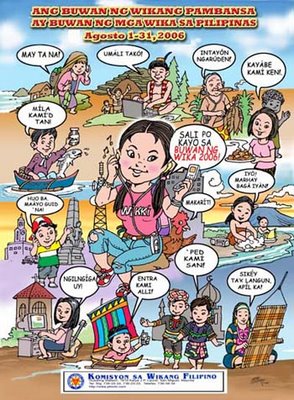
Buwan ng Wika 2006

Buwan ng Wika 2006
The Komisyon sa Wikang Filipino (KWF; National Language Commission) has a poster, a few photos and a list of winners. Other government agencies have a few press releases. Is it any wonder that traditional media did not take much notice of Buwan ng Wika (Language Month)?

I hope this seeming disregard for the event is not an indication of the (ir)relevance of Filipino as a language, but it's a good thing more than a few bloggers wrote about what happened this past month. Of the seven unique results for "Buwan ng Wika" on Google News, only three are worth mentioning:

"August is 'Buwan ng Wika (Language Month)': Celebrating the non-existent Filipino language" by Jes Tirol (Bohol Chronicle, 20 August 2006), who says that "we do not know what we are celebrating because at present nobody knows what is the FILIPINO language. The Filipino language, with an 'F' spelling is no longer the Tagalog base Pilipino, with a 'P' spelling."

"Speaking in tongues–Pilipino-style" by Rome Jorge (Manila Times, 13 August 2006), where KWF chair Ricardo Nolasco explains that this year's theme, "Buwan ng Wikang Pambansa ay Buwan ng mga Wika sa Pilipinas" is a "pitch for linguistic diversity. Isang Bansa, Isang Diwa was the slogan during the martial-law regime and that promoted dangerous ideas such as that having many languages was disadvantageous to the country—and that’s not correct."

"In any language" (Manila Times, 23 August 2006), an editorial, notes that "A speaker begins his sentence in English, lapses into Pilipino and reverts to English with ease, without destroying his train of thought. Or he may begin in Tagalog and repeat the process in reverse. Taglish is spoken by masters and servants, the educated and the masses, the rulers and the governed. In the battle for survival, Taglish will prevail."
For a less formal flavor, check out the posts on Technorati, which include:
Photos taken by Lei at her school's celebration.

"TaluMpaTi," where Jadeangel13 says that, "Masyado nating niyayakap ang wika ng ibang bansa. Dumarating sa atin ang kaisipan na kapag marunong kang gumagit ng wikang Ingles, magaling ka." It's not perfect (notice the typo?), but it's one of the very few speeches written by a student that I've found online.

"Buwan ng Wika: No Longer a Costume" by Loreen, where she highlights her experience wearing a malong the whole day and comes up with a very memorable line: "...bakit ba costume lang ang tingin natin sa kanila? That's because we are now so Westernized... para tayong copy-paste ng mga Western people." Wow!
Finally, there's "A proud moment for gay brothers," which narrates an anecdote about how a small girl won the Bb. Buwan ng Wika (Ms. Filipino Language Month) after answering the question, "Totoo bang masayahin ang mga pilipino? (Are we Filipinos truly a happy people?)" Her reply? "totoo po ito. na kahit anong mangyari..masayahin parin ang mga pilipino. tingnan mo ako! kahit sobrang nininirbyos na dito at halos mahimatay na sa takot.. ngumingiti parin ako." Very Filipino, right? =)


Category: The Philippines

Read More...

Related Posts Plugin for WordPress, Blogger...