Movers & Shakers 2015: Ma. Lorna Eguia
Congratulations to Ma. Lorna Eguia, the first Filipino librarian to be chosen as one of Library Journal's Movers & Shakers!
Her work with victims of Typhoon Haiyan, specifically the bibliotherapy she offered to children through her Books in Bags project, is featured prominently in her citation as a Community Builder.
Library Renewal Partnership
Many people have told me that they want to help build public libraries, but often they think it will be enough to donate books. I tell them that book donations—and even new library buildings—are not enough.
Someone has to be there to make sure that the books are taken out of the boxes, organized, and displayed. Otherwise, it is very likely the books will remain in their boxes forever. Someone also has to open the library on a regular basis, make sure the lights are working and the place is clean, AND tell members of the community about the library's resources and services. Otherwise, like many other public libraries that we have now, most of the people around them will not even know that there is a public library in their midst (see the NBDB Readership Survey 2012). In short, a librarian—or at least someone who loves books and is a full-time employee—must be hired if the public library is to achieve its objective.
But how does one go about hiring a librarian, or helping the nearest public library, for that matter? Wouldn't they have to coordinate with the National Library or the local mayor? What if there's no public library and they'd like to convert an existing space? I can't answer all these questions, but thankfully, there is a foundation that can help answer all these questions, and even help address all other areas of concern =)
According to its website, Library Renewal Partnership (LRP) is "a coalition of local and international partners that aims to to empower over 2 million citizens, by building at least 200 community education centres by the year 2020 and help forge an interconnected archipelago of readers and leaders."
As Quintin Pastrana (LRP's founder) states in "Making a difference, one library at a time" (Philippine Star, 9 March 2015), "...the local government provides the physical structure, overhead expenses, and staffing, while partners and donors provide books, learning materials, and educational programs." How? They work with interested mayors to get a memorandum of agreement signed, which assures them that the local government will take care of providing the following: 70-square-meter space (minimum), Internet connection, and library overhead (including electricity and salaries).
If you'd like to set up a public library in your barangay or municipality, there is no need to reinvent the wheel. Please get in touch with LRP.
For more information about LRP, see their website and Pastrana's 2-part "Where have our libraries gone?"
Preparing to Become a Leader
Did you assume a managerial or supervisory position recently? Or maybe you'd like to know what I did to prepare for my job as "Director, Rizal Library"? If so, you may want to read the article I wrote for The Manila Review:
So You Think You Can Be the Boss
by Vernon R. Totanes
"I am pleased to inform you that the search committee tasked to recommend the next Rizal Library director has recommended that you be appointed director beginning April 1, 2013."
This message appeared in my inbox more than a year ago, as I was finishing my dissertation in Canada. By the time you read this, I will have been Director of Ateneo de Manila University's Rizal Library for more than 90 days.
Read More...
Leadership and Librarians
Stephen Abram showed the slides above at the Forum on Planning for the Future: Developing Librarians’ Leadership Skills, which was held at the Rizal Library on 15 April 2013.
Troy Lacsamana — Library Leader
It is not enough that you have big dreams and plans. I should be able to communicate with my co-staff and co-volunteers the essence of why are we doing such activities and the importance of their contribution to our end goals.The quote above appears on "Leadership Lessons," one of the projects of ALA's Emerging Leaders. But no, the speaker is not an American. Instead, he is the only non-American among the 72 American librarians featured on the site. His name is Troy Lacsamana, a Filipino librarian.
Lacsamana has been featured on this blog before, primarily in connection with his role as founder of Aklatang Pambata. But as the "Leadership Lessons" interview reveals, he is now a multimedia librarian at the Quezon City Public Library, which I suspect owes its impressive website and online catalog to Lacsamana's efforts. In spite of his numerous professional responsibilities—and that he is newly married—he continues with his personal advocacy of building community libraries and reading centers.
I don't quite know how PRC's Outstanding Librarians of the Year are chosen (does anyone?), but I certainly think Lacsamana at least deserves to be nominated. Or, if he's too young, maybe there should be another award for librarians forty years of age or younger. This is something that the Ramon Magsaysay Award Foundation instituted in 2001 with its awards for "Emergent Leadership." Perhaps an award like this will show that you don't have to be the director of a library or close to retirement to be an outstanding librarian.
Of Budgets, Leadership and the National Library
Below are links to a few articles you may have missed, plus my comments.
Public libraries don't get enough funding. From "Public library gets budget for repair, new books" (Cebu Daily News, 20 February 2008)
For the first time, the Mandaue City Public Library is getting a budget to buy new reading materials and repair the building.It's good news of course, but it's really sad that the fact that the library was allotted a budget, which is taken for granted elsewhere, is considered newsworthy. If Orque, as the article reports, has been with the library for 20 years, does this mean that the library has been operating without a budget all that time? Probably not... but I wouldn't be surprised, either, if the answer is "yes."
Acting librarian Marrieta Orque expressed relief that the government has allocated a budget for the purchase of new books for the library.
A town in Leyte seems to be in better shape. From "Poor town has modern library" by Joey Gabieta (Philippine Daily Inquirer, 21 January 2008):
This sleepy agricultural town has what other municipalities in the province lack—a modern and fully air-conditioned library.What's the difference? It's obvious that the town has a leader who thinks libraries are important. I don't really like the fact that no mention is made of the librarian (I certainly hope they hired one), but a new library building is certainly much more welcome news.
Credit goes to its young mayor, Bernard Jonathan Remandaban, who said his "bias" for education was the main driver for the construction of a two-story library building on a one-hectare lot that was once a swampy area at the town center.
And then there's the National Library of the Philippines. From a column by Wilson Lee Flores (Philippine Star, 21 January 2008):
I urge the state to build more public libraries and to rebuild our National Library, instead of more waiting sheds, basketball courts or cock-fighting pits. Why is it that a private-sector bookstore like Fully Booked in The Fort is nicer than our republic’s so-called "National Library," which I believe should be renamed "National Disgrace"!There is, of course, a simple answer: the private sector has more money than the state. And the state has never really considered libraries a priority. So I wouldn't really count on the government allotting a budget for libraries. My suggestion? Get the private sector involved (e.g., naming rights), but before that can be done, we need leaders!
Money is Not the Solution
Earlier today, I was looking for a friend at my alma mater when I suddenly found my underdressed self at a formal, invitation-only event honoring some recipients of the Metrobank Foundation's annual Search for Outstanding Teachers. When I learned that I personally knew the two main honorees—Ambeth Ocampo and Benilda Santos—I thought, what the heck, maybe they'll overlook my shirt-jeans-and-sneakers getup and appreciate my presence at this special event. So I went in and marveled once more at just how lucky I've been to have been taught by so many outstanding teachers.
But the most striking thing that I brought home with me was the reference made by the university president to a recent article about a McKinsey study that shows it is not money that leads to better schools. I, of course, made a mental note to look for the article. The following quotes are from "How to be top" (Economist, 13 October 2007):
Australia has almost tripled education spending per student since 1970. No improvement. American spending has almost doubled since 1980 and class sizes are the lowest ever. Again, nothing. No matter what you do, it seems, standards refuse to budge.What has this got to do with the Philippine situation, especially libraries? Read the passages again, but this time substitute the word "librarian" for "teacher" and "librarianship" for teaching, particularly in the last two paragraphs. As I have written before in "Librarians as Leaders," "I am not saying that money is not important... two individuals given similar amounts of money will not necessarily achieve similar goals." This is not rocket science. This is so old, there's even a parable in the Bible about it. Enough of the excuses. Let's get to work.
Schools... need to do three things: get the best teachers; get the best out of teachers; and step in when pupils start to lag behind.
Begin with hiring the best. There is no question that, as one South Korean official put it, "the quality of an education system cannot exceed the quality of its teachers." Studies in Tennessee and Dallas have shown that, if you take pupils of average ability and give them to teachers deemed in the top fifth of the profession, they end up in the top 10% of student performers; if you give them to teachers from the bottom fifth, they end up at the bottom. The quality of teachers affects student performance more than anything else.
You might think that schools should offer as much money as possible, seek to attract a large pool of applicants into teacher training and then pick the best. Not so, says McKinsey. If money were so important, then countries with the highest teacher salaries—Germany, Spain and Switzerland—would presumably be among the best. They aren't. In practice, the top performers pay no more than average salaries.
Scratch a teacher or an administrator (or a parent), and you often hear that it is impossible to get the best teachers without paying big salaries... McKinsey's conclusions seem more optimistic: getting good teachers depends on how you select and train them; teaching can become a career choice for top graduates without paying a fortune; and that, with the right policies, schools and pupils are not doomed to lag behind.
Wanted: Proactive Librarians as Leaders
While libraries are front and center in two new articles (see "ARMM gov orders establishment of libraries in LGUs" [PIA Press Release, 25 October 2007] and "Public libraries and Kaakbay" by Neni Sta. Romana Cruz [Philippine Daily Inquirer, 27 October 2007]), librarians are mentioned almost as an afterthought. I do not blame the authors, however, for this treatment.
I have groused about the invisibility of librarians before, but after blogging for more than two years, monitoring what appears in print and online about Filipino librarians, contributing what I can to promote librarians worth emulating, and encouraging others to write about their own experiences, I think it's time to admit that the fault lies "not in our stars, but in ourselves."
Many librarians complain that their communities think they do not do anything but sit at their desks and stamp books. But what, I usually ask, are they doing to dispel this notion? We need to be more proactive about communicating and interacting with our own communities, and networking—and working—with other literacy and library advocates.
I have gotten feedback that projects initiated by "outsiders" were left unsupported by library "insiders" because the latter felt that they should be the ones taking the lead. And all I could do was shake my head, and admit that some of our more influential librarians can be rather shortsighted. There are, of course, certain things that "insiders" can do better than "outsiders," but when more of them do research about our own work, and it is because of them that Filipiniana is freely available online, I think we need to thank them, instead of criticizing them for encroaching on our turf.
Enough. If you'd like to see more of what I've written about this, click here: Leadership.
"Be Proactive, Apply for Scholarships"
by Mila Ramos
The author of this post wrote about her experience with "Thinking Outside the Borders" upon my invitation. I hope her story will inspire others to think outside Philippine borders.As early as the first week of October, I got a message from the IFLA listserv regarding this Leadership Program (Thinking Outside the Borders). The deadline for application was Nov. 15 yet, so I didn’t prepare an application right away. I was not so keen on applying, as normally these grant providers think that IRRI, being an international organization, is not a qualified beneficiary. But after a week and receiving another reminder, I said why not? I won’t lose anything in applying.
So on October 16, I requested my immediate boss, Dr. William Padolina (Deputy Director General) and Dr. John Bennett (Deputy Head and Senior Molecular Biologist of the Plant Breeding, Genetics and Biotechnology Division and a frequent Library user) to write letters of support containing comments on my leadership abilities and achievements. So, these two wrote beautiful letters for me. In addition to these, the other requirements that I submitted were:
- a cover letter and brief resume summarizing professional experience, activities, publications, education, participation in leadership programs, international experience and contact info.
- an essay of 500 words or less describing why I considered myself a suitable candidate for the program and how it will help in the achievement of professional goals, benefit the home institution, and contribute to the development of libraries.
- a second essay of 500 words or less describing achievements, experience in working with teams, experience training other librarians, future aspirations, and interest in international library issues.
So, with Lady Luck on my side, I received the good news last Nov. 28, much earlier than the scheduled announcement of the awards. It is good that I hold a 10-year, multiple-entry visa to the US.
The IFLA listserv is a good source of information regarding conferences for library and information professionals.
My advice to other librarians: be proactive, apply for scholarships, travel grants, join international discussion groups, whenever the opportunity opens. International conference presenters are normally given free registration, sometimes free airfare. Last December, Emerald Laxamana and I attended a meeting and presented a paper at the Hong Kong Innovative Users Group and we did not pay any registration fee. We enjoyed privileges like the conference kit, T-shirt, snacks and lunches, free transportation from the hotel, giveaways from sponsors, and a free dinner. This is another venue that is open to us.
Yes, there are a few good Filipino politicians...
In case you missed it, Newsbreak featured six outstanding politicians in its 17 April 2006 issue. They are, in alphabetical order:
- Feliciano Belmonte (Quezon City)
- Josefina dela Cruz (Bulacan)
- Rodrigo Duterte (Davao City)
- Mary Jane Ortega (San Fernando City)
- Jesse Robredo (Naga City)
- Francis Tolentino (Tagaytay City)
If this country is to move forward, then the push will come from the local governments. If the people are to be inspired to do something for their community, then they will have to look up to the leaders closest to them. If we are to prove that such inspiring leaders are not rare or are flashes in the pan, then we will have to tell the stories of these six again and again.And if librarians are to be inspired to do more for their communities, then I think I'll just have to keep on blogging about the stories of inspiring librarians.
Category: The Philippines
Proactive Librarians
The article below is the preprint version of the one I wrote for the next issue of Star Teacher, which will appear in print by June. While some of the details apply specifically to Filipino public school librarians, most of the suggestions in my opinion are also relevant to all librarians.
What can teacher-librarians do to improve their libraries?
By Vernon R. Totanes
Public school libraries in the Philippines tend to be neglected for many reasons, including the lack of a full-time librarian, the designation of overworked teachers as teacher-librarians, and of course lack of financial resources to buy the necessary materials. But why is it that some libraries flourish despite facing the same difficulties that others also have?
Some were lucky because they were chosen to be the beneficiaries of generous donors. But more often than not, the few libraries that have developed more than others had teacher-librarians who were devoted to their students and saw that libraries were important. Even the lucky few were probably chosen precisely because their teacher-librarians exhibited the qualities the donors were looking for.
If you have been designated a teacher-librarian, but don’t really have too much time or were not given enough training or resources to manage the library effectively, what can you do to improve your library? Here are a few suggestions:
Decide that you want to be an agent of change
Yes, it will all have to start with you. You have to make a conscious decision that you want to make the library a place for learning, and that you will find the necessary time, if not resources, to achieve this.
In the parable of the talents, where three men are given money to invest, the lesson is that those who are able to demonstrate that they can do more with what they have will be given even more. And, of course, the one who decided to just bury the money he was given, lost even the little that he had.
You may not have much money from the school authorities, but if you decide that you want to do more with the scant resources at your disposal, then the likelihood that you will be given more goes up. But if you just choose to sit on what you have and hope that someone will come along to help you, you’ll probably have to wait for a very long time.
Think of yourself as a missionary, not a mechanic
The library is not like a car, where all the parts have to work before it can start running. Think of the library as a church or a mosque, where people can still go even if it’s not yet fully finished. This means that you don’t have to be an expert cataloger to arrange the books. If your library has less than a thousand books, you can devise a system so that books may be borrowed and returned without having to assign call numbers.
The bigger problem that needs to be addressed is that of convincing others that the library is important. In short, you need to be a missionary to your principal, co-teachers, students, their parents, and the larger community. Once you’ve convinced others that the library is important—this, however, may take years—then organizing the library and getting the necessary resources, both human and financial, should become easier.
Write your mission statement, and make it happen
Every missionary must have a mission. What kind of library do the students need? Write it down, break it up into realistic objectives and set deadlines for yourself. Back it up with action plans and cost estimates. This is what you will show to those who will want to help you achieve your mission.
Yes, there are people who will want to help you, but you will have to identify these people, present action plans, and show that you are capable of carrying out your plans. It’s not going to be enough to say that you want a “world-class library” or a “good library.” Potential donors will want to know exactly what such a library will be like, why it is appropriate for your school, how much it will cost, and whether you can deliver on your promises.
Self-promotion is a necessary evil
Filipinos tend to be very modest, and so it’s possible that you will want to keep a low profile. But what would the television networks be without the Kapuso and Kapamilya stars? In elections, voters usually write down the names of candidates with whom they have a personal connection, no matter how remote.
You have to be the face of the library, especially if it’s not yet what you hope it will be. Don’t hide in the library; go out there and participate in the school’s activities. If enough people see that the teacher-librarian is capable of hosting events, for example, then they might be more willing to believe that you can achieve your mission.
You also need to be ready for the attention. Don’t just fix up the library, start fixing yourself up, too. And it’s not just physical, make sure that your image is not that of the stereotypical librarian who is masungit (cranky). After all, the school principal and potential donors who see that students are afraid to go to the library will not be encouraged to be generous.
Bring the library to your customers
No, don’t give the books away. What this means is that you need to tell your customers—the members of the school community—that the library exists and what services the library can offer. There are banks where the tellers just sit and wait for people to open the door and come in. And then, there are banks where sales representatives go out and tell potential customers what the bank can do for them. Which banks do you think are more successful?
Another way of doing this is to cooperate with other teachers in their lessons. Try to match what they need with your skills or the resources the library can provide. And then there are special occasions on which they may need your assistance. Plan for those events and offer the information you were able to gather even before they ask for help.
Be proactive
All these suggestions can be summarized in two words: be proactive. And this means doing what must be done without having to be told what to do. Teachers are expected to be proactive and prepare their lessons, instead of going to class unprepared and just reacting to questions posed by students. Teacher-librarians must do the same.
Categories: Librarians, Libraries—Public Schools
Wanted: Leaders
This year's Magsaysay Awardee for Emergent Leadership is Hye-Ran Yoon of South Korea. She was recognized for her "catalytic role in enabling Cheonan’s civil society to exercise its social responsibilities dynamically and democratically." What I found most striking was that she is not the current leader of the many organizations she started. She began with one organization, of course, but in the subsequent ones, "she articulated a need, formed an organization, identified and trained potential leaders, and then mentored the organization to maturity and financial stability before spinning it off" (emphasis added).
It was not until I got home that it occurred to me that I had just gone through my own version of "Leadership Day." After all, I started the day with "The Leadership Challenge," where Dennis Ycasiano, the speaker, differentiated between leadership and management, but emphasized that librarians need to be leaders and managers. Ycasiano also highlighted the importance of collaboration, instead of confrontation. He used the story of "The 100th Monkey" to illustrate the need for a critical mass or "tipping point" to effect change. And then he asked three questions, which I didn't get the chance to answer at the forum, but which I will answer now:
1. What KEY CHANGE should we make if we are to become more effective leaders of Libraries in the Philippines?
We need to start looking at ourselves as leaders, instead of just managers, catalogers, or reference librarians. And then we have to start thinking and acting like leaders. Not in the sense that actors and actresses play roles on stage or screen, but in the proactive sense. Do we really need to wait to be told that the future has arrived? Is it society's fault that negative librarian stereotypes abound or is it ours? Should we just accept that there's no money for the changes that need to be made? Is there really nothing else that can be done?
2. What is the importance of the 100th Monkey Phenomenon to getting Librarians of the Philippines to exercise exemplary leadership?
We have leaders now, but there don't seem to be enough of them. The first time I attended a library association's meeting, I was told by one of those who attended that the officers of the major associations really just take turns at the leadership positions. Is it possible that there are very few Filipino librarians who have leadership potential or are willing to take on leadership roles? Could it be that, as Hye-Ran Yoon has demonstrated, potential leaders just have to be identified and trained?
3. What can we do to inspire others to adopt this change?
All I can really do at this point is write about the need for leadership... and hope that those reading what this monkey writes will start thinking of themselves as leaders. And maybe, someday, we'll reach that tipping point.
Category: Leadership
Leadership
In "Education is simply off the country’s radar screen" (Part I, Part II; Philippine Daily Inquirer, 7 August 2005), Fr. Bienvenido Nebres, SJ, president of the Ateneo de Manila University says:
What we have found in studies as early as the 1990s is that, among schools with more or less the same circumstances and the same budget, success has depended on (1) the leadership of the principal and (2) the support of the parents and the community... Actually, not every problem is about lack of money.Replace "schools" with "school libraries," and "principal" with "librarian," and I may as well have been quoting Nebres in the following posts:
The Principal Factor
In spite of constraints, some public school libraries have developed and flourished... We hardly ever read about the difficulties that had to be overcome. What happened between the "before" and the "after"? How exactly can others replicate their success? Readers may, in fact, get the impression that all you need to have a good library is a donor who has money. But is it really just about money? More...Librarians as Leaders
"We don’t have money" is what many librarians in the Philippines will say to excuse the state of our libraries. But I do not believe that money is the only problem. Many Filipino librarians do not have the leadership and communication skills necessary to persuade their superiors and possible donors—even subordinates—that they can effectively implement the projects for which they ask assistance. More...And then, of course, there's the school director who is willing to allocate money for the library—but won't. Why? Because the librarian can't explain how the interventions s/he wants to implement will help the school achieve its goals. Now, that's a useless librarian.
The Principal Factor

Today I will make my first presentation as a licensed librarian for a group of 100 public school administrators, mostly principals, at the annual Teacher-Librarian Seminar-Workshop sponsored by the Children's Library.
I was invited to be a speaker at the event because of what I have written in this blog, specifically "Librarians as Leaders." This relatively fresh graduate (2004) has the (mis)fortune of being the speaker after the director of the National Library. Wish me luck.
The rest of this post contains the slides and full text of my presentation.
Let me begin by giving you an overview of my presentation.
The original title was supposed to be “So what if we don’t have cash?” But this tends to give the impression that money is not important. However, since money is, in fact, important, I decided to change the title.
“Principal factor” is not a term that is as common as “teacher factor,” which refers to the impact of a teacher’s performance—or lack thereof—on student achievement. The principal factor, as I use it in this presentation, refers not just to the principal’s role in the development of the library, but also to the most important factor that affects library development.
We’ll be going through some basic facts about the state of public school libraries just to make sure that my assumptions are correct. After all, you are the best persons to ask about the state of your libraries.
We’ll also look at some of the factors that affect the development of school libraries. Why is it that some libraries develop more than others? Could it be that they just have more money?
And finally, what can we do about the situation? I hope all of us are here today because we want to improve our libraries.
Why am I here? I have already been introduced, but I think I need to tell you more about myself because, if I were in your shoes, I’d also be wondering, “Sino ba siya?”
The main reason I’m here is that I was invited on the basis of an essay I wrote, which was based on my thesis, entitled “Factors influencing the development of public school libraries.” I am also a licensed librarian who knows what it means to work with pupils, teachers, principals, and administrators—because I was once a teacher myself.
I was also a government employee for a short while, but it was long enough for me to learn just how difficult it can be to try to implement changes with so many constraints. In addition, both my retired parents were once government employees. My mother, in particular, was a public school teacher at T. Alonzo Elementary School in Project 4, Quezon City.
In fact, when I told my parents that I would be speaking to a group of principals, they told me to highlight the fact that they and their brothers and sisters—all seventeen of them—were products of the public school system.
I may not have the benefit of your experience, but I’d like to think that I understand your situation. And so, I do not intend to tell you what to do or prescribe solutions that will be difficult to implement. I hope you will find my suggestions realistic and reasonable.
Why you are here? When I was gathering data for my thesis, I spoke with school principals before talking to librarians because I needed to get their approval and because I wanted to get a bigger picture of the school’s situation.
When I told one of the principals the title of my thesis, she said, “There’s no need to study the matter; you just need money.” Do you agree? Well, as it turned out, money is important, but it is not the only factor.
The principal factor is much more important. Later, I will tell you about two libraries that had money but one was more successful than the other. What was the difference? The principal factor. I hope you are here today because you believe that it takes more than “just money” to set up a library.
In addition, I’d like to think that you’re here because you are interested in upgrading the reading skills of your pupils and that you wish to improve your school library. Why? Because you recognize that the library has an important role to play in the development of your pupils.
Please consider the following findings and think about whether they are applicable to your library:
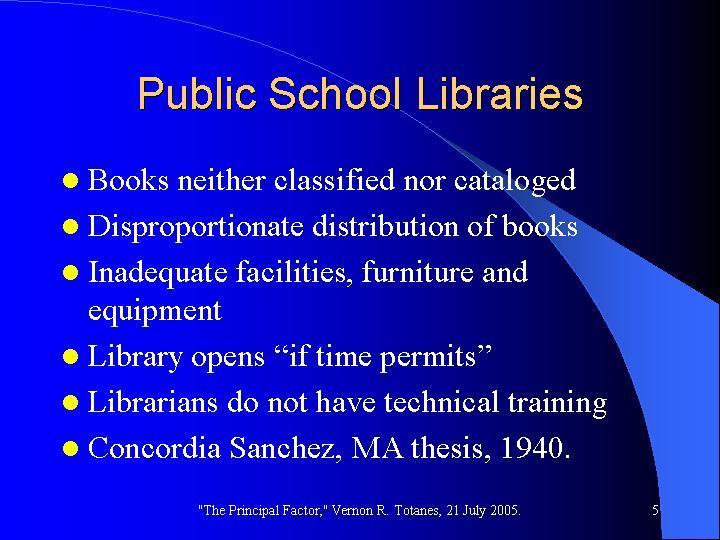
Books are merely accessioned, but neither classified nor catalogued.How many of these would you agree with? Well, these findings also appear in your handouts, but what you will not find there is that I am quoting from a thesis written by Concordia Sanchez in 1940.
This is accompanied by an unbalanced or disproportionate distribution of books.
The housing conditions provided for the library, if any, are poor, and the furniture and equipment are inadequate.
The library is not open long enough for students to use it to the fullest extent. Opening the library is only a matter of “if time permits” for the librarian. Some schools do not even open their libraries at all.
Librarians have not had any training in library work.
How much has changed since then? Please approach me after my presentation if you think that there have been a lot of changes.

I believe that not much has changed since 1940 because of certain constraints. What are some of these difficulties?
In a book published in 1999 about the prevalence of corruption in the Philippine public school system, the canteen is given a section all its own, whereas the library is never mentioned. Why? Because there is money to be made through the canteen, but none through the library. Please tell me if I’m wrong, but no budget allocations are made for most school libraries and, unlike private schools, you are not allowed to collect library fees.
A high-ranking administrator once told me that it is difficult to justify hiring a full-time librarian if you do not even have enough teachers. And so, overworked and underpaid teachers—who have little or no training in library work—are also assigned to be librarians.
Then again, some teachers become temporary “librarians” because—forgive me, but I don't know how else to say it—they are either going to retire soon or cannot teach effectively. There’s also property accountability, which dictates that lost books will be charged to the account of the person responsible for the books.
No money, no time, no training. And the threat of paying for lost books. Can we, therefore, blame librarians for the state of libraries today? Not really.

Have you heard of the “Guidelines on the Implementation of School Library Policies and Programs” issued in 1998 by the then Department of Education, Culture and Sports (DECS)? It should properly be called Enclosure No. 1 of the DECS Order No. 6, s. 1998, signed by Ricardo Gloria—but let’s refer to it as the 1998 Guidelines. Copies are available in your handouts. [For an online copy of the DECS Order, see "The State of Public School Libraries."]
The 1998 Guidelines set forth what should be available in public school libraries in terms of:
- Physical facilities – If, for example, you have an enrollment of 500, then your library should have a floor area of at least 72 square meters.
- Librarian and support staff – If you have 2,000 pupils, then you should have one full-time librarian and one part-time teacher-librarian.
- Programs and services – This includes library orientation during the opening of classes and library lessons as part of the curriculum.
- Collection – Encyclopedias, dictionaries, plus magazines, newspapers and professional books for teachers and librarians.
- Sources of funds – To pay for all these, the 1998 Guidelines state: “Library funds shall be 5-10% of the school funds (based proportionately) as released by the Division office.”

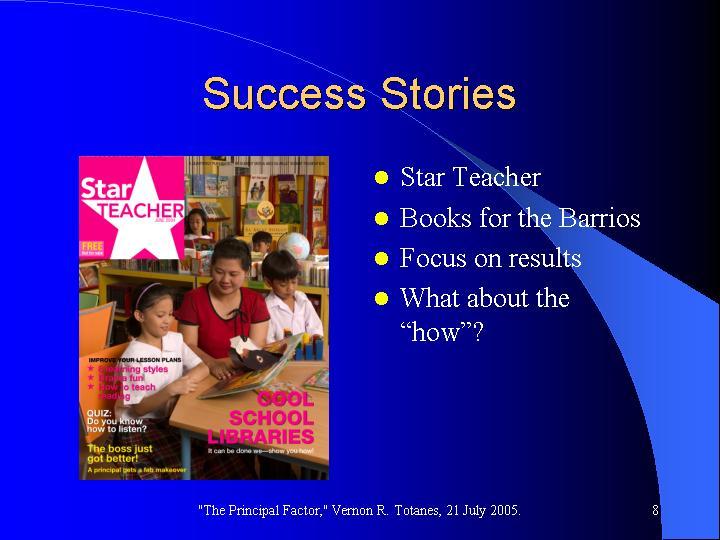
In spite of constraints, some public school libraries have developed and flourished to a point that they actually exceed the requirements of the 1998 Guidelines. You have probably heard of some of these success stories because of articles that have appeared in magazines and newspapers.
Star Teacher has featured libraries sponsored by Hongkong and Shanghai Bank. Articles have also been written about school libraries chosen by Books for the Barrios to be part of its Models of Excellence program. There are others, too, but almost always the focus was on results.
We hardly ever read about the difficulties that had to be overcome. What happened between the “before” and the “after”? How exactly can others replicate their success? Readers may, in fact, get the impression that all you need to have a good library is a donor who has money. But is it really just about money?

The following factors are taken from the findings of a project in the United States called Library Power. I will not go into each one of the factors, but if you look at them carefully, you will see that resources—or money—is just one of many. Which factor is the most important? Which one is the principal factor that will lead to success?
You may also look at these factors as a guide. Ask yourself: How many of these factors are present in your school library? Do you have a vision? Have you created an environment in which change can occur? And so on…
In my thesis, I looked at the development of seven public secondary school libraries in Quezon City. Using the 1998 Guidelines, I quantified the level of development of each library, and focused on the two school libraries with the highest scores. By comparing these two libraries, I was able to determine that both were “developed” according to the 1998 Guidelines, but one was more developed than the other. Not because one had more money, but because one had a factor that the other did not—the principal factor: leadership.

Eleven school libraries in Quezon City were automated as part of the SB e-Library project through the leadership of Mayor Sonny Belmonte, Division Superintendent Victoria Fuentes, Asst. Division Superintendent Meleda Polita, and the school principals and librarians.
The two libraries with the highest scores in my study were part of the SB e-Library project. And that’s why they were the only ones among the seven included in my study that had most of the factors needed for development.
This is a photo of the Juan Sumulong High School e-Library, the library with the highest development score. The other library—please do not ask me to identify it by name—scored much higher than the other five, but it was not a close second.
Sumulong had the principal factor, but the other did not. Please don’t get confused. The principal of Sumulong High School, Noemi Moncada, played a major role in raising funds for the library, but the other principal also raised funds for her school’s library. So leadership was present from the mayor to the principal in both schools. What was the difference? The Sumulong librarian was—and is—a leader.
Susan Torres, Sumulong’s librarian, has the necessary leadership skills that the librarian from the other school does not. One of the most important things that a good leader does is to get people to listen, to pay attention. And Susan Torres, with her principal’s support, gets people to listen.

What do school libraries need? The principal factor.
Leadership is very important. Not just at the librarian’s level or the mayor’s level, but at all levels. And it is especially important at the principal’s level. You, the principal, are a factor. Please correct me if I’m wrong, but directives from the Secretary of Education will have no effect if principals do not believe in them. In fact, if the principal champions the cause of the library, all other factors will follow. And if the principal does not believe libraries are necessary? Even if the librarian is very good, not much will happen.
We need principals who will begin with the end in mind. We need principals who believe in the importance of the library. We need principals who will provide a convenient location for the library. And, more importantly, we need principals who will appoint the right person to take charge of the library.
The right person is someone who actually likes pupils and books. The right person will allow pupils to use the books. With the principal’s support, this person will have time for the library. This person will also have to be a leader because you, the principal, won’t be able to do everything. This person will have to be good at public relations—not just with pupils, but also teachers, parents and possible donors.
Finally, the one factor that was not yet present in any of the libraries I visited: accountability. This factor does not refer just to property accountability. I am referring to how useful the library is. I am referring to test results. It’s very possible, after all, that an expensive, good-looking library will have no effect on learning.

If you would like to read further, I recommend that you look for Information Power: Building Partnerships for Learning (Chicago: American Library Association, 1998). It will probably not be available at any local bookstore, so you are better off checking with the nearest school of library and information science or the Internet.
You may also want to look at School Librarian in Action. Zarah Gagatiga, who will be speaking with the librarians this afternoon, owns this website where she talks about her experiences at Xavier’s Grade School library. She writes, of course, not from a public school perspective, but there is much that can be learned from her experience.
There is also Filipino Librarian. This is my own website. Here you will find the slides and full text of my presentation today, other things I have written about libraries in the Philippines, whether public or private, and resources freely available on the Internet.

Before I end, I would just like to repeat a few points.
Money is important. But there is something more important than money.
School libraries need leaders. And one of the most important leaders is the principal. After all, it is the principal who will choose the librarian, among other things.
Leadership is very important. All other factors will follow, including money, if you have a leader.
Maraming salamat po.
SLA 2005: Justifying the Library's Existence
Some banks do better than others. And I'm willing to bet that they do better because they let customers know what the bank can do for them. The not-so-successful ones probably just wait for customers to find out what the bank has to offer. But customers don't come, profits don't materialize, investors bail out, and the bank eventually closes. Libraries, I believe, are the same.
"Making a Business Case for the Information Center: Key Strategies for Business and Financial Libraries" was a continuing education (CE) course and, as such, it should have cost me US$250. But since I was entitled to attend one CE course as part of the award that I received, I got in for free. It was a four-hour course where I was able to participate in discussions that centered on what can be done to convince decision-makers that what information professionals do is important. What I found most encouraging was that participants were focused on being proactive and customer-oriented. For more information, see the slides (pdf) shown by Lesley Robinson, the speaker, and "Writing a business case to improve organisational impact" (pdf; Legal Information Management, March 2005).
"Top 10 Tips" sounded like a good session to attend. What I didn't know was that all the tips had to do with news libraries. But it was good, in a way, because I've always been interested in newspaper operations and some of the tips could, in fact, be applied to just about any library. For example, one tip involved the compilation of a "kudos file," where all compliments and notes of appreciation were filed, which would then be emailed to the community at regular intervals just to show that the library was serving its purpose. The compilation also became a means to identify those who were either not using the library or were not being served properly. While listening, it also occurred to me that the compilation would be a good candidate for a blog. For a list of all the tips, see "SLA Notes: Ten Top Tricks for News Libraries."
Libraries may not be profit centers, but there is a need to show that they add value to a community or an institution. No one is obliged to recognize the importance of the library. The librarian must, therefore, proactively seek to convince others of the need for the library.
Tag: SLA2005
Related post: What Librarians Can Learn from Basketball
What Librarians Can Learn from Basketball
Basketball is the national sport in the Philippines. If no basketball court is available in a neighborhood, you can be sure that a makeshift one will be built in someone's driveway, an empty lot or even a main thoroughfare. Sadly, the same is not true of libraries. If one is not available, Filipinos do without. Could it be that libraries are unnecessary?
In "Means, not ends" (Journal of the Medical Library Association, July 2004), T. Scott Plutchak makes a connection between basketball and libraries. When you start reading the article, it's almost as if it's going to be just about basketball, but he eventually gets around to libraries:
It is easy to complain about heartless and narrow-minded administrators who do not see the value of the library. But what have you done to prove the value of your library to them? How are you making sure that they see ways that the library can solve their problems? Libraries cost money, and, if the administrator cannot be shown why spending that money improves the overall health of the organization, then the administrator has an obligation to shut the library down and spend that money elsewhere. That may turn out to be a bad decision, but it is still a rational one.Libraries are, of course, not basketball courts. But there is much that librarians can learn by looking at why Filipinos are so devoted to the sport. I do not have time to go into specifics, but Plutchak makes some important points:
Basketball is not an end in itself...—it is a piece, an important piece, of building an overall university community that provides students with a full range of educational, cultural, and community experiences.Libraries are not just about reading and research. Libraries are also about providing what users need or want. And if librarians can entice users to visit the library because of an exhibit, for example, that interests them—say, a retrospective on basketball players or relevant materials on the Anti-Wiretapping Law—then it will be easier to demonstrate the relevance of the library to the rest of the community.
Libraries are like that, too, and librarians need to think of themselves that way... We have talents, resources, and skills that are essential for the success of our institutions... That means getting out of the library and talking with the people we serve about what they are doing and what their goals are. It means thinking about what the institution needs and not what the library needs. Sometimes, it even means going to basketball games.
John Paul II, Stephen Covey, and Leadership
...the best library leaders I’ve known have loved their jobs and people too... To be an effective leader you have to believe in your cause and care about the people you are leading.Are you a leader or a follower? Why do you do what you do? Do you have a vision that you want to achieve? Sometimes, the best way to answer a question is to just point to someone. Whom would you point to? Would you like to follow in your boss's footsteps?
—"The Pope, Leadership, and Me" by Lisa Ennis (LIScareer.com, May 2005)
Leaders do not necessarily have followers in the beginning. You can be your own leader even if you're all alone in your library. Eventually, if you are successful and people start taking note of what you've done (and believe me, they will not notice how precisely you've cataloged the books, so start focusing on your customers' needs), your circle of influence will expand and "followers" will just come in the form of customers, supporters, donors.
Be proactive. Begin with the end in mind. Live what you believe.
For more information, see "Business leaders can learn from pope" by Claudio Luffoli (USA Today, 4 April 2005) and the summary of Stephen Covey's The Seven Habits Of Highly Effective People.
Related posts:
Librarians as Leaders
John Paul II, Pope, 1920-2005
Librarians as Leaders
The following essay is a revised version of the statement I submitted when I applied for the International Travel Award sponsored by ISI Emerging Markets and administered by the Business and Finance Division of the Special Libraries Association (SLA). And yes, I was given the award, so I will be in Toronto, Canada, June 5-8, for the SLA's annual conference, "Putting Knowledge to Work."
“We don’t have money” is what many librarians in the Philippines will say to excuse the state of our libraries. But I do not believe that money is the only problem. Many Filipino librarians do not have the leadership and communication skills necessary to persuade their superiors and possible donors—even subordinates—that they can effectively implement the projects for which they ask assistance.
Blinders
The biggest challenge facing librarians in the Philippines is to take off the blinders that prevent us from seeing that money is not the problem; the way we look at the problem is the problem. If we believe that money is the only problem, then the only solution is more money. And since the government, private institutions and universities of a developing country like the Philippines will probably never have enough money to allocate to its libraries, should we just accept that our libraries will never improve? Of course not.
The thesis I submitted as a final requirement for my master’s degree in library and information science focused on the factors that influenced the development of public school libraries. In my review of literature, I learned that many studies conducted since 1940 to determine the state of public school libraries in the Philippines examined libraries located in different places and, with minimal differences in methodology, came up with the same results. In fact, while these studies detailed how public school libraries did not meet minimum requirements or fared poorly when compared with private school libraries, the majority had as their most important recommendation—whether first or last—the necessity of having an adequate and regular budget for the library.
Findings from studies on public school libraries are not necessarily applicable to all kinds of libraries in the Philippines. But I believe that results will be very similar—even for those with bigger budgets. In my thesis, I compared the two most developed public school libraries. They had similar budgets and populations, but one was more developed than the other. Why? The more developed library had a librarian who enjoyed the confidence of the school principal, district supervisor, and even the mayor. Whereas the librarian in the less developed library—despite having more assistants than the other librarian—could not even get the different subject departments to entrust the collections in their offices to the library.
What was the difference? One librarian could speak her customers’ language; the other could not.
Speaking Their Language
Many librarians focus on organizing their collections and think that should be enough, they’ve done their job. But the truth is that jobs are never really just about the work—in any profession. The ability to communicate what we do, what we’ve done and what else we can do for our customers is very important. Librarians, especially in developing countries where people are less able to appreciate what they cannot eat, need to sell what they can do for their customers—whether it’s storytelling for children, research methods for students or online resources for busy managers. And the only way this can be done is if we learn to speak the language of our external and internal customers.
New librarians need communication skills. In business, if we can’t get others to listen to us, then our ideas are probably not worth considering. Rightly or wrongly, that’s the way the world works. But it’s not just about making ourselves heard either; it’s also necessary to know when—and how—to shout, whisper or keep our mouths shut. Many Filipino librarians just keep quiet, and so their superiors think they have nothing to contribute. And as years pass, these same superiors will cut budgets for their libraries because those in charge are unable to justify the expenses charged to their cost centers. It’s not just the money; it’s the people.
Librarians in developing countries need leaders—leaders who can communicate a vision in a language that their internal and external customers can understand, leaders who can inspire confidence in their subordinates and superiors, leaders who will not excuse mediocrity with “We don’t have money.” Unfortunately, library and information science students in the Philippines are rarely—if at all—taught communication skills, much less leadership skills.
Please don’t get me wrong. I am not saying that money is not important. What I’m saying is that before we can even talk about money, we need leaders who can communicate what an increased budget for the library can contribute to its parent-institution’s mission. As I discovered through my thesis, two individuals given similar amounts of money will not necessarily achieve similar goals. It is not money that will put knowledge to work. People will put knowledge to work.
Conclusion
The biggest challenge facing librarians in the Philippines today is the thought that there is no money to pay for the improvements that we would like to make. With the necessary leadership and communication skills, it is my belief that librarians can and will make a difference—even with the limited amount of money allocated to libraries.
Related posts:
Hope for Public School Libraries
Public School Libraries