Quick Links: Talumpati | Licensed Librarians | Filipiniana Online | Stereotypes | Leadership | The Philippines

Showing posts with label Book History. Show all posts

Book-lat: Reading in the Philippines


In case you missed it last week, the video of a TV5 documentary on reading in the Philippines is now available online. The documentary's title, "Book-lat," references the Tagalog word "buklat" (in English, to open like a book). The question it seeks to answer is "Kaya ba nating makalikha ng isang nasyon ng mga mambabasa?" (Can we create a nation of readers?) Watch the entire documentary below.

Part 1


Part 2


Part 3


Part 4


Disclosure: I was interviewed for the show, and I appear as early as 1:11 in the first segment. Note that I am not identified as a librarian, but as a book historian. Also, the Rizal Library is featured prominently in the host's spiels and my interview, and several librarians and staff are clearly identifiable in the background and walking through the stacks.

Read More...

The Future of Book History

I am a book historian. The biggest gathering of book historians takes place every year at the annual conference of the Society for the History of Authorship, Reading, and Publishing (SHARP), which was held this year at University of Pennsylvania in Philadelphia from 18-21 July 2013. The theme was "Geographies of the Book," which was interpreted both literally (e.g., "circulation... within cities, countries, and across continents") and figuratively (e.g., "imaginative topographies or journeys within fictional works").

In addition to presenting a paper at this year's conference, I was also invited to be one of 12 speakers at the closing plenary session. Each of us was either a PhD student or an early scholar—participants whose voices are rarely heard at plenary sessions. We were given five minutes each, but we were also instructed not to tell anyone about what we were going to do because we were supposed to listen to our colleagues' comments and share their feedback during our reports. (For photos of the closing plenary session, as well as some of the heartening reactions on Twitter to my contribution, see my Facebook post.)

Some speakers spoke extemporaneously, but like a few others, I wrote down my contribution. Here's most of what I said...

First, I will state the obvious, just to get it out of the way. Second, I will state what is not so obvious, just so you know where I'm coming from. And finally, I will state what I am currently doing to promote book history in Asia, as well as what I intend to do in the next few years, which I suspect many of you have already done in the past.

First, despite its global ambitions, it is obvious—based on my own observations, comments whispered in my ear, and tweets posted online, with someone actually using the word "angry" in my presence in relation to yesterday's supposedly global session—that SHARP remains predominantly white, Anglo-American. This reality is reflected in the sites chosen for its annual conferences, as well as the large percentage of papers presented on the book in the West.

Please don't get me wrong. I'm not criticizing anyone for a state of affairs that is not unique to SHARP. I'm also not blaming anyone for not addressing questions they never sought to answer. SHARP's focus on the book in the West is not new. In 2001, Amadio Arboleda, who is based in Japan and could not make it here this year, wrote about what he called the "Gutenberg Syndrome," in which the history of the book is viewed in terms of Western principles and practices. I suspect that his sentiments were not entirely new then, and they're certainly not new now. But I suppose it's worth asking, "How much have things changed since then?" I have a suggestion to address this later.

Moving on. What is not so obvious, perhaps, is that while I am clearly representing Asia today, I am not—in many ways—entirely representative of most Asians, the great majority of whom probably have very little time to think about books because they are more concerned about finding food and work. I have been very privileged. It was as a PhD student that I was able to present papers at SHARP's annual conferences in Oxford, Helsinki, and Toronto. I received most of my travel funding from University of Toronto, but the discounted student membership and conference registration rates were very helpful, and for this I am grateful to SHARP.

I am here this year because I received a scholarship from SHARP—and for this I would like to thank the generous donors who contribute to the travel fund, as well as those who administer the fund. The scholarship I received, however, was sufficient to cover only half of my airfare from halfway across the world, so thankfully again, I am gainfully employed and privileged enough that Ateneo de Manila University has given me enough to pay for most of the other costs of going to Philadelphia.

For the final part of this short report I ran out of time to write it out, so I hope you'll pardon me for relying on bullet points to describe what I hope can be done at future conferences:
  • nice to have this year because of the theme, but can still be done next year: GIS map of book historians, book history prizes, not just place, but also over time
  • immediately: talk to someone i don't know, talk to the person sitting next to me
  • next conference: badge for "first timer"; session for first-timers; mentors for first-timers
Because of my own privileged status as the director of a university library with its own budget, I plan to do the following things to promote book history in Asia:
  • collect public school textbooks for research purposes, and if possible, publishers' archives, in addition to the documents we already collect
  • organize a book history panel for a conference in the Philippines
  • 3 to 5 years: organize a book history conference for Southeast Asia in the Philippines; participate in planning to bring annual conference to Asia, specifically Japan
  • 5 to 8 years: organize annual conference in the Philippines
Thank you very much.

Read More...

What was the first book printed in the Philippines?


Click on the photos above to learn more about each book
and/or download their digital versions.


Earlier this week, I received a text message asking if the essay mentioned by Ambeth Ocampo in his latest column was posted on my blog. Since I had no idea that any publication of mine had been cited in a newspaper recently, I checked out the column. And there it was at the very end of a discussion on "First book(s)" (Philippine Daily Inquirer, 16 January 2013): "For a more recent take on the old issue see Vernon Totanes’ 2009 essay 'What was the first book printed in the Philippines?'"

Since I've never actually posted a link to the journal article on my blog, I thought I'd share it now, along with the abstract, in case someone wants to read it. Click on the title to download the pdf =)

Note, however, that the title is misleading because the article is essentially an introduction to the discipline of book history, and asserts that the two books printed in the Philippines in 1593 are significant in ways that have yet to be fully appreciated.


"What was the first book printed in the Philippines?"
Vernon R. Totanes
Journal of Philippine Librarianship 28:1 (2008), 21-31.

This paper will show that the importance of the imprints lies in the fact that they effectively communicate the idea that printing in the Philippines—and Philippine history—is inextricably linked with the non-Filipino. The first books printed in the Philippines, though not strictly "Filipino," are a physical reminder of the plurality of the nature and culture of the Filipino and the Philippines.

Read More...

History of the Filipino History Book

In case you haven't heard, I successfully defended my dissertation last 22 June 2012. And now I'd like to share its abstract, acknowledgments, and table of contents here on my blog to publicly thank everyone who helped me get to this point, and perhaps inspire other Filipino librarians to obtain their own PhDs.

History of the Filipino History Book


For those who have difficulty reading the document above, I am reproducing the abstract and acknowledgments below:


History of the Filipino History Book
Vernon del Rosario Totanes

Doctor of Philosophy

Faculty of Information
University of Toronto

2012


Abstract

Studies of Philippine historiography often trace the emergence of history books written by Filipinos—or, more simply, Filipino history books—to the influence of Spanish and American colonialism, and the rise of Filipino nationalism. In most cases, the names of historians and the titles of their works figure prominently in discussions devoted primarily to texts and/or their authors' backgrounds, while the names of their publishers and other bibliographical details are either relegated to the footnotes or dispensed with altogether. This study proposes an alternative, complementary approach that seeks to enrich the study of Philippine historiography by reconstructing the history of the Filipino history book using the framework of the discipline known as "book history," and Pierre Bourdieu's theory of the field of cultural production.

The histories of three books, namely, Jose Rizal's annotated edition of Sucesos de las Islas Filipinas (1890), Leandro Fernandez's A Brief History of the Philippines (1919), and what is now commonly known as Teodoro Agoncillo's History of the Filipino People (1960), are presented as case studies through which the evolution of the Filipino history book as a material object and commodity, and not merely as a text to be read or interpreted, may be better understood. Each book represents a different period in the evolution of the study of Philippine history by Filipinos, and was published in multiple editions over several decades.

By examining the prevailing conditions throughout each book's life cycle, the contributions of agents other than their authors, the struggles that accompanied their publication and distribution, and the evidence that may be gleaned from the books themselves, this dissertation shows that Spanish and American colonialism, and Filipino nationalism, did shape the development of Philippine historiography from the late nineteenth century to the twentieth century, but it also reveals that the Catholic Church played an important role in the production and circulation of books regardless of who was in power, and that struggles between agents involved in the historical field have affected the history of the discipline in ways that have yet to be fully acknowledged.


Acknowledgments

Dissertations, like books, are usually credited to their authors alone, but such works often also benefit directly and indirectly from the efforts of family and friends, librarians and archivists, publishers and professors, and many others. This dissertation is no exception. Hence, I would like to express my gratitude and appreciation to those who have contributed in various ways to the writing of this work:

Patricia Fleming, for agreeing to be my adviser even though she had just retired, and for her kindness, patience, and support as I wrote and rewrote numerous drafts over the years; Alan Galey and Malavika Kasturi, the members of my committee, for challenging me to complicate my analysis using methods and approaches I had not previously considered; and Vyva Victoria Aguirre, Roland Sintos Coloma, Gordon Davies, Leland de la Cruz, Tarleton Gillespie, Greta Golick, Christine Lao, Thomas Kessler, Susan MacDonald, Scott McLaren, Ari Ngaseo, Fr. John Schumacher, Brian Cantwell Smith, Karen Smith, and Ethel Tungohan, for asking questions, answering queries, giving feedback, and suggesting improvements.

Sharon Henry, for encouraging me to apply for the travel grant that brought me to Toronto; Lourdes David, for planting the seed that led me to contemplate the pursuit of a doctorate; Patricia May Jurilla, for introducing the study of book history as an academic discipline to Philippine studies; Leslie Howsam, for showing that history books are material objects and commodities with their own histories; Ambeth Ocampo, for suggesting that I look into the history of what is now commonly known as Teodoro Agoncillo's History of the Filipino People; and Filomeno Aguilar Jr., Bernardita Churchill, Natalie Zemon Davis, Milagros Guerrero, Reynaldo Ileto, Gregory Pfitzer, Vicente Rafael, and Edgar Wickberg, for showing interest in my research and encouraging me to continue.

Salvacion Arlante, for granting access to the Teodoro A. Agoncillo Papers and other resources at the Main Library of the University of the Philippines; the librarians and archivists at Ateneo de Manila's Rizal Library, Biblioteca Nacional de España, Biblioteca del Ateneo de Madrid, Bibliotecas AECID, Bibliothèque nationale de France, British Library, Columbia University, Lopez Museum and Library, Newberry Library, New York Public Library, Philippine National Library, US Library of Congress, US National Archives, University of California Berkeley, and University of Michigan, for not only preserving the primary sources I needed for my dissertation, but also for organizing them so that necessary materials could be easily found; and the visionaries behind Google Books, Internet Archive, and Hathitrust, for digitizing books and documents, and making them freely available online.

Teodoro V. Agoncillo III, for answering my questions and generously sharing documents I could not find elsewhere; Elvie Lapuz, Grace Tabiendo, and Ricky Punzalan, for their help in obtaining copies of library and archival materials that I was unable to physically examine; and Jonathan Balsamo, Maricor Baytion, Jonathan Best, Karina Bolasco, Mario Feir, Stephen Feldman, Caroline Garcia, Susan Go, Caroline Hau, Chas Navarro, John Silva, and Gas Vibal, for welcoming me into their offices and homes, translating documents, and/or assisting with the collection of data.

The University of Toronto, for providing the fellowship that made it financially possible for me to study in Canada; the Doctoral Thesis Completion Grant, as well as the Ethel Auster Bursary, for additional funding; Bonnie McElhinny, for the research assistantship that allowed me to visit UC Berkeley's Bancroft Library and the US National Archives; and the Faculty of Information, the School of Graduate Studies, the Asian Institute, and the Doctoral Students' Association, as well as the University of Michigan's Bentley Historical Library, for grants and awards that facilitated research trips and conference-related travel outside Toronto.

Bro. James Dunne, Onofre Pagsanghan, and Fr. Victor Salanga, for being good teachers and advisers inside and outside the classroom, and for being even better friends after I finished high school and college; Dulce Abad and Donna Shotwell, for being my mentors in and out of the corporate world even after we set off in different directions; Jim Arshem and Raphael Gancayco, for befriending a stranger like me and letting me stay with them on research trips to Washington, D.C., and New York, respectively; and Vanny Bicomong, Bong Buenaventura, Rene Cruz, Tom Frias, Ed Gulane, Cheche Soberano-Kau, Tony Liam, Malix Huidem, and Rancy Recato-Buenafe, for their friendship and support as I traveled between Toronto and Manila over the past six years.

My aunts and uncles in Canada and the United States—namely, Fe and Ben Dueñas, Tessie and Rudy Escribano, Aida Geronimo, Cora and Dick Macalinao, Gee and Bill Orr, Ernie and Mae Totanes, and especially Lory and Phil Mancini, and Stan and Rose Totanes—for welcoming me into their homes, and essentially treating me as one of their children; my cousins and their husbands or wives (if any)—Ben and Emily, Edgar and Teena, Erwin and Lyn, Eugene, James, Joey and Weng, Maris, Mike and Priscilla, PJ, Rachel, Rhia and Mike, Tony and Chiqui, and Vi and Ronnie—for going out of their way to spend time with me; and my siblings, Veraflor and Verchie, for helping me in countless ways over the years.

And finally, my parents, Ver and Flor, for teaching me to read and to write, to live and to love. This dissertation is dedicated to them.

Read More...

Teodoro A. Agoncillo, 1912-2012


Today is the centennial of the birth of Teodoro Agoncillo. He was, in my opinion, the most influential Filipino historian of the twentieth century. And it is only appropriate that historians like Ambeth Ocampo, Renato Perdon, and Michael Xiao Chua have paid tribute to him as a historian. But before Agoncillo became recognized for the history books he wrote in English, he was in fact better known as a literary critic and poet... in Tagalog. Other lesser-known details about him include the fact that despite the perception that he was anti-Catholic, he counted Horacio de la Costa, a Jesuit priest, among his closest friends, and sent his children to Catholic schools. Also, while he never earned a PhD degree, he did receive an honorary doctorate (see photo above).

The brief biography below, which reveals a few more details that are not widely known, is a slightly revised version of several paragraphs from “History of the Filipino History Book,” my dissertation, in which Agoncillo figures prominently. I have removed the footnotes to make it more readable.


Born in the province of Batangas in 1912, Teodoro Agoncillo grew up surrounded by relatives and friends who survived the wars against the Spanish and the Americans. His father, in particular, fought alongside one of the last Filipino generals to surrender to the Americans in 1902. His grand-uncle was one of the first Filipino diplomats who sought to gain international recognition for the first Philippine republic, and his wife was one of the three women who sewed the very first Philippine flag. He was also a distant relative of Emilio Aguinaldo, the first President of the Philippines, who married an Agoncillo after his first wife died in 1921.

He learned Spanish in kindergarten, and attended the public schools established by the Americans, where he became fluent in English, but affirmed his Filipino identity by reading Jose Rizal’s Noli Me Tangere (1887) and El Filibusterismo (1891) as early as the seventh grade. By the time he graduated from high school, Agoncillo had already begun writing poems, most of which were penned in Tagalog. It is hardly surprising, therefore, that he entered the University of the Philippines in 1930 with the intention of majoring in English, not history. He credits Leandro Fernandez, author of A Brief History of the Philippines (1919), and who was then UP’s registrar and chair of the history department, for convincing him that a student did not need a degree in English to be a good writer, and persuaded him to switch to history.

Agoncillo’s stint as a campus journalist at the Philippine Collegian, UP’s student newspaper, proves that Fernandez was correct, but it was not until after he began his master’s degree in history in 1934 that his writing began to draw feedback similar to the heated reactions his later articles and books received. Among those early, critical works were “Glaring Errors in a Doctoral Dissertation” (1935), a pamphlet he coauthored that questioned the content of a dissertation and its acceptance by the University of Santo Tomas, and “Ang Banaag at Sikat ni [Glimmer and Radiance by] Lope K. Santos” (1936), which faulted the classic Tagalog novel’s author, who was considered an established pillar of Tagalog literature, for turning his protagonists “into mere sounding boards for Santos’ political slogans.”

But it was the publication of Agoncillo’s review of Ricardo Pascual’s Dr. Jose Rizal Beyond the Grave (1935)—in which he supported the author’s position that Rizal’s so-called retraction document was a fake, and made disparaging remarks about the Catholic Church—that resulted in the suspension of the Collegian’s editor-in-chief, the first recorded instance of censorship in the history of the campus paper. Agoncillo did not, however, consider it his duty to challenge authority whatever the cost.

Not long after he coauthored Ang Kasaysayan ng Pilipinas (with Gregorio Zaide), the first Tagalog history textbook, and got married in 1941, the Japanese attacked Pearl Harbor and were effectively in control of the Philippine Islands within a few weeks. During the Second World War, Agoncillo’s wife refused to let him work for fear that he would be picked up by the Japanese and sent elsewhere, which was not uncommon during that period. Thus, he stayed home and, using his own private library, continued doing research, reading, and writing. He also collected periodicals and other printed materials, and recorded his observations about the war, which eventually ended up in some of his books.

After the war, a friend convinced him to join a government-sponsored, biography-writing contest because of all the data he had accumulated, and his wife again played an important role in his career when she taunted him after learning he had yet to write a single paragraph. He finished typing his manuscript in January 1948, and barely beat the deadline for submission. Agoncillo’s entry was unanimously chosen the winner in July 1948, but it was not until The Revolt of the Masses was actually published in 1956 that he finally gained acclaim as a historian.

The book was supposed to be printed at the government’s expense, but its publication was blocked not once, but twice, by two Presidents of the Philippines: Elpidio Quirino in 1948, and Ramon Magsaysay in 1956. Scholars have alluded to these struggles before, but what is rarely mentioned is that the circumstances surrounding the book’s controversial publication are indicative of the political and social tensions—or struggles in the field of power—that existed during that time.

In 1950, newspaper coverage of the objections made by the Catholic bishops of the Philippines to the distribution of copies of the English translation of Rafael Palma’s Rizal biography, The Pride of the Malay Race (1949), to high school students paled in comparison to the threat posed to the government by the Huk movement, a peasant resistance organization during the Japanese occupation that transformed into a communist insurgent group after independence. By 1956, the Huks were not as potent a threat as they had been six years earlier, but the specter of communism remained, which the authors of an anti-Revolt pamphlet invoked soon after Agoncillo was granted permission to have the book printed himself. Within a month after the pamphlet’s release, debates erupted on the Senate floor over the Rizal Bill, which required students to read Rizal’s novels in class, but this controversy is seldom mentioned in connection with the disputes over the publication of Agoncillo’s Revolt.

Although it was probably the last time that books written by Filipinos were the subject of consecutive, front-page controversies in the same year, the lack of significance attached to this confluence of events is understandable. Scholars who mention the battle over the Rizal Bill usually do so in relation to Rizal’s importance to Filipinos, while those who discuss the publication of Agoncillo’s book often focus on its role in the emergence of Bonifacio as a viable alternative to Rizal as national hero. The two controversies, however, were directly related: Agoncillo was responsible not only for writing Revolt, but also the earliest draft of the Rizal Bill, which sought to promote the teaching of the lives and works of Filipino heroes, not just Rizal.

In 1958, Agoncillo was hired as a full professor at the University of the Philippines, and chaired its Department of History from 1963 to 1969. By the time he retired in 1977, Agoncillo had received numerous awards, as well as an honorary doctorate, and had been promoted to University Professor, the highest academic rank at UP. A few months after his death in 1985, he was posthumously proclaimed a National Scientist. In the year 2000, he was declared one of the Philippines’ “Most Influential 20” in the twentieth century—the only academic in a group that included presidents, movie stars, and business leaders.

Read More...

Rizal's Noli, Fili and "Mi Ultimo Adios"


Photos of front and back of what is perhaps the best-known and most-translated document written by a Filipino. Note that it does not have a title. Click photos to enlarge.


Jose Rizal's original, handwritten manuscripts of Noli Me Tangere and El Filibusterismo will be exhibited at the National Library of the Philippines on 17 June 2011 [UPDATE JUN 15: Extended to June 18] as part of its "Exhibit of Original Rizaliana Materials." It is unclear from the announcement whether the "Mi Ultimo Adios" will also be on display, but I certainly hope it will also be shown to visitors. [UPDATE JUN 15: According to its caretaker, the "Mi Ultimo Adios" is "too delicate and too faded to be exhibited."]

I just happened to be around on 12 May 2011, when the Noli, Filiand "Mi Ultimo Adios" were officially turned over to the directors of the National Library and the National Archives by the German conservators who undertook the repair of Rizal's best-known works. It was interesting to learn that Rizal himself had bound the manuscripts of his novels, and that the Noli had been so tightly bound, according to the conservators who reconstructed Rizal's binding, that it is practically impossible to open the manuscript without breaking its spine (see photo below).

The conservator shows just how far the Noli manuscript
can be opened without damaging its spine.


The Fili manuscript, unlike the Noli, can be opened easily,
but it does not have a cover like the one Rizal designed for the Noli.


What struck me most, however, was the the size of the "Mi Ultimo Adios," which was only slightly larger than an iPhone. But even more remarkable is the fact that all these were written in Spanish, and that somehow—despite the reality that very few Filipinos were fluent in Spanish during the late nineteenth century AND even fewer copies were available—Rizal's words and ideas inspired his countrymen to fight both their Spanish and American colonizers in pursuit of the establishment of an independent Philippines.


Thanks to Director Antonio Santos of the National Library, Director Ino Manalo of the National Archives, and Anne Rosette G. Crelencia (head of the Rare Books and Manuscripts section of the National Library) for letting me—perhaps the only last-minute guest at the turnover—join the exclusive event and blog about it, too!

Read More...

FO: Shih-lu, 1593


The Biblioteca Nacional de España has digitized the only known copy of the Shih-lu, and—with a little prodding from this blogger—made it freely available online. The entire book may be downloaded here: Shih-lu (pdf). To see its bibliographic record, click here: Shih-lu.

Note that, like most books in Chinese, the Shih-lu may be described by those not from China as having been printed back-to-front. This means, concretely, that the Shih-lu's first page is not found at the beginning of the file, but toward the end, specifically page 155. A brief history of this book follows below.

On 20 June 1593, the governor of las Islas Filipinas wrote the following to the king of Spain:

Señor:—En nombre de V. Mag, e dado licencia para que por esta vez, por la gran neçesidad que avia, se ymprimiessen las Doctrinas Xpianas que con esta van, la vna en lengua tagala, que es la natural y mejor destas yslas, y la otra en la china...

[Sire, in the name of Your Majesty, I have for this once, because of the existing great need, granted a license for the printing of the Doctrinas Christianas, herewith enclosed—one in the Tagalog language, which is the native and best of these islands, and the other in Chinese…]
Much more has been written since then about the first two books printed in the Philippines in 1593, but most either refer to just one book—usually the Doctrina Christiana in Spanish, romanized Tagalog and baybayin—or, contrary to the evidence in the governor's letter, even three! Many of the authors apparently had not read Piet van der Loon's "The Manila incunabula and early Hokkien studies" (Asia Major [1966] 12, 1-43), which clearly lays out his reasons for concluding that the third "first book" was actually printed later, perhaps in 1605.

But one of the most problematic assumptions of many who write about the first Philippine imprints, at least to me, is that the Shih-lu was merely a translation of the Spanish-Tagalog Doctrina Christiana. Now that the Shih-lu is available online, and its contents can easily be compared and contrasted with the Doctrina Christiana, even someone with no knowledge of Chinese, Spanish or Tagalog will see right away that the two are very different books.

Special thanks to Lourdes Alonso and Cristina Guillen of the Biblioteca Nacional de España for their effort in making the Shih-lu freely available online, and to Francis Navarro for his assistance in Madrid.

Read More...

"The Great Book Blockade of 2009" is over

It all started with Robin Hemley's "The Great Book Blockade of 2009," which laid bare the plan to start taxing books imported into the Philippines—contrary to the Florence Agreement—because a customs undersecretary decided that she was the only one in more than fifty years who could interpret the Agreement correctly. There's more in my post on "Libraries and 'The Great Book Blockade of 2009'," but all's well that ends well because today it was reported that "Taxes on book imports lifted." Finally, here's the summary of events and reflection written by Hemley for the Far Eastern Economic Review on the role he played in all of this: "Notes from a Blockade Runner."

I'm happy, of course, that it's over. But the very first question I asked when I learned about the blockade remains: "why did it have to take a foreigner to write about it in a foreign publication?" (see 2nd comment on "The Great Book Blockade of 2009 (updated)"). If bookstore owners and book dealers already knew about it weeks and months ago—some were even at that infamous meeting with the undersecretary herself—how come we never heard from them until after Hemley broke the story? I have nothing against Hemley or foreigners, but I really think it's amazing that scandal-sniffing Filipino reporters didn't pick up on this right away.

In "The Great Book Blockade of... 1959," I linked to an article by Joaquin Po, a bookstore owner. I haven't found out how that "blockade" ended fifty years ago, but I'd like to think that Po's efforts were rewarded eventually. There's a lesson here... and not just for bookstore owners and book dealers. Someone has to speak up. How do we work together to solve a problem if very few know the problem exists?

Read More...

The Great Book Blockade of... 1959

Deja vu?! Well, the circumstances fifty years ago were a bit different, but those complaining about "The Great Book Blockade of 2009" should read "Bookselling In Manila" (pdf; registration required but it's free!), a 1960 article by Joaquin Po, who was then owner and manager of Popular Bookstore and president of the Philippine Bookseller's Association:

Prior to the enactment of the 25% margin fee law, the 17% exchange tax was converted into the 17% special import tax in accordance with the Laurel-Langley Agreement. In order that imported books be exempted from this tax, a certification has to be obtained from the Secretary of Education to the effect that they are texts, references, scientific, technical or religious books - which means, of course, that general books for general readers are not considered at all. After obtaining the certification, it still has to be submitted, together with other documents, to the Central Bank for approval in order that the books can be exempted from the payment of the 25% margin fee.

It is very frustrating to note that all these restrictions are being imposed on the importation of books in spite of the fact that the Philippines is a signatory to the UNESCO Agreement on the Importation of Educational, Scientific and Cultural Articles and Materials... Instead of abiding by these international commitments, our government in most instances has been doing just the opposite...


Source: Philippine Studies 8 (1960): 389—393

Read More...

1, 2 or 3 Books Printed in 1593?

Feedback I emailed to Queena Lee-Chua appeared in her column today (see "Readers speak out," Philippine Daily Inquirer, 11 May 2009). If I had known that she was going to print my short email, I would've presented the reasons for my assertion that "The evidence that only two books—not one, not three—were printed in 1593 is very strong." I will be working on a post that will layout my position as clearly as possible. In the meantime, I'm reproducing the relevant portion of Lee-Chua's column, followed by my reply to Teresita Ang-See, which was not printed.

Von Totanes writes: I read your column on Bahay Tsinoy (Jan, 19, 2009). You may want to forward this link to founder Teresita Ang-See: http://filipinolibrarian.blogspot.com/2007/07/first-books-printed-in-philippines.html. The evidence that only two books—not one, not three—were printed in 1593 is very strong.
Ang See’s reply: Von’s points are well taken and I have encountered them before. I accept Von’s arguments as valid, but I cannot also say categorically that there are only those two books. According to the foreword of the “Shih Lu, Zhen Jiao Bian Zeng” (Apologia), it could be the first book printed here. But I doubt it because the book was an elaborate treatise on what true religion is.

The Chinese philosopher was arguing fiercely with the Dominicans about questions of philosophy. That the Dominicans won the argument is given because it became a book, right? The friars who wrote back to Spain said they translated into Chinese the catechisms and religious tracts in order to convert the Chinese. They were not as interested in Christianizing the Chinese here as in using them as stepping stones towards evangelizing a million “barbarian souls” in Cathay. Shouldn’t the “Doctrina Christiana” have been published ahead of the “Shih Lu?” It is easier to translate the “Doctrina” than it is to record and put into a book the debate on true religion...

We cannot also conclude that the “Doctrina Christiana en Lengua China” (the earlier version) doesn’t exist just because the original book can’t be found anymore. Remember the Boxer Codex? If it were not brought to London and if Boxer didn’t buy it and later donated it, would we have known that the book existed?

So I’d like to just let it be [three books]. Let’s just be aware that the Chinese played a role in the easier and faster spread of Christianity because of the art of printing, which they brought to the Philippines.
Here's my reply to Ang-See's email, which I also sent to Lee-Chua:
thanks for taking the time to reply. and i'd like to apologize if my blog post was confusing, but there is no question that the doctrina china exists. the only known copy is in the vatican library.

i decided to send feedback after reading dr. queena's lee's column because i am doing research on the history of the book in the philippines as a phd student in university of toronto, and i believe that the chinese have been rendered invisible when references are made to the doctrina christiana in spanish and tagalog as the first book printed in the philippines. what about the other book in chinese? the reference to one book printed in 1593 is more common in popular publications and tv shows. and the lack of acknowledgment of the existence of the other book, aside from being less than truthful, only reinforces the notion that the important role the chinese have played in philippine history continues to be ignored.

in this regard, i hope you will have time to read the article by P. van der Loon [“The Manila incunabula and early Hokkien studies,” Asia Major 12 (1966), 1-43], upon which i and other researchers have based our conclusion that the doctrina china was printed after 1593. it should be available in many libraries because the national historical institute printed copies in the 70s, but if you can't find a copy, i'll gladly bring a copy to your office.

i'm hoping you can take a look at his article because van der loon was a sinologist who looked at the text of the shih-lu and the doctrina china, and concluded that some of the chinese characters used in the latter prove that it must have been printed many years after 1593.

Read More...

Filipino Book Historians in Manila

Karina Bolasco, May Jurilla, Ambeth Ocampo, Vernon TotanesFrom left: Karina Bolasco, May Jurilla, Ambeth Ocampo and me.

The promise I made in "Filipino Book Historians in Oxford" has been fulfilled. The panel entitled "On the History of the Book in the Philippines" went very well this morning, despite a delayed start followed by technical difficulties, at the 8th International Conference on Philippine Studies. Papers were read in the following order:

Making a List: Analytical Bibliography,
Literary Historiography, and the Filipino Novel
PATRICIA MAY JURILLA

30 Years of Philippine Tradebook Publishing
KARINA BOLASCO

The Importance of the First Two Books
Printed in the Philippines
VERNON TOTANES

Publishing the History of
Jose Rizal’s Noli Me Tangere and El Filibusterismo
AMBETH OCAMPO
The best part came during lunch when a participant volunteered, with no prompting whatsoever, that ours was the best panel she had attended =)

Read More...

Filipino Book Historians in Oxford

Von Totanes, May Jurilla, Megumi Ishida, Amadio Arboleda

From left: Me, May Jurilla, Megumi Ishida and Amadio Arboleda.
The photo above was taken at the opening reception of the 2008 annual conference of the Society for the History of Authorship, Reading and Publishing (SHARP). In case you're wondering what it is that book historians do, the SHARP website provides the following description:
Book historians study the social, cultural, and economic history of authorship; the history of the book trade, copyright, censorship, and underground publishing; the publishing histories of particular literary works, authors, editors, imprints, and literary agents; the spread of literacy and book distribution; canon formation and the politics of literary criticism; libraries, reading habits, and reader response.
More concrete examples may be seen in the papers we presented. Patricia May B. Jurilla, author of the newly-published Tagalog Bestsellers of the Twentieth Century, spoke on "Book Alike: Publishing and Photocopying Textbooks in the Philippines." The photo below illustrates the question that went through the minds of those who attended the session: Which one is the original book and which are the photocopies?

May Jurilla
Megumi Ishida and Amadio Arboleda presented a paper on the "Catalytic Role of Major Bookstores in National Book Culture: Case Study of Maruzen Company, Ltd." We all considered Ishida an honorary Filipina because she did her thesis on "The Role of Bookstores in Book Distribution: The Case of the Philippines." Arboleda, her mentor, is Filipino, finished high school and college in the Philippines, and has lived in Japan for more than three decades. We were joking about how Filipinos all seem to be related, when Jurilla and Arboleda discovered that they do have a common link, and may in fact be related to one another!

My paper was on "Teodoro Agoncillo's History of the Filipino People and the History of the Filipino History Book." All of us were part of different panels, but mine was the only one where we were all present because Jurilla and Ishida-Arboleda were on panels scheduled at the same time.

If you're interested in learning more about book history, a panel entitled "On the History of the Book in the Philippines" will be held at the forthcoming 8th International Conference on Philippine Studies. Papers will be read by Ambeth Ocampo, Karina Bolasco, May Jurilla and myself.

Read More...

The First Books Printed in the Philippines

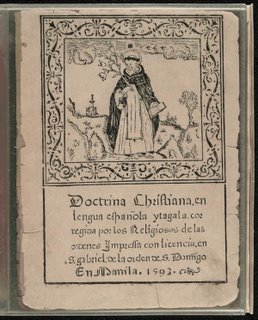
First page of Wuchi t’ien-chu cheng-chiao chen-chuan shih-luTitle page of Doctrina Christiana, en lengua española y tagala

Two books were printed in the Philippines in 1593, but it is unclear which one was printed first. Only one copy of each book is known to exist. The Doctrina Christiana, en lengua española y tagala (aka Tagalog Doctrina) may be found at the Library of Congress (LC) in Washington, DC, while the Wuchi t’ien-chu cheng-chiao chen-chuan shih-lu (aka Shih-lu) is at the Biblioteca Nacional in Madrid.

If you'd like to examine the books but can't afford to travel to the United States or Spain, the Tagalog Doctrina has an excellent digital copy, and facsimiles—entitled Doctrina Christiana: The first book printed in the Philippines, Manila, 1593, one published by LC (1947; available online via Project Gutenberg) and another by the National Historical Commission (1973)—are probably available at major libraries in the Philippines. Unfortunately, there is no online version of the Shih-lu, but it's possible that your library has a copy of Pien cheng-chiao chen-ch’uan shih-lu, which was published in 1986.

It must be noted that the 1947 facsimile of the Tagalog Doctrina was published before any other books were found, and so perhaps its subtitle may be excused. But the 1973 facsimile is more problematic. Its foreword clearly indicates that two books were printed in 1593, but whoever decided on the subtitle must not have read the foreword. The Shih-lu facsimile's subtitle is more circumspect: "First book printed in the Philippines?"

Just in case you're getting confused—maybe you were taught that there was only one book or three books printed in the Philippines in 1593—below are quotations from some websites, followed by my comments, which I hope will help to clear up the (mis)interpretations that have accumulated over the years.

Txtmania.com

It is believed that the first book in the country was Doctrina Christiana en letra y lengua China, which was printed in 1593 by Juan de Vera, a Filipino-Chinese.
My comment
This book, aka Chinese Doctrina, surfaced in 1948 after the Tagalog Doctrina and before the Shih-lu. Some have asserted that the Chinese Doctrina was printed before 1593, but the evidence that it was printed early in the 17th century is stronger. Also, the Chinese Doctrina's title page indicates that the book's printer was Keng Yong, which may or may not have been the Chinese name of Juan de Vera.
Filipiniana.net
This first book printed in the Philippines... contains the basic elements of the Christian religion based on the catechism of Saint Robert Bellarmine, a Jesuit theologian and Cardinal of the Roman Catholic Church, who was canonized by Pope Pius XI in 1930... Originally in Chinese, a new version was released just a few months later using the ancient Tagalog script known as baybayin.
My comment
Bellarmine’s Doctrina Christiana appeared in 1597, and so could not possibly have been the basis for the Tagalog Doctrina or any book printed in 1593. If the Tagalog Doctrina was "Originally in Chinese" and "a new version was released just a few months later," this means that the Tagalog Doctrina was printed after the Chinese "version," and so, must not have been "first." In addition, the use of the word "version" implies that the content of the Tagalog Doctrina and the other book were similar, if not the same. But the Shih-lu is, in fact, completely different from the the Tagalog Doctrina in terms of content.
National Commission for Culture and the Arts
...the first books were called the Doctrina Christiana en Lengua Espanola y Tagala (Tagalog edition) and the Doctrina Christian [sic] en letra y lengua china (Chinese edition) by Keng Yong... Scholars have since accepted the third doctrina dubbed the Tratado [aka Shih-lu] to be the Chinese doctrina referred to in the Dasmarinas letter of 1593. Scholars have agreed that the Keng Yong Doctrina must have been printed around 1590...
My comment
This NCCA article is an example of some of the confusing narratives that have been written about the first Philippine imprints. If, for instance, scholars have accepted that the Shih-lu was printed in 1593, why does this writer refer to the Tagalog Doctrina and the Chinese Doctrina as the first books printed in the Philippines? Is it possible that she thinks the Shih-lu and the Chinese Doctrina are one and the same? If so, is the "Keng Yong Doctrina" different from the Chinese Doctrina? Finally, if the Keng Yong Doctrina was printed in 1590, shouldn't that make it the first book printed in the Philippines?
If you have read this far and gotten even more confused by my comments, just go back to the first two paragraphs of this post and pretend that you did not read the rest =)

Read More...

Ambeth Ocampo on Doctrina Christiana

Another interesting link recommended by a blogger brings you to the US Library of Congress and allows you to flip through a digital copy of the first book printed in the Philippines, the “Doctrina Cristiana” of 1593.

—"Time capsules" by Ambeth Ocampo (Philippine Daily Inquirer, 1 December 2006)
If you happened to read Ambeth Ocampo's column last week and wondered how you could find the "digital copy" of the Doctrina Cristiana he was referring to, he was actually referring to my post entitled "FO: Doctrina Christiana."

Did you try looking for the digital book using a search engine? Well, as I wrote in that post, "Not everything shows up on search engines" =)

And even if you tried looking for it using the Library of Congress catalog, unless you knew exactly how to use the catalog and what you were looking for, it would still be difficult to find the book. So if you'd like to tell other people how to find it, just tell them to search "filipino librarian doctrina."

Category: Filipiniana Online

Read More...

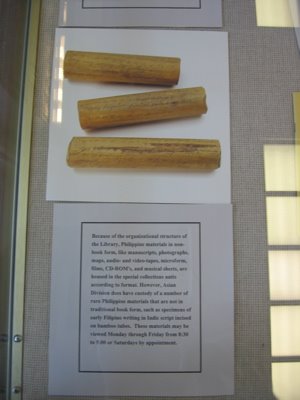
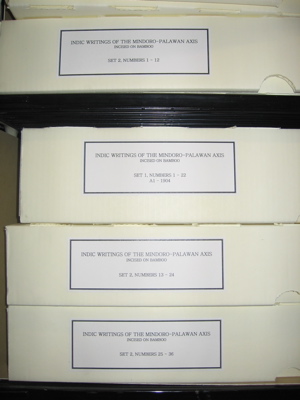
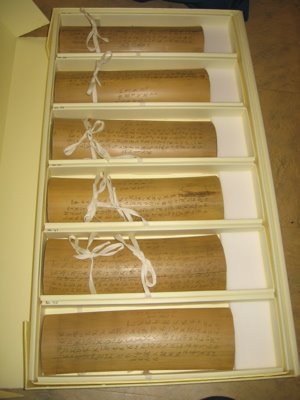
"Books" on Bamboo Tubes

mangyan bamboo texts

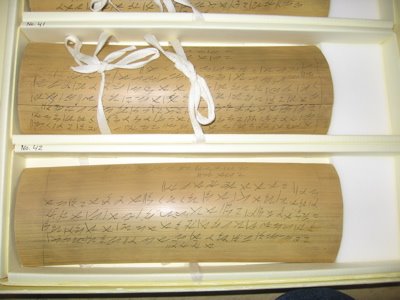
Aside from the Ate Vi issue of Liwayway that I saw at the Asian Reading Room of the Library of Congress, I also found some examples of "early Filipino writing in Indic script incised on bamboo tubes."

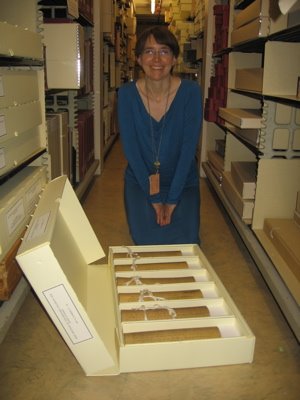
And though I was not able to make an appointment in advance, Kathryn Wellen (see photo below, right) was kind enough to show me the bamboo tubes for real. The tubes, incidentally, are Wellen's grab-and-run items in case of emergency. Yes, these bamboo tubes are the most important in the entire Southeast Asian collection.

mangyan bamboo texts mangyan bamboo texts mangyan bamboo texts kathryn wellen
Click on the photos to see larger versions.

As John Reyes, the Filipino who used to work for the Asian Division, once wrote,
These specimens of Filipino writing in old Indic script were gathered on the island of Mindoro around 1938. This collection of 55 bamboos in prose and 22 in verse provides a glimpse into Mangyan (Hampangan) and Tagbanua society.
mangyan bamboo texts

Wellen also took me to the Rare Book and Special Collections Reading Room, where she got the librarian on-duty to show me what is probably the only existing copy of the Doctrina Christiana. I wasn't allowed to touch the book or take photos, but... wow!

Unlike the Doctrina Christiana, the bamboo tubes shown above are not available online. And so, I suppose this post will have to suffice until the Library of Congress decides to "digitize" the bamboo tubes.


Category: The Philippines

Read More...

FO: Doctrina Christiana, 1593

See also "The First Books Printed in the Philippines."

Doctrina Christiana
Not everything shows up on search engines. If you would like to read Doctrina Christiana, one of the two books which are said to have been the first to be printed in the Philippines, Google and Yahoo! will most likely lead you to Project Gutenberg's text-only version. But because search engines don't normally show results from the "invisible" or "deep" web, you probably won't find the "digital book" version. And yes, that means you can read the entire book online almost as if you were turning the pages of this very rare book printed in 1593.

Notes:
  1. The site indicates that there are 91 pages, but the text appears only on pages 5 to 80.
  2. If you would like to know how the book was preserved, check out the eighth item in "Books: Preserving the the Nation's Heritage at the Library of Congress."

Category: Filipiniana Online

Read More...

The State of Filipiniana

In "Filipiniana Online," I quoted from an article published in Sanghaya 2001 (Manila: National Commission for Culture and the Arts, 2001). I would have wanted to reprint the whole article then, but I was unable to get in touch with either the authors or the publisher. Well, I was finally able to get the authors' permission, so if you'd like to know more about the state of Filipiniana as of 2001, please read on.

The State-of-the-Art of Filipiniana Collections in the Philippines
by Salvacion M. Arlante and Rodolfo Y. Tarlit


From November 24 to 26, 1992, the Philippine Librarians Association, Inc. (PLAI), held a national convention which focused on the Filipiniana collections in the country. The convention was in line with the national efforts to make librarians aware, fully understand and appreciate the nature and importance of building and developing special Filipiniana collections. The success of the convention may be gauged from the number of queries received concerning Filipiniana materials by the convention organizers. There can be no doubt that librarians became aware of the worth of Filipiniana materials for scholars and researchers.

In July 2000, a meeting was arranged to respond to such queries between Dr. Serafin D. Quiason, consultant, Eugenio Lopez Foundation, Inc., and Mrs. Salvacion M. Arlante, University Librarian, University of the Philippines Diliman. Soon after, Carmelo Lopez, director of Library, Ateneo de Manila University; Dr. Irene D. Amores, director of libraries, Polytechnic University of the Philippines and head, Committee on Libraries and Information Services, National Commission for Culture and the Arts; and Prof. Rosa M. Vallejo, former Dean, UP Institute of Library Science, joined Dr. Quiason and Mrs. Arlante in conceptualizing a seminar on the State-of-the-Art of Filipiniana Collections in the Philippines.

The seminar was held at the Eugenio Lopez Center in Antipolo City on November 29, 2000. It was meant to follow up the PLAI national convention in 1992 and also to address these following objectives: to survey the state of Filipiniana materials in the major libraries and institutions in the Philippines; to consider new methods of developing Filipiniana collections; to focus on the practical and theoretical aspects of conservation; to explore the computerization of Filipiniana holdings; and to address problems and issues related to inter-library cooperation.

The seminar drew more than 100 participants from all over the country, including two Spanish nationals and Dr. Jaime C. Laya, NCCA chairman, Dr. Pablo Trillana III, chairman of the National Historical Institute, and Dr. Benito F. Legarda. According to Dr. Quiason, the papers presented “are precious stones, strung together to form a tapestry showing the nature and extent of Filipiniana collections” in the following university libraries and institutions: Ateneo de Manila University, Quezon City; Central Philippine University, Iloilo City; De La Salle University, Manila; Filipinas Heritage Library, Makati City; Lopez Memorial Museum, Pasig City; Mindanao State University, Marawi City; The National Library, Manila; Silliman University, Dumaguete City; University of San Carlos, Cebu City; University of Santo Tomas, Manila; University of the Philippines Diliman, Quezon City; and Xavier University, Cagayan de Oro City.

The seminar produced a remarkable amount of information on the state-of-the-art of Filipiniana collections in the country, resulting in “new lines of thought and programs.” The participants were made “aware of the issues and concerns relating to Filipiniana collections throughout the country.” Most important of all, the participants unanimously agreed to form the core group that would, as stated in Dr. Quiason’s closing remarks, “reaffirm the burden of our responsibility and commitment to collect, organize and serve the Filipiniana materials to our scholarly clientele at the most expeditious way and preserve them in whatever form for posterity.”

Nature and scope of Filipiniana materials

According to Vallejo, the term “Filipiniana” is derived from two root words: Filipinas for the country and “ana” or “aniana” for “collected items of information, especially anecdotal or bibliographical”, e.g., Americana, UPiana, Rizaliana, La Salliana.

Two views emerged as to the scope of Filipiniana: one comprehensive and the other specific. The majority of the participants acquire Filipiniana according to any one or all of the following criteria:

The printed books in the Philippines, irrespective of subject matter, because all of them are indispensable to the complete study of typography in the Archipelago (See Wenceslao Retana, Aparato Bibliographico dela Historia General de Filipinas, Madrid: M. Minuesa de los Rios, 1906);

Those that deal with the Philippines in whatever language they may be written and place were they may have been printed, because they are more or less needed for the study of said country;

Those published by Filipinos, about any topic, regardless of the publication’s imprint, because they are very helpful in providing us information on the extent of the intellectual faculties of those born over there, their industry, their likings, inclination, etc;

Those written in the Philippine languages regardless of the subject of the author, and the place of publication (See Luis Montilla, “A Brief Survey of the Bibliographical Accomplishments of the Past: A Plan for a New Philippine National Bibliography,” 1940);

All those printed in the Philippines prior to American rule, irrespective of authorship and subject matter;

Works containing distinct chapters or passages on the Philippines useful for local historical investigation and research; and

Books and non-book materials about the Philippines, produced in or outside the Philippines, by Filipinos or non-Filipinos, in any of the Philippine languages, or in a foreign language (See Isagani Medina, “Collection Building: Filipiniana.” In Developing Special Library Collections, Filipiniana: Proceedings, November 24-26, Camelot Hotel, Quezon City, Manila: Philippine Librarians Association, 1992).

Some participants follow strictly Medina’s definition of Filipiniana. One library, the De La Salle University Library, has a unique definition of Filipiniana. As reported by Ms. Fe Verzosa, the scope of Filipiniana at the DLSU is as follows: all book publications about the Philippines, its peoples and culture, regardless of author, imprint and language; generally works written by Filipinos except works by De La Salle University faculty, administrators, and students/alumni, theses and dissertation, faculty or university publications, La Salliana materials, and works and other original research studies on universally accepted knowledge, such as chemistry, mathematics, physics, biology, etc.; books written in Philippine languages; Philippine government publications and yearbooks, except publication by Philippine corporate bodies the subject matter of which does not have anything to do with the Philippines; publications containing substantial portions or chapters regarding the Philippines (publications with only a small portion or a chapter on the Philippines are not considered Filipiniana, but analytics are provided for that portion or chapter); and works dealing with the application of scientific thought and methodology to Philippine and local needs and circumstances.

In a survey conducted by Vallejo of 14 academic libraries and the National Library, nine libraries consider Filipiniana based on the criteria of subject, imprint, author, language, etc.; five libraries do not consider imprint as a criterion, and another two libraries do not consider author/writer as criterion for inclusion.

Because of the perceived dearth of Filipiniana materials, which are scattered in diverse locations, it was agreed that librarians, historians, libraries and institutions should not confine, limit or restrict their collection development program of Filipiniana to any one of these definitions. Rather, in building their Filipiniana collections they should consolidate/integrate the salient points from these definitions for a comprehensive Filipiniana collection in keeping with their respective institutional mission and objectives.

The Filipiniana collections of the 12 university libraries and institutions that participated in the seminar come in various forms. Aside from books, monographs and periodicals, these libraries also collect, maintain and make available a substantial number of special collections in the form of government documents and publications, theses and dissertations, cartographic materials, pamphlets, music, sound recordings, motion pictures and video recordings, graphic materials, three-dimensional artifacts and realia, microforms, and the very latest electronic resources such as CD-ROMs and other online databases both textual, visual, and bibliographic. Most guarded collections are rare books and archival papers of individuals as well as corporate entities.

The combined Filipiniana book collection of the 12 institutions is approximately 350,000 volumes with the UP Diliman contributing 25 percent. The collection covers a broad spectrum of topics, with the social sciences and the humanities extensively represented, particularly culture and history, politics and government, social conditions and art, languages and literature. Unbelievably, books on the natural and applied sciences constitute, perhaps, a measly 10 percent or less of the total book collection.

The libraries are very proud of their respective rare book collections. These are their most treasured Filipiniana holdings. The Filipinas Heritage Library holds around 2,000 rare books and manuscripts, the oldest of which is the Proceso de la Demanda de Nulidad de Matrimonio, published in 1647 on characters no longer used today. Of the 215 Philippine imprints published from 1597 to 1800 in Manila and other key towns, the Eugenio Lopez Library has 12 rare titles; 69 rare items for the 18th century, and 777 titles for the 19th century. A rare gem is the first edition of Belarmino’s opus Doctrina Cristiana (Manila, 1620) translated into Ilocano (Libro a Naisuratan Amin ti Bagas...) by Father F. Lopez and printed by Antonio Damba, a Pampangueño, and Miguel Saixo, a Japanese.

Another jewel is Pedro Chirino’s Relacion de las Islas Filipinas (Rome, 1604). The Eugenio Lopez Library also holds various early and rare works on the different languages of the Philippines. The National Library boasts of having in its Filipiniana collections the first known book written about the Philippines, Maximilianus Transylvanus’ De Moluccis Insulis, a very tiny, 30-page book measuring 7 1/2 x 15 centimeters and 1/2 centimeter thick. It was written in Valladolid, Spain, in October 1522. It is about Magellan’s voyage to the East based on testimonies of the few survivors of the Magellan’s expedition. Also priceless are Antonio de Morga’s Sucesos de las Islas Filipinas, which was printed in Mexico in 1607, Antonio Pigafetta’s First Voyage Around the World, and the facsimile copy of the Doctrina Christiana (1593), an incunabulum by the Filipino printer Tomas Pinpin, and one of the extant eight incunabula in the collection of The National Library.

Most libraries that participated in the seminar have also the facsimile edition of the original Doctrina. Books and documents comprising the Filipiniana Rare Book Collection of the UP Library number 3,441 titles with imprint dates ranging from the 16th century to the early 20th centuries. Most of the materials are on history (57 percent) and social sciences (30 percent). The rest are on general works, philosophy and religion (13 percent) and science, agriculture, technology and bibliography (6 percent). Most of these have been microfilmed.

Special collections are rare, unique, out of print, unpublished ephemera or fugitive materials as well as non-textual materials. These collections supplement or offer information on various subjects not readily available in books and periodicals. Most are donations from individuals as well as corporate entities. Many of these collections contain primary sources such as correspondence, reports, diaries, etc.

The collections of Amado V. Hernandez, Gabriel Bernardo, Sixto de la Costa, Frank H. Golay, Arturo B. Rotor, Trinidad H. Pardo de Tavera, the American Historical Collection and the Women’s Writings Collection are in the Ateneo de Manila University.

The collections of Lopez-Bantug, Ambeth Ocampo, Literary History of the Philippines Collection of regional literature, International Corpus of English-Philippine Component Project Collection, Bitanga-Valero are in the De La Salle University.

The Maisie Van Vactor Collection of Islamic and Philippine Muslim Materials is in the Gowing Memorial Research Center, Dansalan College Foundation, Marawi City.

The Rizaliana Manuscripts, Philippine Insurgent Records, Philippine Presidential Papers, the Tabacalera Collection and the collections of Lope K. Santos, Julian Cruz Balmaseda, Raymundo Banas, Cirilo Honorio, Anita Garcia, Amado V. Hernandez and Atang de la Rama, Camilo Osias, Encarnacion Alzona, Leonora Orosa Goquingco, Benigno Zamora, and Paul Verzosa are in the National Library. The World War II Records/Papers of Negros Oriental are in Silliman University.

The historical papers of Carlos V. Ronquillo, Teodoro A. Agoncillo, Philippine Insurgent Records, Luther Parker, Japanese Occupation Papers, Jose Llanes (Guerilla Papers), Panay Guerilla Movement Papers, Delfin Jaranilla, People’s Court Papers, the Communist Party of the Philippines Papers, the Literary Collections in various Philippine languages (Faustino Aguilar, Florentino Collantes, Alberto S. Florentino, Hermogenes E. Ilagan, Julian Cruz Balmaseda, Tomas E. Remigio, Bikol Collection, Sugbuanon Collection, Hiligaynon Collection, Ilokano Collection, Pampango Collection), Philippine Radical Papers, Local History File, H.H. Bartlett Collection, Harry Whitfield Harnish Collection, the UP Presidential Papers, and other papers of UP’s outstanding alumni, faculty and administrators are in the University of the Philippines.

Other special collections are separately maintained because these require special handling and storage. Such collections include theses and dissertations, maps, vertical files, CD-ROMs, university publications, faculty files, audio-visual materials, music, pictures, stamps, biography files, posters, speech files, and art works.

Of special interest is Filipinas Heritage Library’s Photo Archive, a subset of the library’s photo archives which is a treasure trove of images of Philippine life, history and culture from the fifteenth century to the early 1970s. The black and white photographs numbering around 9,747 scanned images are already available online. The beta site can be viewed at this URL address (www.fillip.or.ph/retrato). The database includes engravings, lithographs, drawings, and other modes of visual representations as well as original photos gathered and annotated by the Ayala Museum Research Department over several years.

Issues and concerns

One of the objectives of the seminar was to find out the problems of librarians concerning their Filipiniana collections. The papers presented and the ensuing discussions during the open forum yielded these observations and concerns:

Collection Development. There is an apparent difficulty in the selection and acquisition of Filipiniana materials due to lack of reviewing media and systematic listing on published Filipiniana materials. There is also a dearth of authors and publishers on Filipiniana materials. Another problem is the limited printing of Filipiniana publications due to a limited market and the apathy of Filipiniana users.

Organization. Filipino librarians use the Anglo-American Cataloging Rules, the Library of Congress Subject Headings, the Library of Congress Classification System and the Dewey Decimal Classification System to organize their Filipiniana book collections. However, the librarians’ concern was that these tools are inadequate, aside from the fact that some are very difficult to use or understand. Some do not provide provisions for local applications. Difficulty in cataloging and classification also arise out of the uncommon characteristics of many Filipiniana publications, e.g. information on the place of publication, name of publisher, and date of publication is not always available.

Reference Services. The librarians agreed that there is a lack of Filipiniana materials that would easily answer bibliographical, biographical, historical, geographical and facts-and-figures questions posed by library users. The participants also deplored the limited indexing services for Filipiniana materials. Most participants, however, know of the services provided by the UP, Ateneo, and the Mendiola Consortium.

Usage and Access. Policies on access to Filipiniana materials, particularly rare materials and special collections, are definitely wanting. Users may not be able to access such materials due to some restrictions imposed by donors of special collections or due to the deteriorating physical conditions of rare materials. Some librarians are in a dilemma whether or not to allow duplication of Filipiniana materials. The reason is that photocopying or other forms of duplication expose the materials to harm that could permanently damage their original physical conditions.

Preservation. Most librarians worry about what to do about the deteriorating and decaying physical conditions of their Filipiniana materials. They are worried that in due time such materials will be lost forever. They expressed the need to have trained personnel to undertake the preservation of their Filipiniana collections.

Copyright. The Filipinas Heritage Library worries about questions on copyright ownership of digitized materials and how to protect such resources that are freely and easily downloadable. Participants would like to know if printing of images from websites constitutes copyright infringement.

Use of Information Technology. It was observed that most computerized Filipiniana databases are bibliographic in nature. There is a clamor for more text-based databases. Another problem concerns some media which become inoperable and their contents inaccessible after sometime. Moreover, some digitized information may be lost when converted into other media, e.g., print, microfoms, etc.

Conclusion

One of the unexpected results of the seminar was the formation of a core group made up of the seminar participants themselves to look into the many problems that concern the acquisition, organization, servicing, and preservation of Filipiniana materials. Many participants consider this development as a big step towards real inter-library cooperation and networking among libraries and institutions in the country.

No individual or institution was named, but it was suggested and unanimously adapted that a reviewing medium to aid librarians in the selection and acquisition of Filipiniana materials be set up.

Computerization of bibliographic information of Filipiniana holdings throughout the country can start with the ARALIN database as suggested by Corazon M. Nera who started the development of such a database. ARALIN is a computerized bibliographic database of Filipiniana titles available in many university, college and school libraries in the country. From there, the core group could work towards shared creation and global access to one national Filipiniana database.


About the Authors

SALVACION M. ARLANTE received her M.A. in Library Science from the University of the Philippines. She is the University Librarian and head of the University Archives and Records Center of the UP Main Library in Diliman, Quezon City.

RODOLFO Y. TARLIT is the head librarian of the Filipiniana section of the UP Main Library. A senior lecturer at the UP Institute of Library Science, he has also served as president of the Philippine Librarians Association.

Category: Filipiniana Online

Read More...

Related Posts Plugin for WordPress, Blogger...