Quick Links: Talumpati | Licensed Librarians | Filipiniana Online | Stereotypes | Leadership | The Philippines

Showing posts with label Filipiniana Online. Show all posts

FO: Rizaliana Online


I was invited to talk about "Rizaliana Online" at the Philippine Historical Association's National Conference on Teaching the Rizal Course. I don't have time to share what I said, but I did promise to share the links to the sites I mentioned.

Disclaimer: The inclusion of a website in the list below does not mean that I fully endorse the site and that there are no problems with its content or usability =)

Possible Sources for the Rizal Course

TV5 search: "jose rizal"
e.g., History | #pogiproblems ni Dr. Jose P. Rizal Part (1/3)

ABS-CBN News search: "jose rizal"
e.g., ABS-CBN's Bayani - Jose Rizal: "Sa Aking Mga Kababata"

GMA News and Public Affairs search: "jose rizal"
e.g., Pluma: Si Rizal, ang dakilang manunulat

JoseRizal.ph
Rizal-Blumentritt Friendship
Virtual Travels of Rizal

HathiTrust
e.g., Data papers: International Congress on Rizal (1961)

National Library of the Philippines: Digital Collections
Rizaliana: Manuscripts, Books and other Monographs
e.g., Noli Me Tangere (1887)

The United States and its Territories
e.g., El Filibusterismo (1900)

José Rizal, obras, en lenguas originales
e.g., Noli Me Tangere (1961) (pdf)

Internet Archive
e.g., Sucesos de las islas Filipinas (Morga, 1609),
Sucesos de las islas Filipinas (Rizal, 1890)

Biblioteca Digital Hispanica
e.g., Sucesos de las Islas Filipinas (Retana, 1909)

Read More...

Top 5 Free Sources for Filipiniana Online (Books)


"Online research" is supposed to be what lazy students do. Scholars, meanwhile, are expected to travel to different libraries, archives, and museums to consult documents, photographs, and books. This, however, is not necessarily true anymore because more and more resources are becoming available online. In some cases, surfing the web is not only less expensive, but also more productive because researchers can examine texts more closely and are not limited by policies regarding physical access to the materials. Plus, if your university library is closed, but you just need to check one small detail, online research is the most convenient alternative.

The 5 websites enumerated below in alphabetical order are, in my opinion, the best free sources for Filipiniana online at this time. They each have their own strengths and weaknesses, and you'll have to search them all if you want to make sure that a particular title is really not available on any of them, but what's really good about these sites, is that unlike others that only reproduce the texts, you can see for yourself how the text originally appeared on the page, you can cite specific page numbers as if you had the book in front of you, and you can even download the entire book or certain pages (with one exception, which is indicated below).

If you have any suggestions, please send a message or leave a comment via Facebook.


Biblioteca Digital Hispanica (Hispanic Digital Library)
This site is, of course, in Spanish, so if you can't read Spanish, make sure you click on "Welcome" (other languages aside from English are also available) at the top-right corner of the page. Once you're looking at the book, you can download the entire book by clicking on the disk icon on the upper-left corner of the page, next to the book's title. Some of the books available are:
La música popular de Filipinas (Walls, 1892)
Archivo del bibliófilo filipino (Retana, 5 vols., 1895-1905)
Mga tala ng aking buhay at mga ulat ng Katipunan (de Jesus, 1932)

HathiTrust Digital Library
This website was very helpful when I was doing my PhD because it was the only one then that had such a huge collection of downloadable books on the Philippines. Note, however, that many titles are not accessible to all. You'll have to select "Full view only" to limit your search to the ones that are freely available. Also, if you see that a book is downloadable today, don't assume that it will be downloadable tomorrow. So it's probably best if you download a title when you see it. Some of the books I've downloaded in the past are:
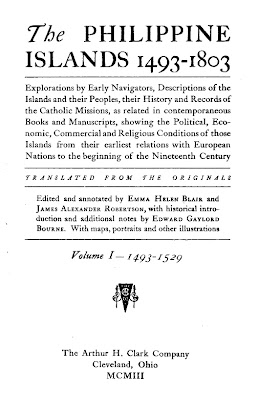
The Philippine Islands (Blair and Robertson, 55 vols., 1903-1909)
A history of the Philippines (Barrows, 1905)
A short history of the Philippines (Jernegan, 1905)

Internet Archive
This site doesn't only host the Wayback Machine, it also provides access to a lot of books digitized by different libraries around the world. What's good about it is that you can actually turn the pages by clicking on the left or right pages. Some of the books available are:
Arte de la lengua tagala (Totanes, 1745)
The medicinal plants of the Philippines (Pardo de Tavera, 1901)
Census of the Philippine Islands (1918)
Vols. I | II | III | IV.1 | IV.2 | Appendix to Vol. I

UC Press E-Books Collection, 1982-2004
This site is the only one that provides access to books that are still copyrighted. Not all books, however, are accessible, so you'll have to choose "public access books" to limit your search to the ones that are freely available. Note that books or pages cannot be downloaded, but page numbers are indicated at the end of every "page." Some of the books available are:
Unequal alliance: the World Bank, the International Monetary Fund, and the Philippines (Broad, 1988)
Sugar and the origins of modern Philippine society
(Larkin, 1993)
Muslim rulers and rebels: everyday politics and armed separatism in the southern Philippines (McKenna, 1998)

The United States and its Territories: 1870-1925 (USIT)
I've called this site "the best and largest online collection of Filipiniana materials available for free" before, and in some ways, it is still the best because while its name suggests a larger geographic reach, it is the only one on this list that is almost exclusively made up of Filipiniana. And while most, if not all, its titles also appear in Hathitrust, some titles can only be downloaded on USIT. One big difficulty with this site, however, is that you cannot download entire books. You can only download one page at a time. Some of the books available are:
La imprenta en Filipinas: adiciones y observaciones á la Imprenta en Manila de D. J. T. Medina (Retana, 1899)
FO: Reports of the Governors General (1900-1915)
A review of the identifications of the species described in Blanco's Flora de Filipinas (Merrill, 1905)

Other sites you can check are: Biblioteca Virtual Miguel de Cervantes, Digital Public Library of America, Google Books, and Project Gutenberg.

Read More...

FO: Rare Books


In "Old-fashioned books" (Philippine Daily Inquirer, 4 March 2015), Ambeth Ocampo states that
Today, many of the rare books on the Philippines are now available online. Some are copied out by Project Gutenberg, while others have been scanned and are downloadable free from the Biblioteca Nacional de España and other websites. The National Library of the Philippines has many important Philippine materials available online for free, while the Filipinas Heritage Library has its digitized books available online for a minimal fee, the Lopez Museum and Library has its major holdings scanned and can be consulted in-house.
It is difficult, however, for those reading the column—whether in print or online—to appreciate his point because there are no links that lead to the rare books to which he refers. Even if readers are able to Google the sites he mentions, it is not necessarily easy to find the books on the Philippines that have been digitized. So here's a little public service: the same paragraph with clickable links (and some instructions) that will make it easier to find rare books on the Philippines.
Today, many of the rare books on the Philippines are now available online. Some are copied out by Project Gutenberg, while others have been scanned and are downloadable free from the Biblioteca Nacional de España [use "Filipinas" as the search term] and other websites. The National Library of the Philippines has many important Philippine materials available online for free, while the Filipinas Heritage Library has its digitized books available online for a minimal fee, the Lopez Museum and Library has its major holdings scanned and can be consulted in-house. [Unfortunately, the Lopez website does not reveal much about its Library's holdings.]
If you would like to see other sites that have been featured on this blog, as well as some of the more important rare books that may be accessed online, see the following:

Read More...

What was the first book printed in the Philippines?


Click on the photos above to learn more about each book
and/or download their digital versions.


Earlier this week, I received a text message asking if the essay mentioned by Ambeth Ocampo in his latest column was posted on my blog. Since I had no idea that any publication of mine had been cited in a newspaper recently, I checked out the column. And there it was at the very end of a discussion on "First book(s)" (Philippine Daily Inquirer, 16 January 2013): "For a more recent take on the old issue see Vernon Totanes’ 2009 essay 'What was the first book printed in the Philippines?'"

Since I've never actually posted a link to the journal article on my blog, I thought I'd share it now, along with the abstract, in case someone wants to read it. Click on the title to download the pdf =)

Note, however, that the title is misleading because the article is essentially an introduction to the discipline of book history, and asserts that the two books printed in the Philippines in 1593 are significant in ways that have yet to be fully appreciated.


"What was the first book printed in the Philippines?"
Vernon R. Totanes
Journal of Philippine Librarianship 28:1 (2008), 21-31.

This paper will show that the importance of the imprints lies in the fact that they effectively communicate the idea that printing in the Philippines—and Philippine history—is inextricably linked with the non-Filipino. The first books printed in the Philippines, though not strictly "Filipino," are a physical reminder of the plurality of the nature and culture of the Filipino and the Philippines.

Read More...

FO: Shih-lu, 1593


The Biblioteca Nacional de España has digitized the only known copy of the Shih-lu, and—with a little prodding from this blogger—made it freely available online. The entire book may be downloaded here: Shih-lu (pdf). To see its bibliographic record, click here: Shih-lu.

Note that, like most books in Chinese, the Shih-lu may be described by those not from China as having been printed back-to-front. This means, concretely, that the Shih-lu's first page is not found at the beginning of the file, but toward the end, specifically page 155. A brief history of this book follows below.

On 20 June 1593, the governor of las Islas Filipinas wrote the following to the king of Spain:

Señor:—En nombre de V. Mag, e dado licencia para que por esta vez, por la gran neçesidad que avia, se ymprimiessen las Doctrinas Xpianas que con esta van, la vna en lengua tagala, que es la natural y mejor destas yslas, y la otra en la china...

[Sire, in the name of Your Majesty, I have for this once, because of the existing great need, granted a license for the printing of the Doctrinas Christianas, herewith enclosed—one in the Tagalog language, which is the native and best of these islands, and the other in Chinese…]
Much more has been written since then about the first two books printed in the Philippines in 1593, but most either refer to just one book—usually the Doctrina Christiana in Spanish, romanized Tagalog and baybayin—or, contrary to the evidence in the governor's letter, even three! Many of the authors apparently had not read Piet van der Loon's "The Manila incunabula and early Hokkien studies" (Asia Major [1966] 12, 1-43), which clearly lays out his reasons for concluding that the third "first book" was actually printed later, perhaps in 1605.

But one of the most problematic assumptions of many who write about the first Philippine imprints, at least to me, is that the Shih-lu was merely a translation of the Spanish-Tagalog Doctrina Christiana. Now that the Shih-lu is available online, and its contents can easily be compared and contrasted with the Doctrina Christiana, even someone with no knowledge of Chinese, Spanish or Tagalog will see right away that the two are very different books.

Special thanks to Lourdes Alonso and Cristina Guillen of the Biblioteca Nacional de España for their effort in making the Shih-lu freely available online, and to Francis Navarro for his assistance in Madrid.

Read More...

FO: Blair and Robertson

Blair and RobertsonIts official title is The Philippine Islands, 1493-1898, but this 55-volume collection—primarily English translations of books and documents originally written in Spanish—is more popularly known as "Blair and Robertson," after its editors. The entire collection is freely available online at The United States and its Territories: 1870-1925: The Age of Imperialism (USIT), which I have previously dubbed "the best and largest online collection of Filipiniana materials available for free."

To see all the volumes on USIT, you can click here: "Blair and Robertson." But the USIT list can get confusing because, as I noted before in relation to Philippine Journal of Science, "volume 1 is followed by volume 10, 11, 12, etc.; 2 by 20, 21, 22, etc.; 3 by 30, 31, 32, etc." I recommend that you check out Primary Sources in Philippine History, which reproduces the tables of contents of all 55 volumes, and provides links to the different books and documents in each volume on USIT. Here are my notes from a previous post on how to maximize USIT's interface:

The interface isn't the easiest to use, but make sure you explore the site's toolbar at the top. Changing "Format" allows users to view a... page as an image, as text or download it as a pdf file. "Page no." may be used to go directly to "Title Page" or "Table of Contents," which may in turn be used to jump to a specific page... And then, of course, "Page size" and "Search this text" are self-explanatory =)

I've linked to "Blair and Robertson" before in "Filipiniana Online: Links Shared at Rizal Library International Conference," but very few people seem to have seen it. Thanks to Maita's "reference question," I decided that it was time to give "Blair and Robertson" their own post.

Read More...

FO: The Original Spanish Edition
of Jose Rizal's Noli Me Tangere

Rizal's Noli Me Tangere (Original Spanish Version)

When I posted "FO: Books in Spanish," I linked to a reprint of Noli Me Tangere in Spanish, but it was not the original edition printed in Berlin. Thanks to John Nery, I am now able to link to the original 1887 Spanish edition of Noli Me Tangere by Jose Rizal on Scribd, which may also be downloaded as a pdf file.

Incidentally, a new English translation of Noli Me Tangere is now available as part of the Penguin Classics series. Hear Harold Augenbraum, the translator, explain his involvement with Rizal's book in an interview by Elda Rotor in a podcast on "José Rizal and the Novel That Sparked the Philippine Revolution." Unlike the original Spanish edition above, which is freely available, the Noli's new English edition and Augenbraum's forthcoming translation of El Filibusterismo (the sequel to the Noli) are available in print and eBook editions for a fee.

Is Augenbraum's translation of the Noli better than previous ones? See what Nery has to say in "Erasing Ateneo" (Philippine Daily Inquirer, 16 June 2009).

Read More...

FO: Books in Spanish

This post is for anyone who has ever had difficulty finding the original Spanish texts of English translations of books about the Philippines and/or by Filipinos.

The books listed below are from Biblioteca Virtual Miguel de Cervantes, Biblioteca Digital Hispanica, The United States and its Territories, Project Gutenberg and Google Books. There are, of course, other books about the Philippines and/or by Filipinos on these sites. Note, however, that some of the sites are easier to use than others. And if you need help searching the sites, Google Translate can help translate Spanish words, phrases, and even entire pages into English, Tagalog, or thirty-eight other languages.

Aduarte, Diego
Historia de la Provincia del Sancto Rosario de la Orden de Predicadores en Philippinas, Iapon y China

Chirino, Pedro
Relacion de las islas Filipinas

Mas, Sinibaldo de
Informe sobre el estado de las Islas Filipinas en 1842

Morga, Antonio de
Sucesos de las Islas Filipinas (Retana, 1909)

Pardo de Tavera, Trinidad H.
Contribucion Para El Estudio de los Antiguos Alfabetos Filipinos
El sanscrito en la lengua tagalog

Retana, Wenceslao E.
La imprenta en Filipinas: adiciones y observaciones á la Imprenta en Manila de D. J. T. Medina

Rizal, José
Noli me tángere
El Filibusterismo

Read More...

FO: Philippine Journal of Science (1906-1949)

In 1908-1909, the first systematic environmental surveys of the Philippines were made upon direct orders from President Teddy Roosevelt... American botanists inventoried our plant diversity. The records of their works are in the Philippine Journal of Science. Unfortunately you will have to travel to the USA to get access to a complete set of the tomes. I haven’t found a library in the Philippines with a complete set. Blame the Japanese for setting on fire the libraries in 1945.

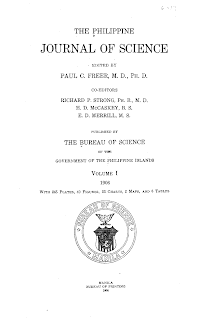
The quote above, from "Beyond 'Earth Hour': Some new things I’ve learned," reminded me that I've been meaning to feature—again—The United States and its Territories: 1870-1925: The Age of Imperialism (USIT), which includes in its collection all the volumes of Philippine Journal of Science (PJS), from the first one ever published in 1906 to 1949.

Philippine Journal of Science 1906 Philippine Journal of Science 1949

I have previously dubbed USIT "the best and largest online collection of Filipiniana materials available for free," although I've also said that, "The site has some usability issues, but hey, if you need something and the library's closed or too far away, USIT is it." In the case of PJS, there will be no need "to travel to the USA," but you'll have to keep the following in mind when trying to locate particular articles:

1. A search on USIT for "philippine journal of science" as title will lead to a list that does not recognize the volume numbers as such. For instance, volume 1 is followed by volume 10, 11, 12, etc.; 2 by 20, 21, 22, etc.; 3 by 30, 31, 32, etc.

2. Some volumes contain all issues published that year, while others seem to be collections of articles that appeared in different sections of PJS for a particular year. This means that some links on the list will lead to webpages that include ALL the issues published in one year, while links to some volumes will be split into, for example, 11-A, 11-B, 11-C and 11-D. Note, however, that 12-B does not appear with 12-A, 12-C and 12-D, but at the end of the list. [Don't ask me why. It must have something to do with the metadata.]

3. Not all the links will lead to actual issues. In some cases, these go to supplements, and one in particular takes the reader to a separate index for the years 1916-1925.

4. The interface isn't the easiest to use, but make sure you explore the site's toolbar at the top. Changing "Format" allows users to view a PJS page as an image, as text or download it as a pdf file. "Page no." may be used to go directly to "Title Page" or "Table of Contents," which may in turn be used to jump to a specific page. This is also very helpful in the case of volumes with multiple issues, and hence, multiple title pages and tables of contents. And then, of course, "Page size" and "Search this text" are self-explanatory =)

Read More...

FO: Philippine Studies, 1953-2006

There's no need to be alarmed. The title of this post refers not to the demise of Philippine Studies (PS), but to the fact that more than five decades of its issues—from the first one published in 1953 to the last issue in 2006 not covered by the embargo mentioned in "FO: Philippine Studies"—are now available online.

In addition, subscribers inside and outside the Philippines now have other options for renewing subscriptions. Full-text searching is not possible, but an index for the 1993-2007 issues (pdf) may be downloaded. Here's hoping the indexes for the older issues will also be made available.

Read More...

FO: Katipunan Documents and Studies

Why was the Katipunan established? What exactly did Katipuneros talk about during their meetings? What were the names of the Katipuneros? All these questions and more are addressed by Katipunan Documents and Studies (KDS), which presents transcriptions of primary documents—in Tagalog and/or the Katipunan's secret code—along with translations, introductions and sources in English (though not consistently for all documents).

It is noted on the site that KDS intends to complement—not compete with—Bonifacio Papers (which I first featured in "FO: Bonifacio Day"), but any comparisons made are not really applicable because KDS presents primary sources, not just what scholars have written about them. KDS is an excellent resource, but photos of the actual documents—not just transcriptions—would have been even better. Then again, the absence of photos could just be an indication of the dearth of evidence about Bonifacio and the Katipunan.

Read More...

Too Busy to Blog... Again


Just in case you've been wondering what happened to this blog, here's the official announcement: This blog has not been updated in the past two weeks and will not be updated for at least another two weeks because its owner is too busy to blog... again.

In the meantime, you may want to check out the following:

The Manila International Book Fair still has a few days to go. Read what's been written about it in newspapers and blogs.

Issues of Philippine Studies from 1975 onward are now freely available online, according to a comment left by its editor on "FO: Philippine Studies." The editor also writes that more issues are forthcoming. Let's hope their example galvanizes other publications into action.

Finally, Filipino "blogger and Internet librarian" Arnold Zafra was interviewed on "24 Oras" recently about "What? A social networking sites for pets?" There's a photo of a TV set with Arnold's face on his blog, but you'll want to watch the video, which Arnold himself doesn't seem to be aware of, on "Social networking sites for pets gaining popularity" =)

Read More...

FO: Philippine Studies

Two weeks after I wrote "FO: Open Access Journals," Philippine Studies (PS) launched its own website. There is, unfortunately, no link yet from either its page on Philippine Journals Online or the Ateneo de Manila University, its parent institution, which would help make this open access journal more visible to scholars and other researchers via search engines.

At this point, Kasarinlan, whose archives go back to its first issue in 1985, is probably the Filipino open access journal with the most issues online. PS, however, should take the "lead" (not that there's any competition going on) once all its issues from 1953, which have already been digitized according to Filomeno Aguilar, Jr., its editor, are uploaded.

Note that there is a two-year embargo, which means that the latest PS issue available in full-text right now is from 2006. (No such embargo seems to exist for Kasarinlan, though its first issue for 2008 is still not online.) I suppose a mechanism will be provided in the future so that subscribers will eventually be able to access the most current issues. Also, like most of the journals mentioned in "FO: Open Access Journals," searching is limited to authors, titles, and abstracts—not the full text of articles—perhaps because the digitized files have not (yet?) been converted into searchable text.

Read More...

Filipiniana Online: CORMOSEA Bulletin 31 (2008)

The latest issue of the CORMOSEA Bulletin (pdf), published by the Committee on Research Materials on Southeast Asia (CORMOSEA), focuses on the Philippines. The articles include

"Documentary Sources on the History of Manila at the Archdiocesan Archives of Manila" by Rev. Fr. Roy M. Rosales (pp. 1-8)
"The Culion Leprosy Museum and Archives" by Ricardo L. Punzalan (pp. 9-18)
"Filipiniana Online" by Vernon R. Totanes (pp. 19-23)
I wrote the last article even before my presentation at the Rizal Library International Conference. Unfortunately, due to the unpredictability of the publication process, the article only came out now—a few months after Microsoft’s Live Search Books, one of the sites I recommended, was shut down.

The first paragraph of my article is reproduced below, so you can see whether you'd like to read the rest of it =)
"Online research" is supposed to be what lazy students do. Scholars, meanwhile, are expected to travel to different libraries, archives and museums to consult documents, photographs and books. This, however, is not necessarily true anymore because more and more resources are becoming available online. In some cases, surfing the web is not only less expensive, but also more productive because researchers can examine texts more closely and are not limited by policies regarding physical access to the materials.

Read More...

FO: Open Access Journals

In "Open Access in the Third World," I predicted that "the traditional journal will eventually have to be abandoned" and that "in a Third World country like the Philippines, it is, in my opinion, the only way to go." Two years later, it seems that the open access movement is finally gaining supporters in the Philippines. True, many of the journals listed below still do not make articles available in full text (so don't disregard my old list of "Journals" just yet), but enough of them have entire articles—not just abstracts or excerpts—available as PDFs that there is reason to believe that the others will follow suit eventually.

It is, I think, rather unfortunate that there seem to be two competing sites, instead of just one, but hey, whatever works! There are also other journals that could at least be listed with one or the other (e.g., Kritike, Philippine Journal of Science), but aren't. Here's hoping their editorial boards will see the wisdom of appearing on the same page as other Filipino journals.

The titles with one asterisk (*) are those that provide the full texts of some articles for free, while those with two asterisks (**) are those that make all articles available for download. If you discover that I missed putting an asterisk(s) after a title, please leave a comment below.


University of the Philippines Diliman Journals Online

Humanities Diliman*
Science Diliman*
Social Science Diliman*
Journal of English Studies and Comparative Literature*
Kasarinlan: Philippine Journal of Third World Studies**
Plaridel
Review of Women's Studies
Philippine Humanities Review
Diliman Review

Philippine Journals Online
Asia-Pacific Social Science Review
Augustinian
Budhi: A Journal of Ideas and Culture**
DLSU Business & Economics Review**
Far Eastern University Communication Journal
Far Eastern University English Language Journal
Ideya**
Journal of Research in Science, Computing and Engineering
Kritika Kultura**
Loyola Schools Review
Malay
Mindanao Law Journal
Philippine Computing Journal**
Philippine Information Technology Journal**
Philippine Journal of Neurology
Philippine Journal of Psychology
Philippine Journal of Public Administration
Philippine Population Review
Philippine Sociological Review
Philippine Studies* (see also "FO: Philippine Studies")
Tambara
The Asia-Pacific Education Researcher
The Philippine Scientist*
University Belt Consortium Research Journal

Read More...

FO: Plays

Thanks to a comment left by Aurelio, I thought of looking for plays that are available online. The works listed below are available in their entirety on The United States and its Territories (USIT), Literatura and Pantas.

The following are some of the plays found on USIT (click on the link to see the rest). These were published between 1904 and 1938 in Tagalog, Cebuano and Hiligaynon. I don't know how good these plays are or how many people watched them, but I think that the fact that a publisher actually thought they were worth printing says something about their quality and/or popularity. I don't think many plays in Philippine languages ever make it into print nowadays, but I'd be very happy if someone can prove me wrong. Leave a comment =)


FLORENTINO BORROMEO
Ang kagawasan

FRUTO CRUZ
Pagcabunyi nang mahal na Sta. Cruz

E. DE LA RAMA
Ang basa-basa

GABRIEL BEATO FRANCISCO
Ang Katipunan

EMILIANO GABUYA
Tirana

ANGEL MAGAHUM
Ang gugma sang maluib

JOSE J. SANCHEZ
Kasingkasing sa babaye

PIO B. SEAN
Talikala

JOSE MARIA RIVERA
Cinematografo

VICENTE SOTTO
Ang dila sa babaye

The Palanca Award-winning one-act plays listed below, in contrast to the USIT plays, are the only ones on Literatura with their full text available online. Excerpts of other plays—including the authors' email addresses—may also be found in Literatura 8, 10, 12 and 13. Please note that permission from the authors must be obtained before any of the plays listed below are performed.

DEAN FRANCIS ALFAR
The Kite of Stars

ALFONSO DACANAY
First Snow of November

GLENN SEVILLA MAS
Her Father’s House

Two more plays are available as PDF fles on Pantas:

WILFRIDO MA. GUERRERO
The Condemned

JOSE RIZAL
Sanggunian ng mga Dios-Diosan

Read More...

FO: TV Ads (1970s-Present)


I've written about TV ads before, but since YouTube wasn't as big then as it is now, and the 20th Philippine Advertising Congress is currently underway, I thought I'd share the "Karen" ad from McDonald's (above) and some links to a few TV ads—courtesy of ADman1909—as a way to get you to take a look at some of the 204 ads he's uploaded so far. You may view all of the TV ads uploaded by ADman1909, who also takes requests, by clicking on the following:

All Videos | Most Viewed | Most Discussed
By the way, some of the ads have poor video or poor audio or both. But if you look at "Related Videos" in the sidebar, you may just find a better version uploaded by someone else.
680 Department Store (Bert Marcelo)
Palmolive: "I Can Feel It" (Alice Dixson)
San Miguel Beer: Sabado Nights (Ina Raymundo)
Purefoods Tender Juicy Hotdog: Goodbye, Carlo
Coke: The Coke Beat

Read More...

FO: Reports of the Governors General (1900-1915)

"Old but timely reports" by Ambeth Ocampo (Philippine Daily Inquirer, 20 October 2007) reminds me that I have not even begun to fulfill my promise to write about the sites to which I linked in "Filipiniana Online: Links Shared at Rizal Library International Conference."

Let me start with the The United States and its Territories: 1870-1925: The Age of Imperialism (USIT), which I have previously dubbed "the best and largest online collection of Filipiniana materials available for free." The name of the site suggests a scope both wider and narrower than what it contains, and is perhaps the reason it is not better known. While some content is related to Cuba and Puerto Rico, the majority of the texts are devoted to the Philippines. And though most of the materials were published between 1870 and 1925, there are books and journals in the collection that appeared from 1926 onward. The site has some usability issues, but hey, if you need something and the library's closed or too far away, USIT is it =)

Its collection includes what have come to be known as the “Reports of the Governors General of the Philippine Islands” even though they do not all bear the same title. [For the students out there, please note that it is "Governors," not "General," that is pluralized.] If, however, you'd like to read for yourself the report that Ocampo cites in his column, you'll have to look elsewhere because it's not available on USIT.

I will be featuring other materials available on USIT, but for the meantime, below are the “Reports of the Philippine Commission" from 1900-1915. Due to cataloging rules that non-librarians will most likely not be familiar with, the uniform title "Report of the Governor General" is used for most of them on USIT. But if you know your Philippine history, you may be able to figure out why “Reports of the Philippine Commission" became "Reports of the Governors General" after 1916. Finally, not all volumes are available, but all years are represented.

Report of the Philippine commission: 31 Jan 1900
Vol. 1, Vol. 2, Vol. 3, Vol. 4

Report of the United States Philippine commission: 1 Dec 1900-15 Oct 1901
Part 1

Report of the civil governor: Year ending 1 Oct 1902

Annual report of the Philippine Commission
1902 - Part 2
1903 - Part 2 of 3
1904 - Part 2 of 3
1905 - Part 2 of 4, Part 4
1906 - Part 2 of 3, Part 3
1907 - Part 2 of 3, Part 3
1908 - Part 2 of 2

Report of the Philippine Commission
1909
1910
1911
1912
1913
1913-1914
1915

Read More...

Filipiniana Online: Links Shared at
Rizal Library International Conference

The links below lead to sites featured in the presentation I will be making today at the 3rd Rizal Library International Conference held at the Ateneo de Manila University, 22-23 October 2007. Those that I have previously written about will have two links: one to the site, and the other to my post [in brackets]. In the next few days (maybe weeks), I will be writing about the others, and updating this post accordingly.

Definition of Filipiniana: [Filipiniana Online]

Bookstores and Libraries

Amazon.com
Google Book Search
Microsoft’s Live Search Books
Search all three: Booksearch x 3

Internet Archive
Project Gutenberg [FO: Project Gutenberg]
Universal Library
International Children’s Digital Library [FO: International Children's Digital Library]

World Digital Library
Examples:
- The Promise of the Foreign by Vicente Rafael (2005)
- Chenelyn! Chenelyn! by Rhandee Garlitos (1999)
- The Hispanization of the Philippines by John Leddy Phelan (1959)
- Twenty Years in the Philippines by Paul Proust de La Gironiere (1854)
- Doctrina Christiana (1593):
-- Project Gutenberg
-- Filipiniana.net
-- Library of Congress [FO: Doctrina Christiana]
Filipiniana
Filipiniana.net
The United States and its Territories: 1870-1925: The Age of Imperialism [FO: Reports of the Governors General (1900-1915)]
- Blair and Robertson (all 55 volumes)
- Philippine Journal of Science (1906-1949)
Technical Reports
Asian Development Bank
UNESCO
World Bank
SocioEconomic Research Portal for the Philippines [FO: Socio Economic Research Portal]
Open Access
Directory of Open Access Journals [Directory of Open Access Journals]
Filipino journals: [FO: Journals]
arXiv.org (sciences)
Multimedia
Southeast Asian Images and Texts [FO: Photos from SEAiT]
Southeast Asia Visions Collection
YouTube: Black-and-white newsreels, TV ads [FO: TV Ads (1970s-Present)]
Beauty Pageant Winners [FO: Beauty Queens]
artsentralmanila.net [FO: Paintings]
Perry-Castañeda Library Map Collection [FO: Newer Maps]
Philippine Comics Art Museum [FO: Comics]
Banknotes.com [FO: Paper Money]
Bangko Sentral ng Pilipinas [FO: Peso-Dollar Exchange Rate]
My other posts:
- Filipiniana Online (Mar 2005-Dec 2006; titles only)
- Filipiniana Online (Jan 2007- present; full text or first few paragraphs)

Read More...

When was Martial Law "Declared"?

Many history books state that martial law was declared by Ferdinand Marcos on 21 September 1972, the date that appears on Proclamation 1081. Those who lived through those times (not me!) will say, however, that the anniversary of martial law falls on September 22, if they were arrested on that day; or September 23, the day when Marcos appeared on TV to announce the imposition of martial law.

To complicate matters further, two months later, Marcos claimed to have signed Proclamation 1081 on September 17. So was it postdated or antedated? Or do we just rely on the date on the document? Fortunately, we have Manolo Quezon, who seems to have encoded Marcos's diary entries from January 1971 to September 1973 all by himself. [Aside: Why are these entries not available on the Marcos, NHI or RMAO websites?] Here's an excerpt from Marcos's entry for September 21:

Delayed by the hurried visit of Joe Aspiras and Nating Barbers who came from the Northern bloc of congressmen and senators who want to know if there is going to be Martial Law in 48 hours as predicted by Ninoy Aquino.

Of course Imelda and I denied it.

But Johnny Ponce Enrile, Gen. Paz, Gen. Nanadiego, Kits Tatad and I with Piciong Tagmani doing the typing finished all the papers (the proclamation and the orders) today at 8:00 pm.
This seems to imply that Proclamation 1081 was finalized on September 21, and must only have been signed afterward. But why would Marcos later claim that he signed it on September 17?

Anyway, assuming Proclamation 1081 was signed on September 21, should that be equated with "declaring" martial law? If perhaps all we had was the official document, and everyone who lived through those times were dead, then maybe we would have to settle for what was written on the document. But lots of books and articles are available attesting to the fact that people were arrested on the evening of September 22, and that Marcos announced the imposition of martial law on September 23. What exactly should be given more weight, the official document or other written and oral sources?

But the weirdest thing, though, is that I attended the Philippine Historical Association's National Conference last Saturday, 21 September 2007, which had as its theme "Controversies and Fallacies in Philippine History," and not once was any reference to the declaration of martial law made during the day-long event. The conference itself was quite enlightening about matters that occurred more than a century ago. But I wonder whether the absence of references to more recent events (aside from the extended discussion of textbook errors) was done intentionally.

Read More...

Related Posts Plugin for WordPress, Blogger...