
It's Mother's Day tomorrow. Check out everything that will be written about mothers on Google News, Yahoo! News and Topix.net (news and blogs).
But please consider "Global mamas" by Michael L. Tan (Philippine Daily Inquirer, 13 May 2006) and the report he discusses in his column: Save the Children’s "State of the World’s Mothers 2006" (press release, full report [pdf]). (Note: One big difference between bloggers and newspaper columnists is that the former can provide links that the latter forget or choose not to include.)
According to Tan, "Many Filipinas aren’t just global nannies, they’re now global 'nanay' [mothers], global mamas, often at great cost to their own children back home." Much has been made of the exodus of nurses, doctors and teachers, but what of the mothers among this group? And then there are the domestic helpers, entertainers, etc. They are very likely mothers, too. We haven't just been exporting skilled or unskilled Filipino workers; I'm willing to bet that we've exported more mothers than fathers.
And then there's Salary.com's "What Is Mom's Job Worth?," which quantifies the actual and potential salaries of Working and Stay-at-Home Moms. The figures are in dollars, of course, but it makes me wonder what mothers are really worth, and just how much we really owe them. I'm sure they did it all for love, and that they don't expect anything in return, but quantifying what they've done in pesos and centavos just makes it that much clearer how much we've taken our mothers for granted. Or maybe I should just speak for myself.
Anyway, to all the mothers reading this: Happy Mother's Day!
Categories: Events, Filipina
Filipino Mothers for Export
A-LIEP: LIS Research
To put these figures into perspective, it must be noted that in "Is There a Role for Professional Associations in Fostering Research?" by Kerry Smith and Ross Harvey, the Australian authors expressed dissatisfaction with their country's research output. If librarians from the number one country—with 26.2 percent of articles—are not happy with their output, what should Filipinos feel?
According to ISIHighlyCited.com, there is only one Filipino among its list of "the most highly influential scientists and scholars worldwide"—Bienvenido Juliano of the Philippine Rice Research Institute, who has written or collaborated on 367 articles since 1955. But that's in the field of agricultural sciences. What about our own field?
Of the 9 articles written by Filipinos, 4 were published from 1981-1990, 4 from 1991-2000, and just 1 from 2001-2005. Looking at the names, only a few are familiar; the rest may not be librarians. The article by Oberthur, Dobermann, and Aylward, does not even seem to have a Filipino among its authors.
Could it be that Filipino librarians have not been doing research? Or did their articles just not make it into the top 20 journals?
The following is the list of articles included in Park's study:
Carino, PB. COMPAIS - a computer-assisted information-system. Journal of Information Science, v.4, no.1 (1982).
Cornelio, AF, Neelameghan, A and Tongco, LV. DAIS - a computer-assisted documents acquisition information-system. Journal of Information Science, v.5, no. 1 (1982).
Dizon, LB and Sadorra, MSM. Patterns of publication by the staff of an international fisheries research-center. Scientometrics, v.32, no.1 (Jan. 1995).
Flor, AG. The information wastage ratio - Toward a theory of rates of information generation and utilization. Scientometrics, v.13, no.1/2 (Jan. 1988).
Lustria, MLA, Case, DO. The SPARC initiative : a survey of participants and features analysis of their journals. Journal of Academic Librarianship, v.31, no.3 (May 2005).
Maclean, J, Janagap, C. The publication productivity of international agricultural-research center. Scientometrics, v.28, no. 3 (Nov.-Dec. 1993).
Neelameghan, A, Pascua-Cruz, MD. Online access to remote data-bases – an experiment in user sensitization. Journal of Information Science, v.7, no. 3 (1983).
Oberthur, T. Dobermann, A, Aylward, M. Using auxiliary information to adjust fuzzy membership functions for improved mapping of soil qualities. International Journal of Geographical Information Science, v.14, no. 5 (Jul-Aug 2000).
Opena, MM. Unity in diversity : toward a common professional vision of health science librarianship. Bulletin of the Medical Library Association, v.84, no.1 (1996).
Category: A-LIEP
Handsome Librarian
Nope, I'm not talking about myself =)
In "Librarian as Game-Show Winner," I wrote about Aldric Gaerlan, who won PHP 500,000 with his partner in a noontime show. Well, Gaerlan has written an article about his experience. Check it out at UPLSAA Online.
And nope, he didn't need to take Biogesic to win.
Categories: Stereotypes, Librarians
A-LIEP: Books
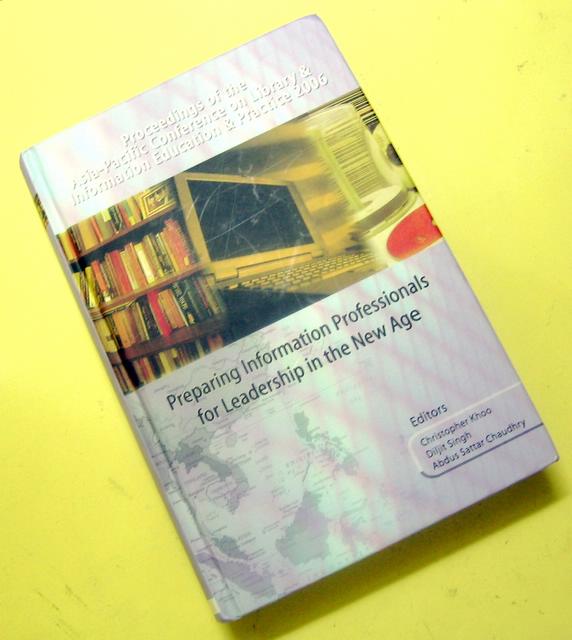
In "A-LIEP: Proceedings," I promised to post the photo of the Proceedings of the Asia-Pacific Conference on Library & Information Education & Practice. That's the book on the left.
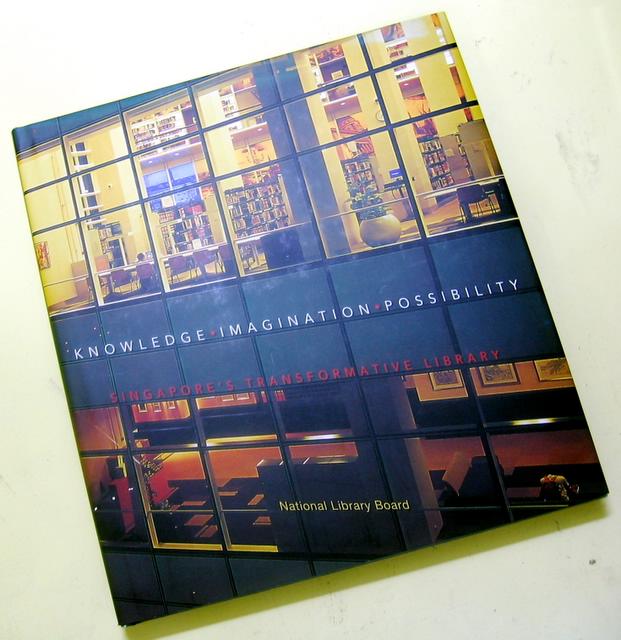
The photo of the book on the right is of Knowledge, Imagination, Possibility: Singapore's Transformative Library. Rambling Librarian generously gave me a copy when I said that I wanted to get one for the ILIS Library. For more about this book, see the second article in "New initiatives to boost National Library's vision to be reference and research hub (Access, December 2005)."
Click on the photos above to see the larger versions. Or, if you'd like to read the books, visit the ILIS Library by June 2006.
Category: A-LIEP
Stereotypical Librarian?
If a picture paints a thousand words, what exactly would this TV commercial do for the image of librarians?
Note: Click on the arrow to watch the video. It will take some time to load, so I suggest you click on the "pause" button while waiting. The video will stop playing, but it will continue to load.The commercial is set in a library. The librarian—wearing glasses and with her hair in a bun—is in the foreground stamping books. Meanwhile, the library user in the background causes the shelves to topple like dominos. This, apparently, causes the librarian to have a headache, the voiceover promotes Biogesic as a safe and effective painkiller, and after the librarian gets over her headache—presumably because she took Biogesic—she tells the user, "Pulutin mo 'yan" (Pick that up).
I really don't know what to say.
Category: Stereotypes
A-LIEP: Money and Leadership
The paper I presented in Singapore last April 5—"Money and leadership : a study of theses on public school libraries submitted to the University of the Philippines’ Institute of Library and Information Science"—is now available as a pdf file at E-prints for Library and Information Science.
Just for the record, but especially for the benefit of search engine spiders, the bibliographic information for the article is as follows:
Totanes, Vernon. 2006. Money and leadership: a study of theses on public school libraries submitted to the University of the Philippines’ Institute of Library and Information Science. In Proceedings of the Asia-Pacific Conference on Library & Information Education & Practice, edited by Christopher Khoo, Diljit Singh, and Abdus Sattar Chaudhry, 445-451. Singapore: National Technological University.
Categories: A-LIEP, Leadership, About Vonjobi
Edsa Dos 20/20: Cory and Loi
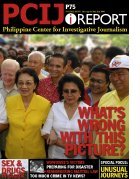 If a picture paints a thousand words, just how much does the cover photo on the right say about Filipino politicians? Even PCIJ, which is not exactly on the current administration's list of friends, is moved to ask, "What's wrong with this picture?"
Could it be that Cory Aquino, Teofisto Guingona and Franklin Drilon think Erap should still be President? Should GMA, therefore, urge the Sandiganbayan to set him free? Or could it be that Filipino politicians don't really care who they get into bed with as long as they get what they want?
To paraphrase a joke, if Ninoy were alive today, he'd be turning in his grave. But it's really not funny. Not at all.
Category: The Philippines
Librarian as Indiana Jones
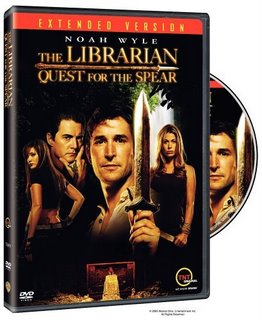 The Librarian: Quest for the Spear, a TV-movie originally released in the United States in 2004, will be shown in the Philippines via Star Movies on the following dates and times:
- Friday, May 5, 7:25 pm
- Saturday, May 6, 6:45 am
- Wednesday, May 10, 1:00 am
- Saturday, May 13, 12 noon
- Friday, May 19, 2:30 pm
- Wednesday, May 24, 12:30 am
- Sunday, May 28, 4:00 pm
 . The TV-movie was so successful that a sequel is on the way and a comic book will accompany its premiere.
If you would like to know more about the image of librarians in movies, check out the following sites:
- The Hollywood Librarian: Librarians in Cinema and Society - a documentary now in production
- Librarians in the Movies: An Annotated Filmography - groups movies into those with major or minor librarian roles, libraries as settings, librarians or libraries are mentioned, and those that are said to feature librarians
- Top Ten Films featuring Libraries, Librarians and the Book Arts - it is what its title says it is
- Librarian Spotting - a school assignment that situates stereotypes in the movies in the larger context of the profession
- The Depiction of American Public Libraries in Film - consists of MS Word documents made available by the dissertation's author
- The Librarian Stereotype and the Movies - a journal article published in 1993
Category: Stereotypes, Books and Movies
A-LIEP: DSpace and EPrints
In "Innovative Information Services in Academic Environments," Michael Leach discussed quite a few things, but I'll just focus here on DSpace and EPrints, which are software commonly used to build institutional repositories, but may also be used for records management and even archiving of personal documents.
The best way to explain what an institutional repository is would be to cite an example. And since there is only one Filipino institution utilizing DSpace at this time, check out Saint Louis University's Digital Research Repository, where users can view the abstracts of graduate and undergraduate theses as pdf files.
For a better understanding of what DSpace is capable of, check out the Cornell University Library's Open Access Repository, which has the full metadata record of a dissertation that cites the Filipino jeep. It looks like those who have the proper password can actually download, or at least access, the entire dissertation.
There does not seem to be any Filipino institution utilizing EPrints at this time, but E-prints for Library and Information Science (E-LIS) is a very good example. I have actually deposited the paper I presented at A-LIEP and, assuming it is accepted, it looks like it will be the first paper submitted by a Filipino author. A full-text search for "Philippines" yields 17 documents, none of which are really about the Philippines.
Filipino librarians can definitely take advantage of DSpace and EPrints, but it will take a bit more technical know-how than a blog requires because the necessary software must first be downloaded, configured and installed. This should not be difficult, however, because quite a few institutions are already digitizing their theses collections.
For more examples of institutional repositories, see the Live DSpace Sites and the known archives running EPrints.
Category: A-LIEP

