
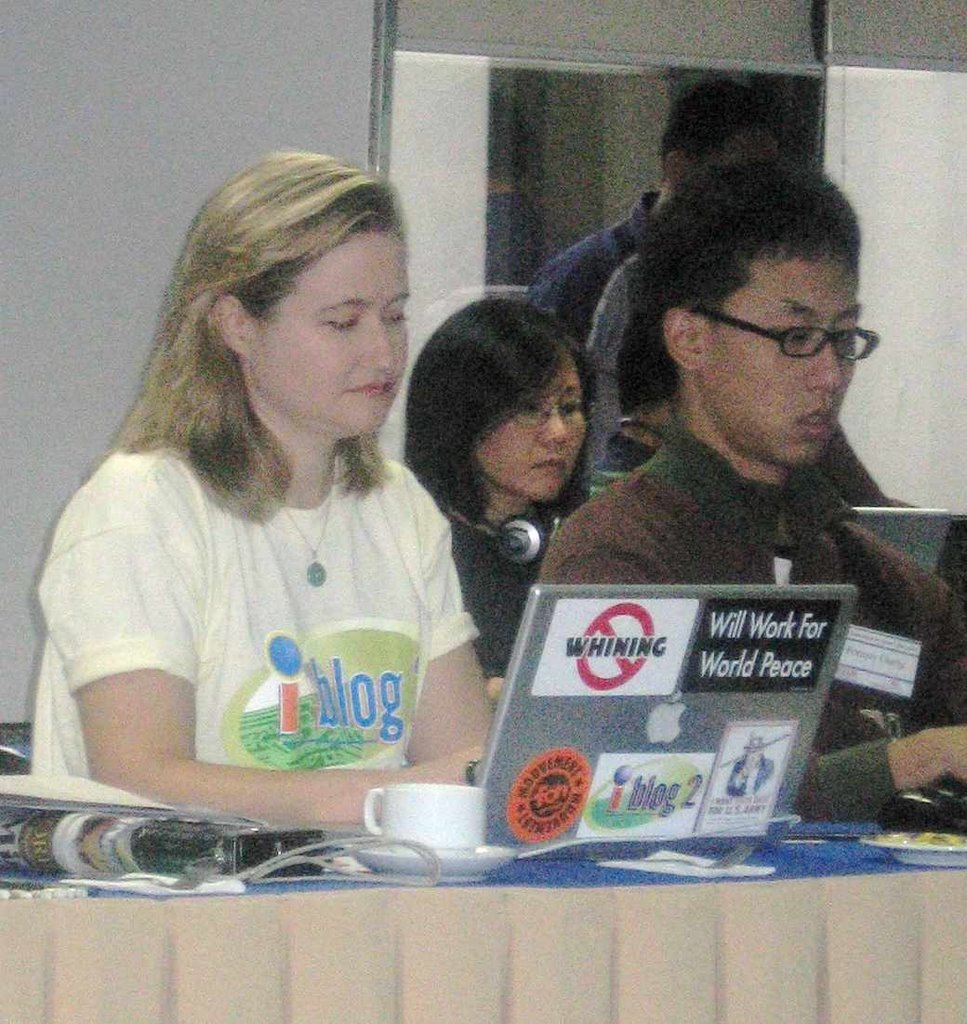
 I'm currently at “Free Expression in Asian Cyberspace (FEAC): A Conference of Asian Bloggers, Podcasters and Online Media." It's interesting that there are quite a few who were at iblog2 who are also at FEAC. That's Rebecca MacKinnon in the photo above wearing an iblog2 shirt and whose laptop is also sporting an iblog2 sticker.
Category: Blogging
iblog2 at FEAC
Google Newsletter for Librarians, Teachers, et al.
 In case you didn't know it, Google has a Librarian Center. And as the title of this post implies, it also has a Librarian Newsletter. But if you're not a librarian, don't tune out just yet because the third issue, like previous ones, will be of interest not just to librarians, but also to those who wish to understand how Google works and how it can be used in an educational setting.
The current issue focuses on Google Earth and includes articles on how it works (this is for the technogeeks) and how to take a virtual field trip using the software. And then there are links to lesson plans and downloadable posters (click on the image above) that can be used by librarians and just about anyone who wishes to tell others how to maximize Google.
Categories: Education, Internet
SLA International Travel Award
Note: This is the award I received last year that allowed me to attend the 2005 SLA Annual Conference in Toronto, and gave me the chance to inquire about applying for a PhD at the Faculty of Information Studies, University of Toronto. "Librarians as Leaders," was a revised version of the application I submitted for the award AND is one of the reasons this blog is what it is today. The text below is a revised version of an email I received.The SLA Business and Finance Division, with the sponsorship of ISI Emerging Markets, is offering ONE (1) award in the amount of US$ 2,000, plus a complimentary CE course registration, to an information professional from a developing country to help cover expenses at the 2006 SLA Annual Conference, to be held in Baltimore, Maryland from 11-14 June 2006.
ELIGIBILITY
- Applicants must be citizens or permanent residents of a non-G8 country.
- The 2006 Baltimore conference must be the first SLA annual conference attended.
- Applicants must indicate the amount and source of any additional funding which, combined with the Travel Award, will permit them to cover their expenses to attend the Annual Conference.
- The recipient may not accept a travel award for the 2006 conference from any other SLA Division or Chapter.
APPLICATION PROCEDURES
- Prepare a written statement, in English, of approximately 750 words, answering the following questions:
- What is the biggest challenge facing the information profession in developing countries?
- What skills must the new business information professional possess?
- What do you hope to gain from the conference?
- Include a current Curriculum Vitae.
- Submit the above documents, along with your address, telephone number, and email address, in Rich Text Format (RTF) or Microsoft Word by EMAIL no later than Friday, 28 April 2006, 5:00 p.m. Eastern time, to: robert.clarke@mcgill.ca
- The winner will be notified no later than Friday, May 5th.
POST AWARD REQUIREMENTS
- Winners MUST attend the B&F Division's Annual Business meeting in Baltimore.
- Recipients will write a brief article (approximately 500 words) for publication in the Fall 2006 issue of the Bulletin on their conference experience.
- Recipients will agree to serve on one of the B&F Committees or Sections, such as the B&F International Relations Committee or the College & University Business Libraries Section, during 2006-07.
About the Award Sponsor:
Internet Securities, Inc. (trading as ISI Emerging Markets), was founded in 1994 and acquired by Euromoney Institutional Investor PLC in 1999. It delivers hard-to-get information on more than 70 emerging markets through its award-winning online Emerging Markets Information Service.
It aggregates and produces unique content including full-text news articles, financial statements, company information, industry analyses, equity quotes, macroeconomic statistics, and market-specific information, which are derived directly from more than 10,500 local and global publications.
ISI Emerging Markets subscribers include top investment banks, corporations, law firms, consultants, investment and insurance companies, universities and libraries, multilateral organizations, and others.
In addition to worldwide headquarters in New York and European headquarters in London, clients are served through 25 offices in Asia, Africa, Europe and Latin America.
Category: SLA 2006
Good-bye, iblog2
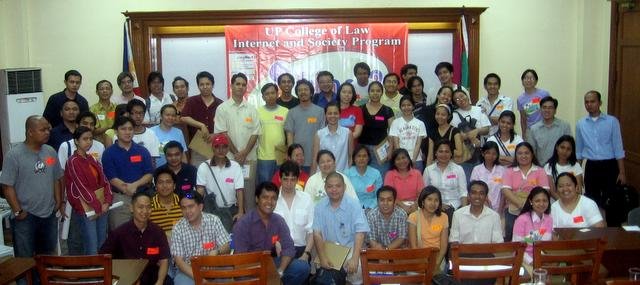
It's done. And I don't know if I'll have the energy to do liveblogging all over again. WordPress is certainly better suited for liveblogging because of its "Save and Continue Editing" button. But it was fun trying to post text and photos even before the speakers finished their talks.
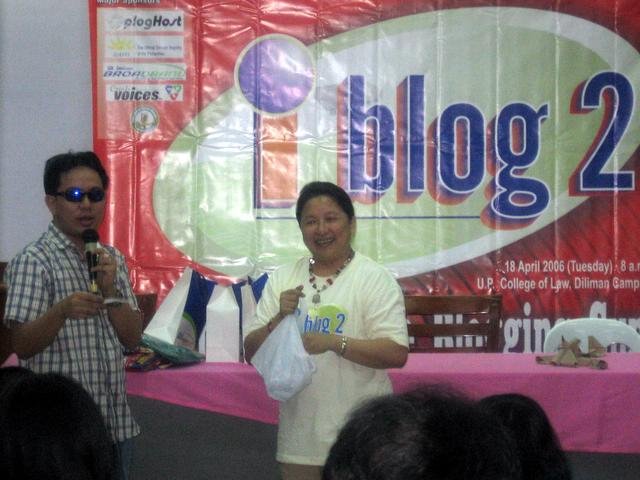
The photo above includes only those participants who stayed until the very end, while the photo below shows Pocholo Gonzales announcing the names of raffle winners using the voices of Erap, FPJ, Mike Enriquez and Mark Logan, as Janette Toral picked out the raffle stubs.
By the way, some bloggers couldn't resist taking a photo of me while I was doing my liveblogging. One of them was Jove. Another was Punzi. Could it be that I'm so cute? Bwahaha! (Note to regular readers: This is not the kind of post you're used to from me. It must be all those bloggers!)
For all the posts by bloggers after iblog2, check out Technorati and Google Blog Search.
Category: Blogging
Liveblogging iblog2, Part 2
It turns out I didn't miss lunch after all. There's now a 15-minute break for lunch.
Quotable quote: While waiting for the next sessions, I was talking to Manolo and Jove, and then Jester-in-Exile joined us and exclaimed, "You're By Jove!"
According to "Speak No Evil?: Libel for Bloggers" by Marvin Aceron (below, standing), for something to be considered libelous, it must be defamatory, malicious, publicly disseminated and the victim is identifiable. After giving a real-life example of a libel case that was filed and went all the way to the Supreme Court before it was thrown out for having no basis, Aceron said that there are enough corrupt members of the judiciary that a libel case filed against a blogger may just prosper. So what are we supposed to do? Just keep on blogging =)
Jester-in-Exile asked a question about whether any nation has jurisdiction over the Internet, which Aceron answered by saying that the Philippine government got around this by saying that it had jurisdiction over the person, and so, had jurisdiction over the case. The context of the question was the recent libel case filed against PCIJ. Noel Oliver Punzalan, the moderator, added that anonymous bloggers can't be sued for libel.
Quotable quote: While waiting for the next sessions, I was talking to Manolo and Jove, and then Jester-in-Exile joined us and exclaimed, "You're By Jove!"
According to "Speak No Evil?: Libel for Bloggers" by Marvin Aceron (below, standing), for something to be considered libelous, it must be defamatory, malicious, publicly disseminated and the victim is identifiable. After giving a real-life example of a libel case that was filed and went all the way to the Supreme Court before it was thrown out for having no basis, Aceron said that there are enough corrupt members of the judiciary that a libel case filed against a blogger may just prosper. So what are we supposed to do? Just keep on blogging =)
Jester-in-Exile asked a question about whether any nation has jurisdiction over the Internet, which Aceron answered by saying that the Philippine government got around this by saying that it had jurisdiction over the person, and so, had jurisdiction over the case. The context of the question was the recent libel case filed against PCIJ. Noel Oliver Punzalan, the moderator, added that anonymous bloggers can't be sued for libel.

While Aceron's talk was interesting, it wasn't quite as real as "Look Before You Link: Avoiding Plagiarism, Copyright Infringement and Other Pitfalls" by Bong Dizon (above, seated) because I hardly ever say anything derogatory about anyone, but I always link. If there's time later, I will be asking about the point Dizon made about one case that said deep-linking is not copyright infringement, whereas another case seems to suggest that using the headline of a news article as a link is an instance of infringement. And now it looks like my practice of using a logo or photo and turning it into a link to another site might be trademark infringement! Oh no... Was able to ask my question. It was a European case that was settled out of court, so the first case is more applicable. I'm safe =)
Dizon's recommendations: always link to the original source, cite name of author and publication, use links for reference-purposes, no inlining, don't cut-and-paste entire works, use quotes, add your own comments, respect another's traffic, golden rule, courtesy, act fairly. He ends by saying that if it's online, then we can link to it.
I was able to catch the Q&A of the Art & Literary Blogging Panel. That's Zarah Gagatiga (below, left) answering a question by delivering a short lecture on information literacy, Dean Alfar (center) and Jonas Diego.

You know you're at the Professional Blogging Panel when all the speakers have their laptops in front of them (below). They are, from left, Marc Hil Macalua, J Angelo Racoma, Charo Nuguid and Abe Olandres.

In "Problogging: Professional Blogging and Blog Monetization," Olandres shared the earnings of one of his blogs (see photo of chart below), which went from zero earnings in April 2005 to Php 25,000 in March 2006. UPDATE: See his notes and download his Powerpoint presentation here.

In "Blogging as a Profession: From Full-Time Employee to Full Time Blogger," Racoma talks about the lessons he learned: blogging can help you get a job, build your blog slowly and earn later, your blog is your online portfolio, connections can mean everything, problogging is just like any career (get pirated, too), but it's not an overnight thing. (Note: There are 7 lessons, but I discovered that I was sitting next to Jayvee Fernandez, one of the probloggers interviewed by Olandres, and so missed lesson 2.) UPDATE: See the full text here.
I was only half-listening to "Putting Search Engines to Work for Your Blog" by Macalua (and I suppose that explains why he's earning a lot from his blog, and I'm not). And so, of course, I missed his comment on Yahoo! Search Marketing.
In "Tracking Blog Performance," Nuguid mentioned that some people actually give out calling cards with their blog URLs on them. Well, I was one them at last year's iblog. I would have given out my calling cards again this year if I hadn't run out. Check out my calling card =)
Category: Blogging
Liveblogging iblog2
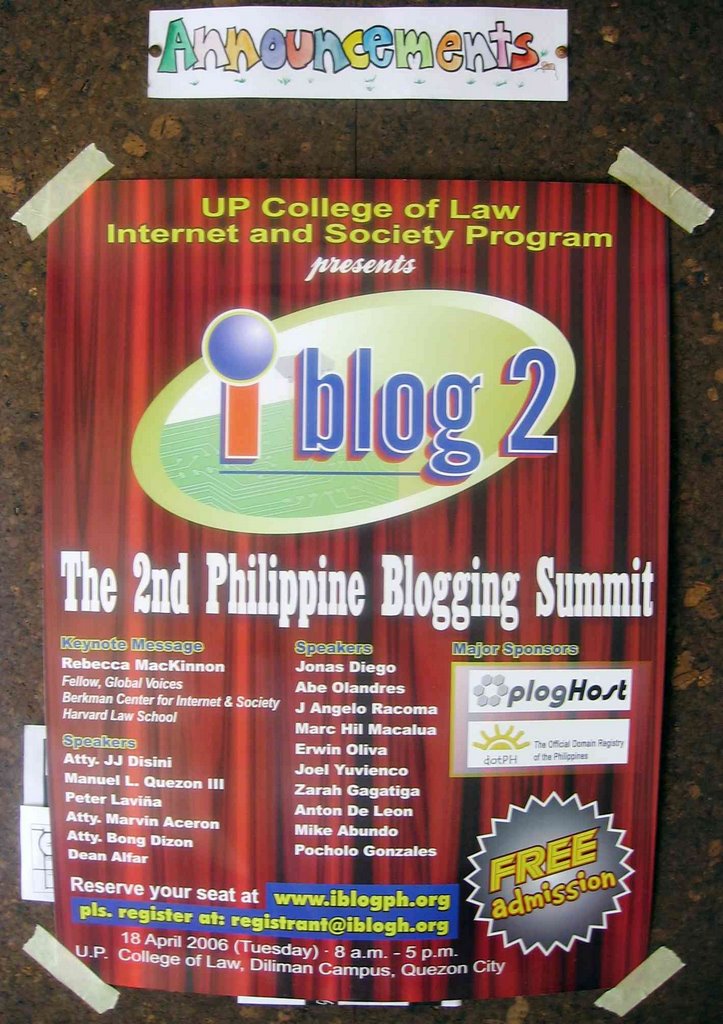
Thanks to Globelines Broadband, I'm blogging now even as iblog2 is beginning with the Welcome Remarks by Dean Carlota of the UP College of Law.
I'm having problems now, however, with the connection, so I wasn't able to post the initial photo I wanted to post. Then, of course, I'm also having problems because I'm using an OS I'm not too familiar with.
Well, we're online again, and Rebecca MacKinnon is telling her blogging story and how she decided to leave a good job at CNN and start Global Voices.

By the way, that's J. Angelo Racoma, the J Spotter, in the foreground, wearing a blue shirt.
In response to a question, MacKinnon referred to the Great "Firewall" of China and pointed to the OpenNet Initiative, which has built a tool that allows Google users to compare results on google.cn and google.com.
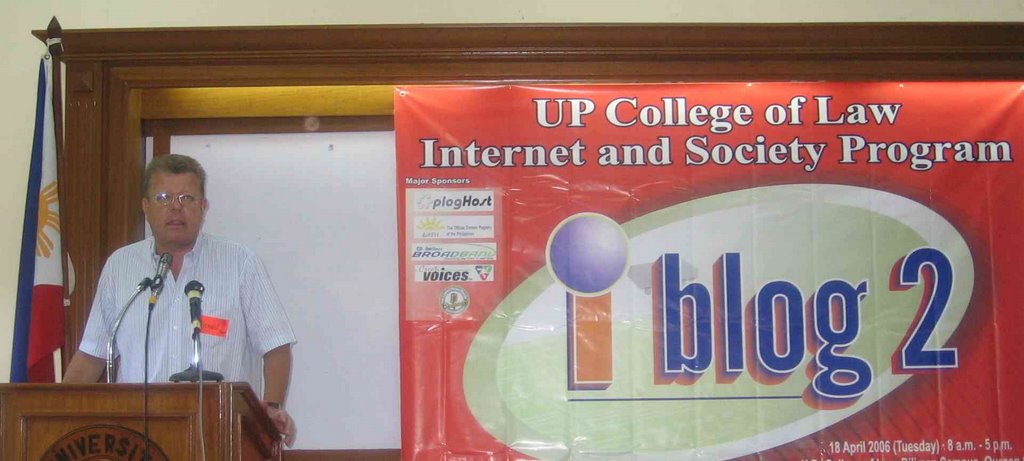
Ronald Meinardus just began his talk on "Blogging and Podcasting as Tools for Political Education." He doesn't have slides, but his paper is now available online at My Liberal Times. If you visit his older site on Blogger, you can see an example of how bloggers "grow" as they gain blogging experience. And now he just said that "the best way of learning is by doing it yourself." Incidentally, some of the iblog2 talks will be posted as podcasts on the Friedrich Naumann Foundation's website.
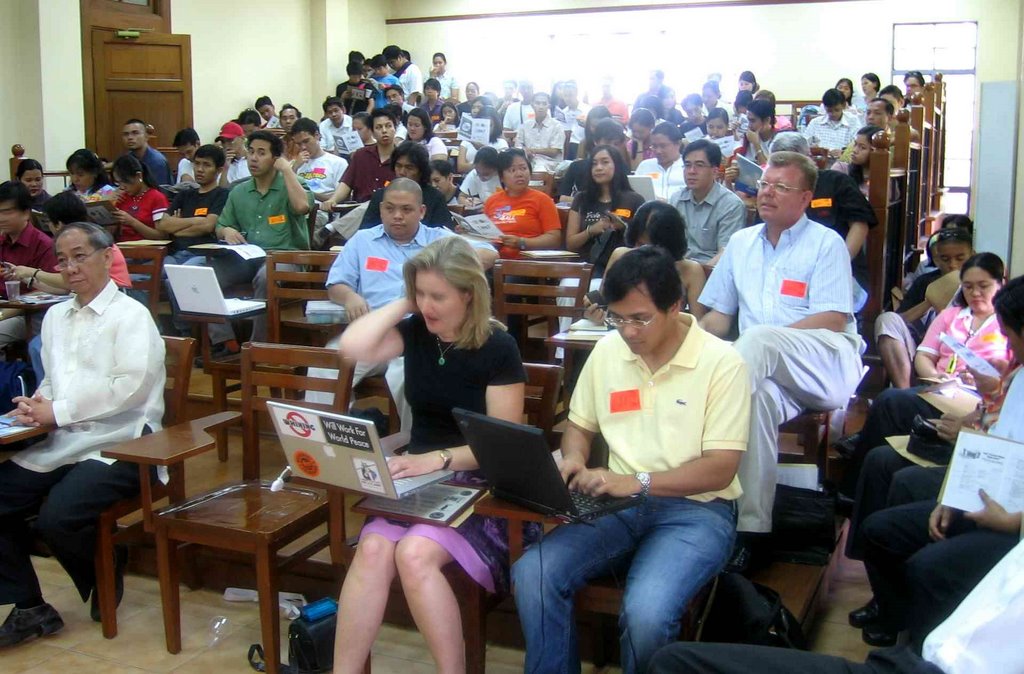
The photo below gives an idea of how big the crowd is at iblog2.
That's Emil Avancena below, who tagteamed with Mikey, for the latest "Trends and Technology for Filipino Bloggers" as seen by i.ph.

I had to leave for lunch and so I missed "Blogs and the battle for ideas: personalities and issues" by Manuel L. Quezon III and "Blogging and Participatory Governance" by Peter Laviña.

But I did come back in time for the Q&A where Dean Jorge Bocobo (below) gave a passionate reaction to the speakers' ideas. And, of course, I missed the parallel personal blogging session altogether.
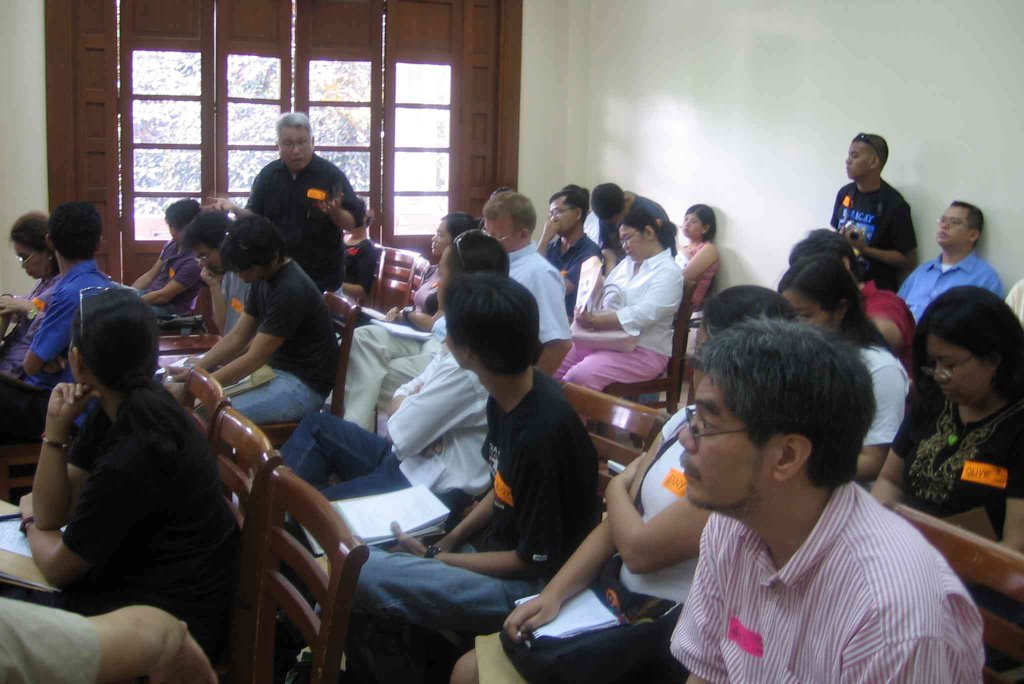
A question has just been asked regarding the predominance of blogs written in English. Manolo commented that some, if not most, would like to have a wider audience than just native speakers. But he did mention that there are already efforts among the Visayans to use their languages on their blogs.
This post is getting too long. See Part 2.
Category: Blogging
Librarians at iblog2
Labels:
Stereotypes

Iblog2 is one such opportunity. Check out the program and you'll see that there are two blograrians who will be more than just active participants. Juned will be moderating the "Media Blogging & Podcasting Panel," while Zarah will be speaking on "Blogs as Teaching Tools."
Go Juned! Go Zarah!
Category: Librarians, Stereotypes
A-LIEP: NUS Central Library


Categories: A-LIEP, Libraries
A-LIEP: National Library of Singapore


Categories: A-LIEP, Libraries
The Da Vinci Code, The Gospel of Judas and (Mis)Interpreting the Bible
Labels:
Religion
Today is Good Friday. It's the day when Christians commemorate the death of Jesus Christ. But have you ever wondered why, unlike Christmas, the day on which Jesus supposedly died keeps changing? Well, the same is true of Easter Sunday.
To truly understand why this is so, we need to remember that the calendar we now have did not exist during the time of Jesus. That no one really knows when Jesus was born, when he died and when he rose from the dead. That the early Church only set the dates—many decades after Jesus died—on the basis of the little evidence they had and existing Jewish and pagan traditions. For more information on how this came to be, see "Christian Calendar." To calculate the days on which "movable" feasts fell or will fall in previous or future years, check out "Calculation of the Ecclesiastical Calendar."
Does the fact that the Church set the dates for celebrating the birth, death and resurrection of Jesus without using official, verifiable documents bother you? If this is so, then you should probably just throw out your Bible and rely on what the media have been saying about The Da Vinci Code and The Gospel of Judas in the past weeks.
To truly understand why this is so, we need to remember that the calendar we now have did not exist during the time of Jesus. That no one really knows when Jesus was born, when he died and when he rose from the dead. That the early Church only set the dates—many decades after Jesus died—on the basis of the little evidence they had and existing Jewish and pagan traditions. For more information on how this came to be, see "Christian Calendar." To calculate the days on which "movable" feasts fell or will fall in previous or future years, check out "Calculation of the Ecclesiastical Calendar."
Does the fact that the Church set the dates for celebrating the birth, death and resurrection of Jesus without using official, verifiable documents bother you? If this is so, then you should probably just throw out your Bible and rely on what the media have been saying about The Da Vinci Code and The Gospel of Judas in the past weeks.
What we must always remember is that when it comes to books, literary form is very important. For instance, the Bible is not just one book, it is composed of many books (e.g., Genesis, Matthew). And while some of them may be considered history books, most of them are not. What's written in the Bible is not supposed to be taken literally.
The Da Vinci Code's literary form is "novel," while that of The Gospel of Judas is, well, "gospel." If reading the former or watching the documentary about the latter cause you to "lose your faith," then perhaps you deserve to lose it. Both should be read as they were written, and not as "proof" of anything. Please don't get me wrong. I'm not saying that either book is wrong or should not be read.
I've read The Da Vinci Code, and it's very entertaining, but please remember that it's in the fiction section. I haven't seen the documentary about The Gospel of Judas, but it's important to note that not everything that is "discovered" proves that a conspiracy exists. See "The Emergence of the Canon," which is part of the website of "From Jesus to Christ: The First Christians," a more credible and less hysterical documentary than the one produced by National Geographic.
Check out what I've written before about reading the Bible: "Introducing Gen X to the Bible" and "'Average' Catholics and the Bible." If you don't trust me and/or you have time to read long, scholarly documents, see the Pontifical Biblical Commission's "The Interpretation of the Bible in the Church" and "The Jewish People and Their Sacred Scriptures in the Christian Bible."
Good Friday is not about historical dates. Just as the Bible is, as I've said before,
Categories: Religion, Books and Movies
The Da Vinci Code's literary form is "novel," while that of The Gospel of Judas is, well, "gospel." If reading the former or watching the documentary about the latter cause you to "lose your faith," then perhaps you deserve to lose it. Both should be read as they were written, and not as "proof" of anything. Please don't get me wrong. I'm not saying that either book is wrong or should not be read.
I've read The Da Vinci Code, and it's very entertaining, but please remember that it's in the fiction section. I haven't seen the documentary about The Gospel of Judas, but it's important to note that not everything that is "discovered" proves that a conspiracy exists. See "The Emergence of the Canon," which is part of the website of "From Jesus to Christ: The First Christians," a more credible and less hysterical documentary than the one produced by National Geographic.
Check out what I've written before about reading the Bible: "Introducing Gen X to the Bible" and "'Average' Catholics and the Bible." If you don't trust me and/or you have time to read long, scholarly documents, see the Pontifical Biblical Commission's "The Interpretation of the Bible in the Church" and "The Jewish People and Their Sacred Scriptures in the Christian Bible."
Good Friday is not about historical dates. Just as the Bible is, as I've said before,
not so much about numbers or facts or history as it is about God's love for his people and the different responses to his love. But if we don't know how to read the Bible, we may just think that the early Israelites lived and thought the way we do today. Or that everything written in the Bible is factually correct. Or that Jesus really was a lamb. And miss the point.
Categories: Religion, Books and Movies
Subscribe to:

