Quick Links: Talumpati | Licensed Librarians | Filipiniana Online | Stereotypes | Leadership | The Philippines

What I Learned Through Blogging

The links listed below are the ones I referred to in my talk on "Weblogs" at PAARL's National Summer Conference on Library and Information in La Trinidad, Benguet, 17-19 May 2006. You can check out the paper I delivered at Consal XIII (full text links only) for the other blogging-related links.
Note: Most of the links will lead to posts that have appeared on this blog. These posts are not necessarily solely about the specified website. Those marked with an asterisk (*) are those sites I have been planning to write about for the longest time. In one case, I linked to another blogger's post so that readers can better understand what the site is about.

Search Engines

Read More...

PAARL Conference Photos

retreat house fellowship - dancing librarians flowers group photo fe angela versoza on library security

In case any of you noticed, I did not post anything here since last Monday because I was at PAARL's National Summer Conference on Library and Information. Click on any of the photos above to see the photos I took. The links I promised to provide in my talk will follow soon.


Category: Events

Read More...

I Am a Librarian


It is not enough to complain about the existence of librarian stereotypes; alternative images must be presented.
Note: Click on the arrow to watch the video. It will take some time to load, so I suggest you click on the "pause" button while waiting. The video will stop playing, but it will continue to load.
When I started this blog, I hoped I could get away with being a "journalist" and write in the third person. I did not wish to be anonymous, but it was also not my intention that the blog would be about me. But there's really no way to avoid coming forward. As I wrote in a soon-to-be-published article, "Self-promotion is a necessary evil."

I found out about Cynthia Wilson's "I Am a Librarian" project after thinking of doing the video above, but we're basically thinking along the same lines:
The image of the librarian is currently portrayed as a homely woman or a sexy woman with glasses and a book in hand. Well, men are librarians too... When I meet people and tell them that I am a librarian, first they comment that they cannot believe that you need a Master’s degree to be a librarian and then they say well, you don’t look like a librarian. Showing pride in our profession and sending a positive image will help the world to realize that the stereotype is not true of all librarians.
Wilson also has a blog and will probably eventually publish the photos she took. But I hope there will be others who will do what I've done. All you need is a digital camera or cell phone that can take videos, and the means to upload your video to YouTube. If there were more authentic librarian videos, then perhaps the relevance and view count results for "librarian" would not be so embarrassing (see "librarians are ugly" and "Naughty Librarian").

Finally, in case you've heard about "Marian the Librarian," but don't know where it came from, click on the link to watch the song from the musical The Music Man, as performed by Matthew Broderick.

Thanks to Hans Hwang for his technical expertise and the use of his equipment.


Categories: Stereotypes, About Vonjobi

Read More...

Response to Da Vinci Code Highlights
Inadequacies of Catholic Church

If I were to give The Da Vinci Code another title, I'd probably call it The Gospel of Dan Brown. And like The Gospel of Judas a few weeks ago, it will not make much of a dent in the number of Catholics who go to Church. As I wrote before—and which a Bible scholar has been quoting—"If reading [The Da Vinci Code causes] you to 'lose your faith,' then perhaps you deserve to lose it."

The CBCP has finally issued a statement on the eve of the movie's release—years after the book started attracting attention. And if you'll look at how the pastoral statements are presented on the websites of the CBCP and the Archdiocese of Manila, you'll see that the latter has a better understanding of what it means to communicate.

In fact, the Archdiocese of Manila also makes "Handling Questions People may ask about the Da Vinci Code" available, the guide referred to in the CBCP's statement. The guide states that, "Brown sounds so convincing that many of his readers simply believe his assertions, due to insufficient knowledge of the Christian faith and a solid background in history and other fields." But why would Catholic readers have "insufficient knowledge" of their faith? Because the Church refuses to accept that times have changed.

Please pardon the language, but nowadays sex sells. I don't mean that the Church should start putting photos of sexy actresses on the cover of the Bible, but the Church needs to work on communicating with the faithful in a language that they can understand. Bishop Arguelles has asked that the movie be banned, but I would suggest that Arguelles, instead, work on his homilies so that the few who attend and stay awake will have their faith lives enriched. (Yup, he's that out of touch.) The bishops may also want to take a look at how Catholic schools are teaching students about their faith (see "'Average' Catholics and the Bible").

Anyway, the Opus Dei is dealing with the movie in a much better manner—and that's to use the opportunity to evangelize and correct errors, instead of trying to stifle contrary opinions. Check out the following:But really, I think it is very appropriate that the best thing that the Catholic Church could have done about this opportunity—nope, it's not a threat—comes from the Inquirer's entertainment section. In an interview with Ruben Nepales (Philippine Daily Inquirer, 14 May 2006), Tom Hanks says,
When the book was setting record sales and everybody was reading it, you could put a sign outside a church that says we’ll be discussing the true meaning of Ash Wednesday or "The Da Vinci Code." A jillion people will show up. Maybe to tear it apart or maybe to support it but, more than anything else, just to have dialogue about what it does and does not mean. What could possibly be wrong with that? I have plenty of friends—people who are serious about their faith—who have said to me, "Let’s get together and not be afraid [to] have a conversation." All it is, is dialogue. That never hurts.
The Catholic Church has failed to communicate with its followers using language that they can understand. Where are the Catholic authors who can write bestselling novels like The Da Vinci Code and the Left Behind series? Fr. Andrew Greeley had some success in the 1980s with The Cardinal Sins and Thy Neighbor's Wife, but the hierarchy didn't exactly approve of his novels either.

What can librarians learn from all this? We can't just leave it to others to tell the people who we are; that's why the stereotypes about librarians continue to flourish. We have to be the ones to go out there and tell people who we are. It's not enough to complain about inaccurate images of librarians; we must be able to present alternative, positive images in movies, books and, yes, blogs =)


Categories: Books and Movies, Religion

Read More...

Filipino Mothers for Export

It's Mother's Day tomorrow. Check out everything that will be written about mothers on Google News, Yahoo! News and Topix.net (news and blogs).

But please consider "Global mamas" by Michael L. Tan (Philippine Daily Inquirer, 13 May 2006) and the report he discusses in his column: Save the Children’s "State of the World’s Mothers 2006" (press release, full report [pdf]). (Note: One big difference between bloggers and newspaper columnists is that the former can provide links that the latter forget or choose not to include.)

According to Tan, "Many Filipinas aren’t just global nannies, they’re now global 'nanay' [mothers], global mamas, often at great cost to their own children back home." Much has been made of the exodus of nurses, doctors and teachers, but what of the mothers among this group? And then there are the domestic helpers, entertainers, etc. They are very likely mothers, too. We haven't just been exporting skilled or unskilled Filipino workers; I'm willing to bet that we've exported more mothers than fathers.

And then there's Salary.com's "What Is Mom's Job Worth?," which quantifies the actual and potential salaries of Working and Stay-at-Home Moms. The figures are in dollars, of course, but it makes me wonder what mothers are really worth, and just how much we really owe them. I'm sure they did it all for love, and that they don't expect anything in return, but quantifying what they've done in pesos and centavos just makes it that much clearer how much we've taken our mothers for granted. Or maybe I should just speak for myself.

Anyway, to all the mothers reading this: Happy Mother's Day!


Categories: Events, Filipina

Read More...

A-LIEP: LIS Research

In "Authorship from the Asia and Pacific Region in Top Library and Information Science Journals" by Taemin Kim Park, articles published from 1967-2005 in the top 20 library and information science (LIS) journals—as ranked by ISI's Journal Citation Reports—were included in the study. Australia, China (including Hong Kong) and South Korea accounted for 50 percent of the articles out of twelve countries. The Philippines was represented by 9 articles, or 0.7 percent.

To put these figures into perspective, it must be noted that in "Is There a Role for Professional Associations in Fostering Research?" by Kerry Smith and Ross Harvey, the Australian authors expressed dissatisfaction with their country's research output. If librarians from the number one country—with 26.2 percent of articles—are not happy with their output, what should Filipinos feel?

According to ISIHighlyCited.com, there is only one Filipino among its list of "the most highly influential scientists and scholars worldwide"—Bienvenido Juliano of the Philippine Rice Research Institute, who has written or collaborated on 367 articles since 1955. But that's in the field of agricultural sciences. What about our own field?

Of the 9 articles written by Filipinos, 4 were published from 1981-1990, 4 from 1991-2000, and just 1 from 2001-2005. Looking at the names, only a few are familiar; the rest may not be librarians. The article by Oberthur, Dobermann, and Aylward, does not even seem to have a Filipino among its authors.

Could it be that Filipino librarians have not been doing research? Or did their articles just not make it into the top 20 journals?

The following is the list of articles included in Park's study:
Carino, PB. COMPAIS - a computer-assisted information-system. Journal of Information Science, v.4, no.1 (1982).

Cornelio, AF, Neelameghan, A and Tongco, LV. DAIS - a computer-assisted documents acquisition information-system. Journal of Information Science, v.5, no. 1 (1982).

Dizon, LB and Sadorra, MSM. Patterns of publication by the staff of an international fisheries research-center. Scientometrics, v.32, no.1 (Jan. 1995).

Flor, AG. The information wastage ratio - Toward a theory of rates of information generation and utilization. Scientometrics, v.13, no.1/2 (Jan. 1988).

Lustria, MLA, Case, DO. The SPARC initiative : a survey of participants and features analysis of their journals. Journal of Academic Librarianship, v.31, no.3 (May 2005).

Maclean, J, Janagap, C. The publication productivity of international agricultural-research center. Scientometrics, v.28, no. 3 (Nov.-Dec. 1993).

Neelameghan, A, Pascua-Cruz, MD. Online access to remote data-bases – an experiment in user sensitization. Journal of Information Science, v.7, no. 3 (1983).

Oberthur, T. Dobermann, A, Aylward, M. Using auxiliary information to adjust fuzzy membership functions for improved mapping of soil qualities. International Journal of Geographical Information Science, v.14, no. 5 (Jul-Aug 2000).

Opena, MM. Unity in diversity : toward a common professional vision of health science librarianship. Bulletin of the Medical Library Association, v.84, no.1 (1996).

Category: A-LIEP

Read More...

Handsome Librarian

Nope, I'm not talking about myself =)

In "Librarian as Game-Show Winner," I wrote about Aldric Gaerlan, who won PHP 500,000 with his partner in a noontime show. Well, Gaerlan has written an article about his experience. Check it out at UPLSAA Online.

And nope, he didn't need to take Biogesic to win.


Categories: Stereotypes, Librarians

Read More...

A-LIEP: Books

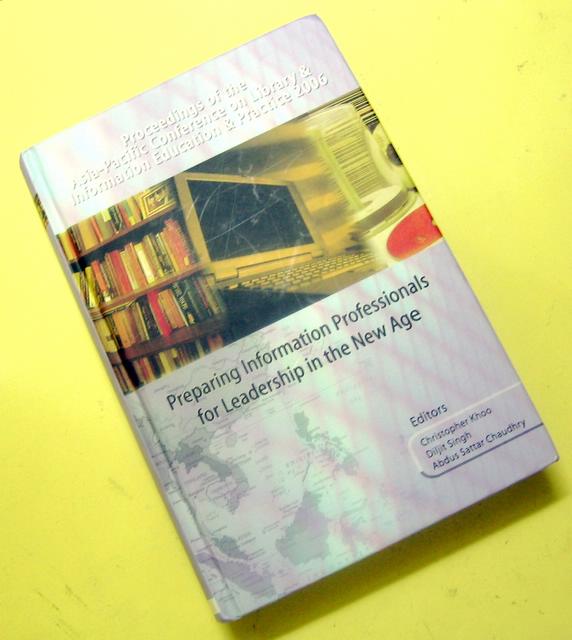
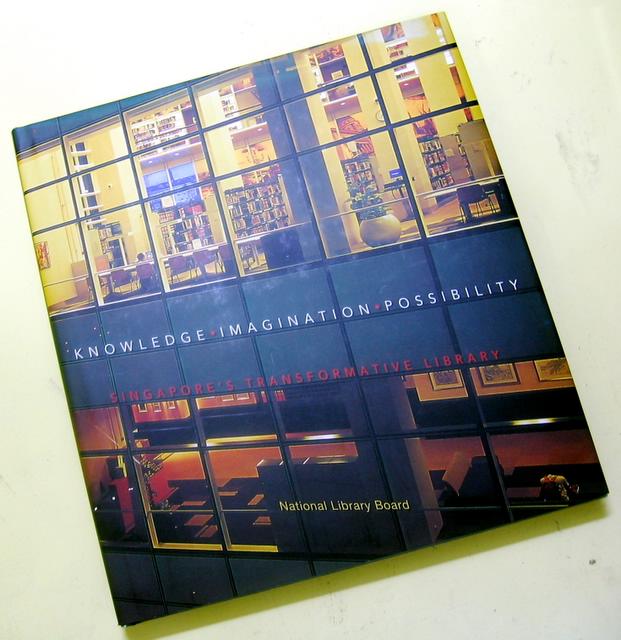
Proceedings of the Asia-Pacific Conference on Library & Information Education & Practice Knowledge, Imagination, Possibility: Singapore's Transformative Library


In "A-LIEP: Proceedings," I promised to post the photo of the Proceedings of the Asia-Pacific Conference on Library & Information Education & Practice. That's the book on the left.

The photo of the book on the right is of Knowledge, Imagination, Possibility: Singapore's Transformative Library. Rambling Librarian generously gave me a copy when I said that I wanted to get one for the ILIS Library. For more about this book, see the second article in "New initiatives to boost National Library's vision to be reference and research hub (Access, December 2005)."

Click on the photos above to see the larger versions. Or, if you'd like to read the books, visit the ILIS Library by June 2006.


Category: A-LIEP

Read More...

A-LIEP: Photos

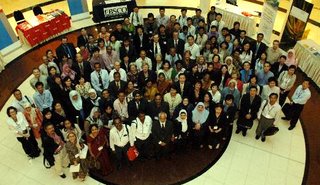
Asia-Pacific Conference on Library & Information Education & Practice
Click on the photo above to see the original. For more photos, check out the following:

Conference
April 3: 1 2 3
April 4: 1 2 3 4 5 6 7 8 9 10
April 5: 1 2 3 4 5 6 7 8 9 10
April 6: 1 2 3 4 5 6 7 8

National Library
Dinner: 1 2 3 4 5
Tour: 1 2


Category: A-LIEP

Read More...

Stereotypical Librarian?


If a picture paints a thousand words, what exactly would this TV commercial do for the image of librarians?

Note: Click on the arrow to watch the video. It will take some time to load, so I suggest you click on the "pause" button while waiting. The video will stop playing, but it will continue to load.
The commercial is set in a library. The librarian—wearing glasses and with her hair in a bun—is in the foreground stamping books. Meanwhile, the library user in the background causes the shelves to topple like dominos. This, apparently, causes the librarian to have a headache, the voiceover promotes Biogesic as a safe and effective painkiller, and after the librarian gets over her headache—presumably because she took Biogesic—she tells the user, "Pulutin mo 'yan" (Pick that up).

I really don't know what to say.


Category: Stereotypes

Read More...

Related Posts Plugin for WordPress, Blogger...