

The photos above show me with the two blograrians I had lunch with last Saturday: Zarah Gagatiga (left) and Peachy Limpin (center). Zarah has already written about what we discussed in "The Quest," so allow me to just comment on changes that have occurred since all three of us began blogging about our profession in 2005:1 The photos were taken not with a camera, but Zarah's MacBook and Photo Booth. It's not easy lugging around a laptop to take pictures, but the fact that there was no need to download the photo from the camera to the laptop or to Photoshop the photos together, tells me that the time when uploading a photo to a blog right after taking the picture (with an iPhone that takes better photos than most phones with cameras, perhaps?) is coming soon.
So what's wrong? Take a look at what an Indian says about the LIS blogs in his country: Indian Library and Information Science Blog(s) are not able to catch sufficient number of user base. His English can be distracting, but what he says could also be applied to LIS in the Philippines. And not just to blogs, but also to research and publications.
2 None of us are blogging as much as we used to. Zarah blogged quite consistently from 2005 to 2007 (about twice a week), but was down to about one and a half posts per week in 2008. Peachy averaged about a post a week when she started blogging, but was down to a little over one post a month in 2008. And then there's this blog, which went from a high of almost one post a day in 2006 to last year's one post a week. Other blograrians have even stopped blogging altogether. True, more librarians are blogging now, but it does not seem to be the case that there are more librarians who are blogging consistently about our profession. And no, posting announcements and job openings doesn't really count =)
3 I will not deny that I have lost some enthusiasm for blogging, but I think much of the decline in number of all our posts may be traced to lifestyle changes. Zarah took on more responsibility as an administrator, Peachy immigrated to Australia with her family, and I crossed an ocean to do my PhD in Toronto. The fact that two of us are now based outside the Philippines is significant. It's not just nurses and domestic helpers who are leaving our country in large numbers. Even the relatively small number of librarians in the Philippines is dwindling further. Is it because there's a high demand for Filipino librarians abroad or could there be some other reason for the accelerating exodus of librarians? But that's another story altogether.
At one point, I thought that blogging could perhaps be the solution to the problem of lack of visibility of our profession. Even the difficulty of disseminating information to Filipino librarians can be—and has been—addressed by blogs. Not all librarians have access to the Internet, of course, but I'm beginning to think that even if all Filipinos were online, our profession would still encounter the same problems.
This post has gotten much longer and more serious than I intended it to be. I'm going to get into trouble with the powers-that-be if I continue what I'm thinking of writing. So I'll just stop here and hope that someone else takes up the cause =)
O Blograrian, Where Art Thou?
In the News & Blogs
In case you haven't noticed—or you've been reading posts via email or RSS—this blog's sidebar has a new feature called "In the News & Blogs." I'm using Furl to bookmark and share news stories and blog posts that I find interesting, but for which I have no time to write separate posts. It looks like some readers have already seen them and started clicking through. I hope this new feature will encourage readers to visit the blog even though I haven't been updating—and probably won't—as frequently as before.
2008: Year in Review
Happy new year!
This is the third time I'm doing this (see 2006 and 2007), but this is the first time I'm posting my annual review in Manila, instead of Toronto. In case you don't know it yet, I'm back in the Philippines for a few months to do research and write the first draft of my dissertation—wish me luck!—while I'm here.
In 2007, I wrote that:
What follows is not exactly the "first paragraph/sentence" of each post... but it's probably better this way. Interestingly, the posts seem to be fairly representative of what this blog is all about.
January: Filipino Librarian : WikiPinoy of the Year?
Recognition is always good, but the reason it has taken me this long to write about it, aside from the fact that I've had a lot to do, is that I have mixed feelings about the "award."February: FO: Plays
Thanks to a comment left by Aurelio, I thought of looking for plays that are available online.March: Of Budgets, Leadership and the National Library
Public libraries don't get enough funding. From "Public library gets budget for repair, new books" (Cebu Daily News, 20 February 2008): For the first time, the Mandaue City Public Library is getting a budget to buy new reading materials and repair the building.April: Deadline for Nominations for 2008 National Book Awards
The deadline for submission of nominations for the 2008 National Book Awards is 30 April 2008. Unfortunately, as far as I can tell, this information has not been widely disseminated.May: Get Hooked on TV... on Your Computer
Before you continue reading, you should know that clicking on any of the links in this particular post may lead to difficulties finishing whatever you need to do.June: Bloggers on Mga Ibong Mandaragit
If a student raises her hand in a class on Philippine literature and says, "Hindi ko maintindihan ang Tagalog" (I can't understand the Tagalog), should the teacher say, "Eh kasi tanga ka" (That's because you're stupid)?July: Filipino Librarians in Vancouver
In "Proudly Filipino in Vancouver," I promised to write about Filipino librarians in Vancouver. Well, three weeks later, I'm finally getting around to it.August: Buwan ng Wika 2008
August is Buwan ng Wika (Language Month). This year, the theme is "Wika Mo, Wikang Filipino, Wika ng Mundo, Mahalaga!"September: Too Busy to Blog... Again
Just in case you've been wondering what happened to this blog, here's the official announcement: This blog has not been updated in the past two weeks and will not be updated for at least another two weeks because its owner is too busy to blog... again.October: Redefining the Dictionary
"Love makes things real." Erin McKean, a lexicographer, wasn't referring to toys, but to words that people love that aren't found in dictionaries. We have many such words in the Philippines =)November: Troy Lacsamana — Library Leader
It is not enough that you have big dreams and plans. I should be able to communicate with my co-staff and co-volunteers the essence of why are we doing such activities and the importance of their contribution to our end goals.December: Christmas 2008
I wouldn't dream of trading Christmas in the Philippines for a white Christmas. And that's why I made sure I'd be home this Christmas.
Christmas 2008
I wouldn't dream of trading Christmas in the Philippines for a white Christmas. And that's why I made sure I'd be home this Christmas. I was hoping to get some work done before the new year, but I was being optimistic. As I wrote before, "schedules, eating habits and exercise routines are thrown out the window" in December.
The video below provides a glimpse of what I mean. Note that "Pasko = Christmas" and "Pinas" is short for "Pilipinas," the Filipino word for "Philippines." I've also reproduced the lyrics, and added my own English translation. Merry Christmas!
Pasko sa Pinas
Artist: Yeng Constantino
Nadarama ko na ang lamig ng hangin
Naririnig ko pa ang maliliit na tinig
May dalang tansang pinagsama-sama’t
Ginawang tambourine
Ang mga parol ng bawat tahana’y
Nagniningning
Ibang mukha ng saya
Himig ng Pasko’y nadarama ko na
May tatalo pa ba sa Pasko ng Pinas
Ang kaligayahan nati’y walang kupas
Di alintana kung walang pera
Basta’t tayo’y magkakasama
Ibang-iba talaga
Ang Pasko sa Pinas
Ang Pasko sa Pinas
Christmas in Pinas
Artist: Yeng Constantino
I can already feel the coolness of the wind
I can still hear the children's voices
Carrying bottle caps strung together
Made into a tambourine
The lanterns in each home
Shimmer and shine
The look of happiness is different
I can already feel the spirit of Christmas
Can anything beat Christmas in Pinas
The joy we feel is incomparable
We don't really care if we don't have money
As long as we're all together
It's really different
Christmas in Pinas
Christmas in Pinas
FO: Katipunan Documents and Studies
Why was the Katipunan established? What exactly did Katipuneros talk about during their meetings? What were the names of the Katipuneros? All these questions and more are addressed by Katipunan Documents and Studies (KDS), which presents transcriptions of primary documents—in Tagalog and/or the Katipunan's secret code—along with translations, introductions and sources in English (though not consistently for all documents).
It is noted on the site that KDS intends to complement—not compete with—Bonifacio Papers (which I first featured in "FO: Bonifacio Day"), but any comparisons made are not really applicable because KDS presents primary sources, not just what scholars have written about them. KDS is an excellent resource, but photos of the actual documents—not just transcriptions—would have been even better. Then again, the absence of photos could just be an indication of the dearth of evidence about Bonifacio and the Katipunan.
LLE 2008: Reasons for
Drastic Drop in Passing Rate
Number of Examinees and Passers, 1992-2008
First, the facts. The 2008 Librarians' Licensure Exam (LLE) had the most number of examinees (1,003) and the lowest passing rate (24 percent) since the exams began in 1992. The number of schools represented by the examinees has increased in the past three years from 105 (2006) to 130 (2007) to 142 (2008). The three schools with the most number of first-time examinees in the last two years—namely Polytechnic University of the Philippines-Main-Sta. Mesa (PUP), University of the Philippines-Diliman (UP) and Philippine Normal University-Manila (PNU)—experienced astonishing declines in passing rates. And then, of course, there's the fact that this exam was the last chance for those with degrees other than bachelor's or master's degrees in library and information science (BLIS/MLIS) to take the exam. Starting next year, only those with BLIS/MLIS degrees will be allowed to take the exam.
Second, the possible reasons for the drastic drop in the passing rate. One is that while more graduates may have taken the exams, a greater percentage of them were just not good enough to pass. But this is based on the assumption that the 2008 exam was just as difficult as the 2007 one. Was it? Only those who drew up the questions and perhaps the ones who took both exams can tell for sure, but the results for the three largest contingents suggest that this year's exams were more difficult than the previous year's. For instance, the passing rates for first-timers from PUP and PNU dropped from 61 percent and 75 percent last year, respectively, to 18 percent and 59 percent this year. But the most compelling evidence that the exams were harder in 2008 was the decline in the passing rate for UP, which has always had at least 93 percent of its graduates getting their licenses. In 2007, 100 percent of UP's first-timers passed the exam; this year, only 85 percent did. This, however, assumes that the 2007 and 2008 graduates of PUP, PNU and UP received the same kind of training and were of comparable competence. It seems unlikely that the current batch was significantly less capable than their predecessors, but the reality that this is the last year that non-BLIS/MLIS degree holders can take the exams could have pushed some to go for it even though they weren't ready or put undue pressure on those who knew this was their one and only chance. This particular theory, though, goes out the window if the 6 UP examinees who didn't pass were all BLIS/MLIS graduates.
Finally, my conclusion. There are probably other possibilities, including disruptions at the testing site (it happened in 2004), misleading instructions and checking or computational errors, but my guess is that the drastic drop in the passing rate was a combination of the reasons offered above. If I had to choose just one, I'd say the exams this year look like they were harder than in 2007, and it just so happened that there were many more examinees who took it.
Leave a comment if you have other theories =)
See also "Librarians' Licensure Exams: 1992-2007."
Note: The data used for this post are from the files sent by the PRC to different newspapers in 2002, 2003, 2004, 2005, 2006, 2007 and 2008; and those for 1992-2001 are from "The professionalization of librarians in the Philippines" (pdf) by Antonio Santos.
LLE 2008: Results
Congratulations to the new librarians!
The passing rate for the Librarians' Licensure Examination went down drastically from 32 percent last year to 24 percent (237 out of 1003). Is the exam getting harder or are there just more unsuccessful repeaters this year? Wait for my update to "Librarians' Licensure Exams: 1992-2007," which should be out within this week.
Below is the Top 10 list from the Professional Regulation Commission (PRC), and the list of successful examinees as published in the Philippine Star. Surprisingly, the PRC website has already been updated—but the 2006 and 2007 results have still not been added. If you're one of the new librarians looking for a job, you may want to check out Job Openings and Career Development.
Top 10ELIJAH JOHN FERNANDO DAR JUAN, 87.75
Successful Examinees
BERNADETTE DAVA SUENO, 86.5
RUEL ROMARATE YU, 86.45
KRISTINE YAP MARTINEZ, 85.7
NOMER ALBARANDO ALCAZAR, 85.6
MARION JUDE MARISTELA GOROSPE, 84.55
JACQUELYN JOY LATINA LLAVE, 84.3
LORRAINE DAWN GAMEL HONRADE, 84.15
CZARINA PAOLA PAREJA DELA LLARTE, 84
EDWARD HILADO PUZON, 83.8ABASOLO, LAARNIE SADILE
ABDALA, MARIA PRETTY LAY TUPAY
ABELARDO, ANGELINE DELA CRUZ
ABUNAN, INOCENCIO JEVY CALIP
ABUTON, GRACIA CAGUIAT
ACOMULAR, FILIPINAS ASUNCION ADVENTO
ADRIANO, MARI ANGELI FALCON
AGBANLOG, JESUSA SALITA
AGRAAN, LUZMINDA AMBROCE
AGUILAR, ANALYN FRANCISCO
ALAYON, STEPHEN BIACO
ALCAZAR, NOMER ALBARANDO
ALCID, JOSEPHINE GARCIA
ALEJANDRIA, MARIA VANISSA PAQUIAO
ALFILER, ANA GRACE PARROCO
ALONZO, EVANGELINE AMARADO
AMISTAD, GEORGINA NAOE
ANDAL, ROWENA ENAJE
ANTONIO, JENNETH BATCAGAN
AQUINO, DANIEL FAUSTO SORNITO
ARIQUE, FEVIE MAYOL
AUSTRIA, EARL LUDWIGVAN REBELLON
AVILA, BELLA YARES
BAGUILNG, JONNALYN PULAC
BAGWIS, JONATHAN NISPEROS
BAJADO, JANE GLOBIO
BALLOVAR, NIKKO CASTILLO
BALOLAO, JULIE SUERTE
BANAWA, SUZETTE CABUNGAN
BANAYAT, JENNIFER PAEZ
BARCELONA, EMILY ALCAZAR
BARNACHEA, AMANTE CABILANGAN
BARO, GERALDINE TUMULAK
BARRIENTOS, ARSENIA JOSOL
BASTIAN, RONDA PELCHONA
BASTIDA, GARRY LEOPOLDO
BELEN, JENNIFER DELOS SANTOS
BENALIO, MARLON TANDAS
BENLOT, EMALYN TEPACIA
BERSALES, NOUVA DAINA SORIÑO
BIANG, ABELYN SAINGAN
BIANG, LIENDEN BONUAN
BIDASWA, MARIAN TOLEDO
BOLANTE, JENELYN BORDA
BORRAS, MARITES RUFFY
BUTCON, AIZA JOAN SANCHEZ
CABALLES, ANABEL HADAP
CABANTOG, JOANNE TORIDA
CALI, JOHAINA BASAR
CARREON, LEA NUÑEZ
CASANDRA, JANERIA JOY CORCOLLA
CASTRO, JANICE CABUHAT
CATALINO, DEBORAH BALLAGAN
CATAYLO, NEVILLE CABARABAN
CAYABYAB, JANICE ALPAJORA
CENIZA, HONELYNN CANONO
CENIZA, RAYMOND LAGUARDIA
CENTENO, RICHIE LUZ SUSIE
COMINTAN, SHERYL ATENTAR
CORTEZ, CHESTER CRISTOBAL
CRESCINI, PAULINA SANTIAGUEL
CUIZON, JUANITA BULAONG
DACWAYAN, GERALDINE PACIO
DAIZ, PHILIP MARK DE PANO
DAR JUAN, ELIJAH JOHN FERNANDO
DE GUZMAN, ANALEA
DE GUZMAN, GLENDA MANALO
DE GUZMAN, HERMINIA MENDOZA
DE LEON, MARIA TERESA DE VERA
DE VENECIA, LAARNI ANGCAP
DEGALA, MEG HOLASCA
DEL CASTILLO, ELIZABETH TABUENA
DEL ROSARIO, GRAZIELLA MAHICON
DELA CRUZ, MARY ANN FRANCISCO
DELA LLARTE, CZARINA PAOLA PAREJA
DELA PEÑA, RIZZA MARQUEZ
DELA ROSA, JENNA JOY BUGARIN
DELA ROSA, RODORA ABANILLA
DELOS SANTOS O P, SR MYRA DEBARBO
DILIDILI, ANALIZA PELLOS
DOGILLO, JULIE DOMALAON
DUCAS, ANDREW GABINO
DUERME, REZIA LOZADA
DUROLFO, JEANA ROSE TALATALA
EBALLE, REBECCA ESTRADA
ELIVER, ROQUE JR ABUAN
ENRIQUEZ, LOREBELLE QUILIZA
ESCOTE, NORIETTE CUBITA
EVALLE, JOSSA ESMORES
EVANGELISTA, DIA MARIE PAÑA
FAJARDO, MARITES AUYONG
FAJARDO, MICHELLE OLIQUINO
FAURA, BARBARA PEPITO
FERMIN, CHRISTIAN LINDBERGH MACASLAM
FERNANDO, MA SHEILA CEDRO
FERRANDO, GRESIEL ESQUADRA
FLORENDO, ROEL BALONZO
FLORES, MERLIE PAZ
FLORES, RHODORA ERMAC
FLORORITA, BABYLYN GARCIA
FONTANOS, CLEOFE MADRIAGA
FORTEZA, CRISTINE CORREA
FRANCO, MERLIZA TENORIO
FUERTES, YVETTE TORANEO
GACETA, CATHERINE URSULA LARON
GADOR, ROXENNE VILLAR
GARIBAY, ALLYN CASTILLO
GECONCILLO, GENEVIEVE CALUNSAG
GELLOANI, ROMA CAWAD
GENERAO, CHRISTIAN ARNE BAUTISTA
GODELOSON, CYRYL MENDOZA
GOMEZ, PIO SANDINO CALALANG
GOROSPE, MARION JUDE MARISTELA
GRAGASIN, ELJEAN DESAMITO
GRIGANA, MAYLENE FLORES
GUIMBA, ALESSANDRA AGAN
H SOLAIMAN, SOHAILAH DARAP
HIRANG, ANA DOMINGUEZ
HISTORILLO, JESALYN MAYO
HONRADE, LORRAINE DAWN GAMEL
HUFALAR, OLIVER BERGONIA
IMPLICA, MAGGIE MAY SALVADOR
INSAS, JESSICA CAMPANA
JIMENEZ, MA RUCHIELLA TOBIAS
LABAJO, ZHERYLL MAE RAZONABLE
LABAN, ALVIN DIVINA
LACASANDILE, JUBY LACASANDILE
LAGAR, CLIFFORD SECO
LAGDA, RHYMERRYZXIAMIKKO FLORES
LALIC, ROSITA SANTIAGO
LANGCAY, DIGNA TURINGAN
LAROZA, GERRY ONA
LASCANO, ELIZABETH ALLAN
LEYCO, LUCIA GUMPAL
LIM, JOANE OREL
LIZADA, ROSARIO ALBERTO
LLAVE, JACQUELYN JOY LATINA
LLAVE, MICHAEL CERVANTES
LUNAR, ALEXANDER TIAGA
MABANTO, IVY BASALAN
MABULOC, JOANNE JOCSON
MACABEO, NIKKI TOM-OKEN
MACAINAN, ROSALY GRAMATICA
MADALANG, NOVIE GRAILE BALIANG
MAGSAYO, RHODORA MAE TUMLAD
MALANA, JENNY DOLADO
MALLO, GERALDINE GARAY
MANABAT, APRIL RAMOS
MANGUBAT, FELICIDAD QUIMPO
MARANAN, CHARLIE BARBADO
MARIANO, JIMSON NAPOLEON DELA PEÑA
MARTINEZ, KRISTINE YAP
MATEO, ROSA MARIKIT MONTERO
MEMORIA, GRETA TRIBULETE
MENDOZA, ADEO CYRUS RAMOS
MERCADO, NORADY DINGLAS
MOLINA, AIMEE MICUBO
MONTECILLO, NILDA PILAR SANTOS
MORALES, TERESITA CONDE
MORES, NESTOR JR DAIZ
MOTILLA, ALICIA ERFE
MUNAR, BENEDICTA BAYAS
MUPAS, CHRISTINE FEBIE MIFA
MUÑEZ, JANIZE APRIL SO
NATIVIDAD, ARLENE DIAMANSIL
NICOL, RUBY ANN VIBAR
ODOÑO, MA MELISSA NAVAL
ONG-ONGAWAN, ELSA MARTIN
OSORIO, WENDYRICA OCAMPO
PADLAN, JODY JAMES SIMPAO
PADOGINOG, LIEZLE ELVERIO
PALATTAO, TEODINA TARCENA
PALAY, GRACE MONDRAGON
PALO, MARICRIS GALVEZ
PAMITTAN, VENANCIO JR SALADINO
PANGILINAN, JUDITH MAG-ISA
PAZ, MARIA CRISTINA TAGUIBAO
POSTRE, MARIFE GUIRIVA
PRADO, LOWELLA GONATO
PUZON, EDWARD HILADO
QUEVADA, JENNIFER ULTADO
RAIRATA, ISABEL NOREEN RODRIGUEZ
RAMO, MARIA BUNTAG
RAMOS, ALBI RABE
RAMOS, FARINMAE FERNAN
RAPA, MARIA VICTORIA BONCALES
REBADULLA, SIRK AUGUST COLANGAN
REGALADO, MARITES GRAZA
REVECHO, MARENEIL MERINO
REYES, LEONILA CUEVAS
RUBIATO, JOANNALYN DE LEON
RUIZ, TERESITA CASTILLO
SAINZ, MARY JEAN SIAMEN
SALAS, CATHERINE CALLEDO
SALAS, JESSA FRANCE CAMINADE
SAMONTE, JENIE RAFOLS
SANDOY, MARIA FE ABAIRO
SANGIL, KATHERINE CRUZ
SANTIAGO, BERNARDO LABAO
SANTIAGO, GINALYN MATIAS
SANTOS, JOHN REGINALD LAURENTE
SARABELLO, MISELISA BASILISCO
SEBIL, RIALENE RED
SERRANO, FARRAH LYN PALCE
SIACOR, MONA LISA PARDILLA
SIBOA, MARY CLAIRE LIBATON
SILAGPO, MA VERONICA ANTOINETTE HERRERA
SILVERIO, REAGAN BIEN
SIOCO, AIMEE JOLORO
SOBREVIÑAS, MARY GRACE CARCELLAR
SOMOSA, CECILIA RADA
SORIANO, MICHELLE TRIFONIA VALENTE
SOTELO, WERRIBEE VICTORIA CRISOSTOMO
SUANQUE, ROVIE ELISAN
SUENO, BERNADETTE DAVA
SUMAMPONG, NARMIE COMANDANTE
SURMIEDA, JANNY SOMBLINGO
SUÑEGA, ROWENA VIRTUDEZ
TABAMO, MINA TUBAN
TAGACAY, SANTIAGO III ANTOLIN
TAGTAG, JEFFERSON MATSU
TAMAYAO, MANUEL SIAPNO
TOMAS, ROSELYN DE CASTRO
TUBIG, JOAFRICA GOZUN
TUMBALI, CORAZON PASICOLAN
TUYOR, LEAH MAR
VALDEZ, JENY CATONG
VALENCIA, JOHN PROS BALANTAC
VELLEJO, RICHARD TIANSON
VERULA, AILYN DIZON
VERUTIAO, JERICA JOCSON
VILLANUEVA, HENRY NEMESIO ASPRA
VILORIA, ELENA MOJECA
VITOS, KRISTA KAMILLE GACRAMA
YNCLINO, MA FE LEAL
YU, RUEL ROMARATE
ZAFE, MARK VENICE MAGARRO
Filipinos in Canada
The conference on the "Filipino Community and Beyond," sponsored by the National Alliance of Philippine Women in Canada ended last Sunday. Aside from being enlightening, the conference was also very refreshing because it was focused on community—not academic—research. Perhaps the most concrete sign that it was not like the other conferences I've been to were the proliferation of baby strollers at the venue.
It was an eye-opening experience for me because while I personally know some Filipinos in Canada who are having difficulty integrating into their new community, I did not realize just how deeply-rooted the problems are or that the multicultural Toronto that I like so much also conceals systemic racism. The only thing I found puzzling, which I think some misunderstood when I expressed it at the end, was that I heard so much about the cases of Jomar Lanot, Charle Dalde and Jeffrey Reodica—all men—but the victims in the cases involving the gender around which much of the conference revolved remained nameless. I know it was not intentional, but I couldn't help but think that this sends a signal that Filipinas like Jocelyn Dulnuan and Juana Tejada are not as important as the men.
The groups at the conference—Kalayaan Centre (Vancouver), Magkaisa Centre (Toronto), and Kabataang Montreal—are identified with the Left, however their members did not seem to be as militant as activists in the Philippines. But I suppose their links with the Left have had an effect on their relationships with other groups in the Filipino community. I have, in fact, avoided going to certain events in the past because I perceived them to be supporting armed revolution in the Philippines. But I think I'll be getting more involved with the Magkaisa Centre.
If you are thinking of migrating to Canada or would just like to know more about the state of Filipinos in Canada today, take a look at the following websites, reports and blog posts:
2006 Census - Visible minority groups
Statistics Canada
A Profile of Filipinos in Canada (2001)
Human Resources and Social Development Canada
"Filipinos"
Encyclopedia of Canada's Peoples
"Filipinos"
The Canadian Encyclopedia
Seeking a Better Life Abroad: A Study of Filipinos in Canada 1957-2007 (2008; order online)
Eleanor del Rio-Laquian and Aprodicio A. Laquian
"Deskilling across the Generations: Reunification among Transnational Filipino Families in Vancouver" (2008; pdf)
Geraldine Pratt, UBC and the Phillippine Women Centre of BC
"Between Homes: Displacement and Belonging for Second Generation Filipino-Canadian Youths" (2002; pdf)
Geraldine Pratt, University of British Columbia
"Canada: The New Frontier for Filipino Mail-Order Brides" (2000)
Philippine Women Centre of British Columbia
"What's Happening, Canadian Dollar?" (2008)
An Adobo Lover In Canada
"Personal view of Filipinos in Canada" (2008)
The nth Time
"Filipinos in Canada" (2008)
alex felipe photography
Book Development Month 2008
 Click on the poster to read the schedule of activities.
"Read Pinoy!" is the theme of this year's celebration of Philippine Book Development Month (PBDM), which has been moved from June to November to coincide with National Book Week (NBW). Check out the new, much improved website of the National Book Development Board (NBDB) for more information about BDM. See the PLAI-CVRLC blog for more about the NBW contests on the theme "Ang Batang Palabasa Dalubhasa sa Kultura," which sounds good but doesn't quite make sense in English (The child who reads a lot is an expert on culture). November is also Library and Information Services Month (LISM). For a list of all activities related to LISM, please visit the PLAI-STRLC blog.
It is rather unfortunate, however, that there does not seem to be much evidence of synergy or cooperation between the different groups behind PBDM and NBW/LISM. It is also quite revealing that while the themes of the different activities occasionally use Tagalog words, all the promotional materials are primarily in English, which suggests that the activities are focused on English books and directed to Filipinos who can read English. Not that there's anything wrong with that (this blog, after all, is written in English), but when the adjectives "Philippine" and "National" are used with the word "Book," it implies that books in all Philippine languages—not just English—are part of the activities. Then again, government documents are primarily in English and the medium of instruction in public schools is English. Maybe it's a chicken-or-egg problem. But that's another post altogether.
Troy Lacsamana — Library Leader
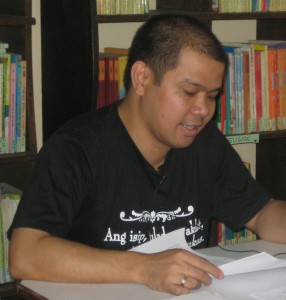
It is not enough that you have big dreams and plans. I should be able to communicate with my co-staff and co-volunteers the essence of why are we doing such activities and the importance of their contribution to our end goals.The quote above appears on "Leadership Lessons," one of the projects of ALA's Emerging Leaders. But no, the speaker is not an American. Instead, he is the only non-American among the 72 American librarians featured on the site. His name is Troy Lacsamana, a Filipino librarian.
Lacsamana has been featured on this blog before, primarily in connection with his role as founder of Aklatang Pambata. But as the "Leadership Lessons" interview reveals, he is now a multimedia librarian at the Quezon City Public Library, which I suspect owes its impressive website and online catalog to Lacsamana's efforts. In spite of his numerous professional responsibilities—and that he is newly married—he continues with his personal advocacy of building community libraries and reading centers.
I don't quite know how PRC's Outstanding Librarians of the Year are chosen (does anyone?), but I certainly think Lacsamana at least deserves to be nominated. Or, if he's too young, maybe there should be another award for librarians forty years of age or younger. This is something that the Ramon Magsaysay Award Foundation instituted in 2001 with its awards for "Emergent Leadership." Perhaps an award like this will show that you don't have to be the director of a library or close to retirement to be an outstanding librarian.

