Quick Links: Talumpati | Licensed Librarians | Filipiniana Online | Stereotypes | Leadership | The Philippines

Filipiniana Online: CORMOSEA Bulletin 31 (2008)

The latest issue of the CORMOSEA Bulletin (pdf), published by the Committee on Research Materials on Southeast Asia (CORMOSEA), focuses on the Philippines. The articles include

"Documentary Sources on the History of Manila at the Archdiocesan Archives of Manila" by Rev. Fr. Roy M. Rosales (pp. 1-8)
"The Culion Leprosy Museum and Archives" by Ricardo L. Punzalan (pp. 9-18)
"Filipiniana Online" by Vernon R. Totanes (pp. 19-23)
I wrote the last article even before my presentation at the Rizal Library International Conference. Unfortunately, due to the unpredictability of the publication process, the article only came out now—a few months after Microsoft’s Live Search Books, one of the sites I recommended, was shut down.

The first paragraph of my article is reproduced below, so you can see whether you'd like to read the rest of it =)
"Online research" is supposed to be what lazy students do. Scholars, meanwhile, are expected to travel to different libraries, archives and museums to consult documents, photographs and books. This, however, is not necessarily true anymore because more and more resources are becoming available online. In some cases, surfing the web is not only less expensive, but also more productive because researchers can examine texts more closely and are not limited by policies regarding physical access to the materials.

Read More...

New Websites and the Future of
Librarianship in the Philippines

What is the state of librarianship in the Philippines? I think the fact that PLAI and PATLS do not have websites says a lot about "Philippine librarianship in the 21st century."

This passage appeared toward the end of a post I wrote about the "Manila International Bookfair 2007." Well, the Philippine Librarians Association, Inc. (PLAI) still does not have a website (thankfully, some of its regional councils have active blogs), but the Philippine Association of Teachers of Library Science (PATLS) now has one that provides reason to hope that future Filipino librarians will be able to take full advantage of the possibilities offered by the Internet.

This development led me to think that it's time I featured some of the new—ok, in some cases, not all that new—websites that I've been hoping to blog about separately. So here goes...

Philippine Association of Teachers of Library Science (PATLS)

It's not quite fully functional yet, but take a look at the new president's speech on "Republic Act 9246 and LIS Education in the Philippines" to see where they're headed. The "Scholarship Program" will be helpful for students, but there don't seem to be any instructions on how to apply at this time.
Infolib
This free library software was one of the few I featured in "Free Library Software" that did not have a website where the software could be downloaded. Now it does. There's no forum for users yet, but there is a "Paypal Donate button," which association websites should consider emulating.
Medical and Health Librarian's Association of the Philippines (MAHLAP)
This association used to have a website that hadn't been updated in years, so this new website looks very promising. Its latest newsletter (pdf) may be downloaded, but either they're still working on making previous newsletters available or I just can't find the links to click.
PAARLWiki
This companion site to the official website of the Philippine Association of Academic and Research Librarians (PAARL) is probably the most complete and updated source for links to articles on, libraries in, standards for, organizations in and outstanding librarians from the Philippines. It has a very limited number of contributors (including this blogger), but most of the work has been done by Fe Angela M. Verzosa.
Finally, there are the websites of the UP School of Library and Information Studies (UP SLIS), the UP Future Library and Information Professionals of the Philippines (UP FLIPP) and the UP Library and Information Science Students’ Association (UP LISSA), all of which sport features that show its creators and readers are not only tech-savvy, but web-savvy.

The future of librarianship in the Philippines looks very bright indeed. I just hope all these websites will continue to be updated regularly.

Read More...

FO: Open Access Journals

In "Open Access in the Third World," I predicted that "the traditional journal will eventually have to be abandoned" and that "in a Third World country like the Philippines, it is, in my opinion, the only way to go." Two years later, it seems that the open access movement is finally gaining supporters in the Philippines. True, many of the journals listed below still do not make articles available in full text (so don't disregard my old list of "Journals" just yet), but enough of them have entire articles—not just abstracts or excerpts—available as PDFs that there is reason to believe that the others will follow suit eventually.

It is, I think, rather unfortunate that there seem to be two competing sites, instead of just one, but hey, whatever works! There are also other journals that could at least be listed with one or the other (e.g., Kritike, Philippine Journal of Science), but aren't. Here's hoping their editorial boards will see the wisdom of appearing on the same page as other Filipino journals.

The titles with one asterisk (*) are those that provide the full texts of some articles for free, while those with two asterisks (**) are those that make all articles available for download. If you discover that I missed putting an asterisk(s) after a title, please leave a comment below.


University of the Philippines Diliman Journals Online

Humanities Diliman*
Science Diliman*
Social Science Diliman*
Journal of English Studies and Comparative Literature*
Kasarinlan: Philippine Journal of Third World Studies**
Plaridel
Review of Women's Studies
Philippine Humanities Review
Diliman Review

Philippine Journals Online
Asia-Pacific Social Science Review
Augustinian
Budhi: A Journal of Ideas and Culture**
DLSU Business & Economics Review**
Far Eastern University Communication Journal
Far Eastern University English Language Journal
Ideya**
Journal of Research in Science, Computing and Engineering
Kritika Kultura**
Loyola Schools Review
Malay
Mindanao Law Journal
Philippine Computing Journal**
Philippine Information Technology Journal**
Philippine Journal of Neurology
Philippine Journal of Psychology
Philippine Journal of Public Administration
Philippine Population Review
Philippine Sociological Review
Philippine Studies* (see also "FO: Philippine Studies")
Tambara
The Asia-Pacific Education Researcher
The Philippine Scientist*
University Belt Consortium Research Journal

Read More...

Filipino Librarians in Vancouver

Grace Valente, Mercy AlmodovarGrace Valente (left) and Mercy Almodovar

Update: It just occurred to me that I should have used their first names below, instead of impersonal surnames, because it would have been fun to end the post with "Yes, I was blessed with Grace and Mercy" =)

In "Proudly Filipino in Vancouver," I promised to write about Filipino librarians in Vancouver. Well, three weeks later, I'm finally getting around to it. And that's pretty good, considering that I still have a lot of outstanding promises =)

Grace Valente and Mercy Almodovar were both librarians at the Ateneo de Manila when I was still in grade school. Valente moved to Canada a few years ago and was working at the BC Cancer Agency when I met her last month. But her biggest news was that she had gotten married only recently. Almodovar, meanwhile, migrated almost two decades ago and is now with a medical library affiliated with the University of British Columbia.

Valente was the one who allowed me to borrow books from the collection of bestsellers reserved for the faculty. She doesn't remember doing that for me, but I did. And the positive experience contributed to the generally positive image of librarians I had even before I became a librarian myself. The opposite is true, too, I suppose. When librarians—perhaps without realizing it—"terrorize" students, they not only perpetuate negative stereotypes about librarians, but also push students away from the library.

Almodovar was the moderator of the Rizal Book Club during one of the years when I was a member. She said that we students probably knew she was very nervous because she was still new then. But she seemed surprised when I told her that I didn't remember her that way at all. Tip to new librarians: Students won't consciously know you're nervous unless you give them reason to suspect that you are. So the image we project—of our profession and ourselves—is really up to us.

Read More...

Filipino Book Historians in Oxford

Von Totanes, May Jurilla, Megumi Ishida, Amadio Arboleda

From left: Me, May Jurilla, Megumi Ishida and Amadio Arboleda.
The photo above was taken at the opening reception of the 2008 annual conference of the Society for the History of Authorship, Reading and Publishing (SHARP). In case you're wondering what it is that book historians do, the SHARP website provides the following description:
Book historians study the social, cultural, and economic history of authorship; the history of the book trade, copyright, censorship, and underground publishing; the publishing histories of particular literary works, authors, editors, imprints, and literary agents; the spread of literacy and book distribution; canon formation and the politics of literary criticism; libraries, reading habits, and reader response.
More concrete examples may be seen in the papers we presented. Patricia May B. Jurilla, author of the newly-published Tagalog Bestsellers of the Twentieth Century, spoke on "Book Alike: Publishing and Photocopying Textbooks in the Philippines." The photo below illustrates the question that went through the minds of those who attended the session: Which one is the original book and which are the photocopies?

May Jurilla
Megumi Ishida and Amadio Arboleda presented a paper on the "Catalytic Role of Major Bookstores in National Book Culture: Case Study of Maruzen Company, Ltd." We all considered Ishida an honorary Filipina because she did her thesis on "The Role of Bookstores in Book Distribution: The Case of the Philippines." Arboleda, her mentor, is Filipino, finished high school and college in the Philippines, and has lived in Japan for more than three decades. We were joking about how Filipinos all seem to be related, when Jurilla and Arboleda discovered that they do have a common link, and may in fact be related to one another!

My paper was on "Teodoro Agoncillo's History of the Filipino People and the History of the Filipino History Book." All of us were part of different panels, but mine was the only one where we were all present because Jurilla and Ishida-Arboleda were on panels scheduled at the same time.

If you're interested in learning more about book history, a panel entitled "On the History of the Book in the Philippines" will be held at the forthcoming 8th International Conference on Philippine Studies. Papers will be read by Ambeth Ocampo, Karina Bolasco, May Jurilla and myself.

Read More...

Outstanding Librarian 2008:
Lourdes T. David

Lourdes T. DavidLourdes T. David
Director, Rizal Library
Ateneo de Manila University

The Professional Regulation Commission conferred the Outstanding Professional Librarian of the Year Award on Lourdes T. David on 20 June 2008. The citation reads:

For her sterling accomplishments as an internationally renowned professional, demonstrating exemplary dedication, competence and integrity, thus earning for her prestigious awards including the Library Technology Award of the University Microfilms International in New York and the Excellence in Library Automation Award of the Electronic Online Systems International; for her invaluable contributions in preparing the United Nations Educational, Scientific and Cultural Organization training modules on library management, information and communication technology, marketing information services, digital libraries and intellectual property rights; for her active involvement in various local and international professional activities which have put Filipino librarians at the forefront of international librarianship; for her able leadership of the Philippines Librarians' Association, Inc.; and for selflessly sharing her knowledge and expertise through published works and papers delivered at international and local conferences.

Thanks to Elvie Lapuz for providing the photo and citation.


Category: Librarians—Awardees

Read More...

SLA 2008: LCSH for Free

The print version of Library of Congress Subject Headings (LCSH; five thick red volumes) is what many catalogers have used for a long time. Some catalogers have begun using "Library of Congress Authorities," which is freely searchable online.

But just today, a participant at a session I attended shared that the entire LCSH has recently been uploaded at lcsh.info, which is an experimental service that aims to "encourage experimentation and use of LCSH on the web."

It's far from being an ebook that non-techies like me can use easily, but if you understand what Simple Knowledge Organization System (SKOS) is all about, you might be able to make it work for you and develop new ways of using LCSH online in non-traditional ways, aside from not having to buy a new set every few years.

See some of the possibilities at "Semantic Search the US Library of Congress." If you know what an API is, you should check out the summary.

Read More...

SLA 2008: Filipino Librarians in Seattle

SLA 2008: Filipino Librarians in Seattle

From left: Me, Jay dela Cruz, Christian Pascasio, Craig Cruz
I'm now in Seattle for SLA 2008, where I'm also blogging for the SLA Blog.

As usual, I've been getting together with Filipino librarians. Unlike previous occasions when most of those who showed up were male, this time we were all male. I met Craig at SLA 2007, Jay and I had agreed to meet via email, and I just walked up to Christian and asked him if he was Filipino (which I've done with others in the past).

Grace Villamora was supposed to join us, but she obviously didn't make it. It would have been nice if Jose Escarilla were around, but he's retired, so he's probably not even here.

Read More...

Proudly Filipino in Vancouver


This is a bit late for Independence Day, but it's finally here =)

The photos above include some of the evidence that I saw of the growing influence of the Filipino community in Vancouver. The photos of the restaurant and remittance centers were taken not in some suburb, but on one of the busiest streets in Vancouver.

Two non-Filipinos are included in the album for reasons that will be made clear below. And just in case you're wondering, I did meet Filipino librarians in Vancouver, but you won't see them here because I'll be devoting a separate post to them.

Ayeza is the pseudonym of a Filipina who migrated to Canada with her parents in the 1990s and got her nursing degree here. She is the owner of Balikbayan Box and was one of my very first friends in the Pinoy blogosphere. One of the most remarkable things I learned about her when we finally met in person was that she usually doesn't bring much with her when she goes to the Philippines, but she does bring a balikbayan box full of Filipino goods with her when she goes back to Vancouver. Yan ang Filipina!

Pamela Dent is Canadian, not Filipino, but she enjoyed working so much as an intern at a Davao school library a few years ago that she went back recently and visited other libraries, too (see her photos here). We began corresponding via email last year while she was doing her masters and thinking of going back to the Philippines. The most memorable thing she said to me was, "I love the Philippines," which is not really something Filipinos normally say. It helped, I think, that she met the man who's now her boyfriend when she was in the Philippines =)

Edgar Wickberg is best known today as the American who rescued the Chinese in the Philippines from the relative obscurity to which they had been relegated by historians before he came along in the 1960s. I thought he turned his back on the Philippines afterward and moved on to doing research on the Chinese in Canada, but I was pleasantly surprised to learn that he merely "took a holiday for twenty years," and still knows what's going on in the Philippines. He's now 81 years old, retired, and is dealing with prostate cancer, but still strong enough to drive his car to meet with a PhD student who wants to talk to him about his work on the Philippines.

Read More...

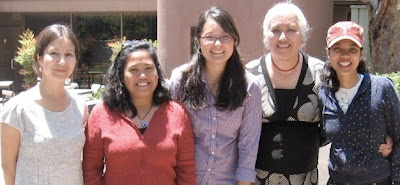
Filipino Librarians at UCLA

Filipino Librarians at UCLAUpdated 7 July 2008 with correct names. Thanks to Becca!
From left: Becca Dean, Jade Alburo, Lessa Pelayo, Eloisa Borah, Glenda Gamboa

It looks like someone else is bringing Filipino librarians together for meals. The photo above appears on blogs owned by Becca Dean and Jade Alburo, but the person who brought them all together is Eloisa Borah, who does not blog but has some useful resources on her website. Unfortunately, neither blogger identified the people in the photo, so here's my best guess: from left, Becca, Jade, [unknown], Eloisa, [unknown] =)

Here's hoping other Filipino librarians who get together outside the Philippines will post their photos, too, and maybe write about what it's like to work as librarians where they are. And no, I'm not discriminating against those in the Philippines—I know they have a lot of photos online.

Read More...

Related Posts Plugin for WordPress, Blogger...