Quick Links: Talumpati | Licensed Librarians | Filipiniana Online | Stereotypes | Leadership | The Philippines

Institutional and Association Blogs

It's not just individual Filipino librarians who are blogging now. The institutional and association blogs listed below are the ones I know about. I have featured some of them before, but others are relatively new or I never got around to writing about them. Some are official library blogs, while others are advocacy or even supplier blogs.

Aklatang Pambata Online
I doubt if there are many in Philippine librarianship who have not heard of or read about Troy Lacsamana and Aklatang Pambata.
ASLP online
The blog of the Association of Special Libraries of the Philippines (ASLP) is hosted by Arnold Zafra, who seems to be doing it pro bono.
Bayan Akayin Sa Abot-Tanaw (BASA)
Basa is the Tagalog word for "read." It's interesting that the driving force behind BASA is not a librarian, but Fr. Ted Gonzales, SJ.
EISI News
It used to be that Electronic Information Solutions, Inc. (EISI) relied more on a traditional website. Now its blog is its website.
Filipino American Library Blog Spot
The Filipino American Library has a website, a MySpace account and a blog. Wow!
What's New at the IRRI Library
The International Rice Research Institute (IRRI) library's blog is also available as a Bloglines blog, which actually came before the one on Blogger.
PLAI-Southern Tagalog Region Librarians Council (STRLC)
Like the Philippine Librarians Association, Inc. (PLAI), PLAI-STRLC does not have a traditional website, but unlike PLAI, it has a blog and is actually using it to share conference presentations.
PNU-LIS Updates
The PNU Library and Information Science Alumni Association (PNU-LISAA) hasn't been updated since December 2005, but now that Peachy Limpin is blogging again (from Australia!), maybe some new posts will be forthcoming.
UP Library Bulletin
The official newsletter of the University of the Philippines Library System now has an online version. Perhaps other libraries will soon follow? =)
Unfortunately, not all of these blogs are updated regularly. But thanks to Jenny Levine and FeedBurner, I've put together a page on Institutions that will be updated whenever any of the blogs above are updated. Alternatively, you can also subscribe to the RSS feed.


Category: Biblioblogosphere

Read More...

Job Openings and Career Development

There's a new Filipino Librarian blog: Job Openings and Career Development. Unlike this blog, the new one will be oriented more toward librarians and their professional development:

If the original Filipino Librarian is the opinion page, then this blog is the classified ads section. Except for the summaries of each post, all posts will appear as they were written by the original authors. Please do not contact me for more information because I don't have any. If you have any suggestions or would like to publicize a job opening or event, email me at von.totanes @ gmail.com.
Thanks to J. Angelo Racoma for making the new blog possible.


Category: About Filipino Librarian

Read More...

One Fine Day

My life came together in a very unique way today.

At 10 am, I met with my adviser as a PhD student. As a librarian, I attended a lecture at 12 noon by the president of the International Federation of Library Associations and Institutions (IFLA). At 2:30 pm, I listened—as a Filipino—to a political scientist discuss volatility in the Philippines.

From there, I hurried to catch the rest of a talk about Michael of Rhodes that began at 4:30 pm, and which was important to me as a student of book history. Finally, I attended Barbra Streisand's concert tonight as a fan =)


Create Your Own!

Pat Fleming, my adviser, said that I was on the right track with what I was doing for my dissertation. Alex Byrne, president of IFLA, wondered why copyrights are extended at around the same time the ones for Mickey Mouse expire. And David McGee suggested that Michael of Rhodes used his legendary manuscript to win votes among passengers who didn't have much to do on board a ship.

It was a bit embarrassing listening to Paul Hutchcroft talk about "Political Volatility in the Philippines: Origins of Crisis, Prospects for Reform" because the circus that's been going on in our country sounds especially absurd when seen in the company of non-Filipinos. Except for a not-exactly-wrong reference to "fall of 2005," I couldn't really say that he said anything wrong. But I had to speak up when someone asked about what's going to happen until 2010, and another commented on the Manila-centric presentation.

I don't know if I expressed myself well enough, but what I wanted to say was that more orchestrated maneuvers and counter-maneuvers will take place but nothing much will happen because the people—including me—are sick of politics. Life goes on, as the could-be-better-but-not-bad state of the economy will attest. And the same is true for those in the provinces—they're sick of politics in Manila, too.

Then there was Barbra Streisand. I "met" her in first-year high school because Mr. Pagsi couldn't stop talking about her "One Voice" concert, which he saw on laser disc. I turned into a fan of her music (mostly the Broadway albums) and concerts over the years, but not her movies.

So when I found out Toronto was going to be one of two non-American cities on her tour, I decided that I'd watch her live in concert if I could get a cheap-enough ticket. I did get a ticket, but I took the warnings seriously and didn't bring my camera. And that's why it's a poster up there, and not a view from my almost-nosebleed-worthy seat.

Aside from the usual goosebumps with songs like "The Way We Were," "People" and "Somewhere," I found the use of a few lines of "You've Got To Be Carefully Taught" (South Pacific) as an intro to "Children Will Listen" (Into the Woods) very effective. Streisand's also still very much a funny girl. I haven't been to too many concerts, but I don't remember laughing as much as I did at this one.

I don't quite know why all these happened on this one day. But I suppose it's a sign that I'm in the right place =)


Category: About Vonjobi

Read More...

i-Conference 2006: Epilogue

The official audio recordings, session notes and photos should be up soon, but in the meantime, you may want to check all the other posts about i-Conference 2006:
Social Life of Information: Intellectual Responsibility, Wired, i-Conference Doctoral Colloquium
SI504: iSchool Conference Google Book Session
digital curry: i school conference : google book project
eighty-eight empires: The Cost of Failure
iSchools Thesis Research: i-Conference 2006
I'm not quite sure what the scarcity of posts means, but it seems that there weren't too many bloggers at the conference.

The following are photos of the unique giveaway each participant received (the conference schedule is on the other side) and the Qwizdom device used at the closing session that allowed the organizers to survey the participants a la "Who Wants to be a Millionaire."

Read More...

i-Conference 2006:
Christine Borgman on the Scholarly Information Infrastructure

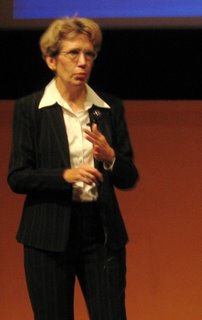
Christine BorgmanIn "Disciplines, Documents, and Data: Convergence and Divergence in the Scholarly Information Infrastructure," Christine Borgman (UCLA) provided an overview of her forthcoming book Scholarship in the Digital Age: Information, Infrastructure, and the Internet (2007). While the other two plenary sessions were good, it was the one with Borgman that I found most relevant to me as a PhD student, librarian and freelance editor.

The fact that she cited websites and not scholarly works as examples is indicative, in my opinion, of the future of scholarly communication. Some of the websites were:
Sloan Digital Sky Survey
Incorporated Research Institutions for Seismology
Electronic Cultural Atlas Initiative
She mentioned the usual technical definition of "data"—"reinterpretable representation of information in a formalized manner suitable for communication, interpretation or processing" (Reference Model for an Open Archival Information System [pdf], 2002)—as an introduction to the socio-technical definition: "alleged evidence" (Buckland, 2006). She then made the point that data needs to be interpreted, analyzed, etc.

Borgman discussed the disciplinary differences between science, social science, and the humanities, and how the data used in the three fields vary greatly. Memorable quote from her friend: "The plural of anecdote is not data." She also talked about incentives to share data (i.e., tradition of "open science"; collaboration; reciprocity; recognition; coercion) and incentives not to share (i.e., rewards are for publication, not data management; effort to document data; competition, priority of claims; intellectual property).

Do scholars share more now? According to Borgman, it depends on the field, but even with arXiv as the poster child for open access and evidence that self-archived articles get cited more, less than 4 percent of publications that should have been archived in PubMed Central are actually available online at this time.

While there is quite a bit of resistance now, I believe that open access journals will eventually be the norm. It may take a decade and some legislation, but it will happen. That should make things easier for publishers and authors in developing countries like the Philippines. But there's another problem: not too many Filipinos are doing research...


Category: i-Conference 2006

Read More...

Support for Library Hub Continues

In line with the thrust of the Department of Education (DepEd) to make every Filipino child a reader by grade three, Secretary Jesli Lapus has pushed for the establishment of library hubs nationwide.

"Education chief pushes for establishment of library hubs"
(Sun.Star Manila, 15 October 2006)

It's good to know that Jesli Lapus, the new DepEd secretary, supports Library Hub. It's interesting, however, that the press release does not mention former undersecretary Miguel Luz at all.


Category: Libraries—Public Schools

Read More...

i-Conference 2006:
Filipino PhD Students

Filipino PhD Students

From left: Mayette Rivera, Fr. Denny Toledo, Ricky Punzalan, and me.
Click on the photo to see a larger version.

I thought Ricky Punzalan and I would be the only Filipinos at i-Conference 2006. But I was happy to learn that I was wrong. It's just too bad that the only time we were all together was for the photo above.

Individual info is as follows:

Ma. Theresa "Mayette" M. Rivera
University of the Philippines
"The Old and the New Media: Community Communication and Citizen Participation in a Tri-cultural Community in Upi, Maguindanao"
Dissertation grant recipient, Fulbright CHED-MAEP

Ramon Prudencio "Denny" S. Toledo, SJ
Drexel University
"Negotiation in Online Collaborative Mathematics Problem-solving"

Ricardo "Ricky" S. Punzalan
University of Michigan
"Culion Leprosy Patient Records: Manifestations of Segregation and Colonial Control"

Vernon "Von" R. Totanes
University of Toronto
"History of the Filipino History Book in the Twentieth Century"
Note: All dissertation titles are tentative.


Category: i-Conference 2006

Read More...

i-Conference 2006:
Digital Libraries as Collaborative Spaces

Dagobert Soergel (Maryland) opened the session "Digital Libraries as Collaborative Structured Information Spaces" with some unique housekeeping matters (e.g., email your questions!) and pointing to the downloadable slides (ppt). He dispensed with introductions and just showed the names of the panelists on a slide: Gary Marchionini (North Carolina) Michael Twidale (Illinois), Christine Borgman (UCLA), Ann Weeks (Maryland), Judith Klavans (Maryland).

Marchionini talked about digital libraries (DL) as "sharium" (i.e., A virtual workspace with rich content and powerful tools where people can work independently or collaborate with each other...). Twidale discussed how DL access structures can facilitate and be facilitated by collaboration. Very interesting: If we build it they will come. We built it - they didn't come - why not? They came & built it themselves. Aside from the usual examples (e.g., Flickr), he also referred to Google's PageRank as a product of implicit collaboration, and the Art Museum Social Tagging Project.

Borgman used her work on the Alexandria Digital Earth ProtoType as an example of how DLs can be used in education and the research issues involved (including "We built it and they didn't come"). Weeks spoke about DL-based collaboration in the context of the International Children's Digital Library. And it has, in fact, come a long way since I last wrote about it.

Klavans shared her experience with DLs and humanities computing involving text and images. Her project on Computational Linguistics for Metadata Building may not compare favorably with Google Images on the keyword "madonna," but since its focus is on exhibition catalogs, textbooks and scholarly journal articles, there's really no sense making the comparison.

Finally, I'm glad that I didn't get so discouraged after the last session and decide to skip this session. Libraries do, in fact, have a place in a flat world.

[5:49 pm] An interesting answer was made in reply to a question asked regarding the use of games in DLs (e.g., Peekaboom). The "Henry Ford" model refers to taking an expensive product and producing it cheaply, while the "Tom Sawyer" model involves portraying fence-painting as fun and getting other people to do the work for you for free. Which one is more prevalent online? =)


Category: i-Conference 2006

Read More...

i-Conference 2006:
iSchools in a Flat World

Ronald Larsen (Pittsburgh) started the session on "iSchools in a Flat World" by referring to Thomas Friedman's The World is Flat and positioning iSchools in the 21st century. He then introduced Raymond von Dran (Syracuse), Shalini Urs (Mysore, India) and Martin Weiss (Pittsburgh). Unfortunately, two speakers from India and China were not able to make it.

Von Dran talked about his school's experience offering online courses at a Toronto university that was scuttled by regulatory policies across the border. And then he told his own recent story about flying from New York to China to keynote a conference and getting sent back because his visa was "improper." Finally, he talked a little about the Wise Consortium.

Urs began with a map showing exactly where Mysore is. She then provided an introduction to the Mysore-based, online International School of Information Management (ISIM), and explained why the cluster approach and collaboration are important to ISIM. Eventually, she ran through the who, what, where, when of ISIM. Classes start next year.

Weiss reported on his school's experiment with offering an online course in collaboration with the Beijing Institute of Technology, and covered similar ground as Urs, except that he was talking in the past tense.

Based on the non-mention of the word "library" since the session started, it does not seem as if libraries and librarians are going to be part of iSchools in a flat world. In fact, except for a session about digital libraries later, the sessions I've attended and the remaining sessions seem to emphasize the iSchools' drift away from libraries.


Category: i-Conference 2006

Read More...

i-Conference 2006:
Emerging Research Agenda

AnnaLee Saxenian (UC Berkeley) started with a few words on "Services: Science, Management, and Engineering Emerging Research Agenda for iSchools," and introduced the panelists: Steve Sawyer (Penn State), Eric Yu (Toronto) and Robert Glushko (UC Berkeley).

Sawyer talked about five points in the context of real estate transactions: interdependence, co-creation, distribution, intangibility, and contextualization. [It's not entirely clear that I got all his points because after the third point, he just kept saying "next point" even after the fifth one. He summarized at the end, but the points seemed to be different from the ones I got. Slides would have been helpful.] Best story: real estate agents now work mostly from their cell phones, and ask their children to manage their websites... and some have recalled their kids from school when the website went down.

Yu discussed "The other 'Service' movement," which referred to a service orientation in computing, and whether iSchools should be involved in this movement. Services, he said with tongue in cheek, are being transformed by adding an "e" to words like "health," "business" and "museums." He then defined service-oriented computing (SOC), cited Google Maps as an example, and made a good point about how systems should be designed with interconnection in mind, and not built first then try to figure out how to connect them. He ended by summarizing: SOC is a major movent today, and iSchools must engage deeply in shaping it.

Glushko focused on "Bridging the 'Back Stage' and 'Front Stage' in Service Systems," and spoke specifically about how "service" is taught in school. Rather than emphasizing differences in service delivery methods, he'd rather emphasize what they have in common: service providers and consumers. [Aside: There was a problem with maximizing a webpage on the Mac, and he said that he hadn't used PowerPoint in four years. I suppose the problem illustrates his point about the back and front stages, but if we think of him as the provider and his audience as the customer, maybe he should have spent time with the software before using it.] He went on to say that there is a need to resolve the tension between the back and front stages, and ended with the role the iSchools can play in the resolution.


Category: i-Conference 2006

Read More...

Related Posts Plugin for WordPress, Blogger...