Quick Links: Talumpati | Licensed Librarians | Filipiniana Online | Stereotypes | Leadership | The Philippines

Teodoro A. Agoncillo, 1912-2012


Today is the centennial of the birth of Teodoro Agoncillo. He was, in my opinion, the most influential Filipino historian of the twentieth century. And it is only appropriate that historians like Ambeth Ocampo, Renato Perdon, and Michael Xiao Chua have paid tribute to him as a historian. But before Agoncillo became recognized for the history books he wrote in English, he was in fact better known as a literary critic and poet... in Tagalog. Other lesser-known details about him include the fact that despite the perception that he was anti-Catholic, he counted Horacio de la Costa, a Jesuit priest, among his closest friends, and sent his children to Catholic schools. Also, while he never earned a PhD degree, he did receive an honorary doctorate (see photo above).

The brief biography below, which reveals a few more details that are not widely known, is a slightly revised version of several paragraphs from “History of the Filipino History Book,” my dissertation, in which Agoncillo figures prominently. I have removed the footnotes to make it more readable.


Born in the province of Batangas in 1912, Teodoro Agoncillo grew up surrounded by relatives and friends who survived the wars against the Spanish and the Americans. His father, in particular, fought alongside one of the last Filipino generals to surrender to the Americans in 1902. His grand-uncle was one of the first Filipino diplomats who sought to gain international recognition for the first Philippine republic, and his wife was one of the three women who sewed the very first Philippine flag. He was also a distant relative of Emilio Aguinaldo, the first President of the Philippines, who married an Agoncillo after his first wife died in 1921.

He learned Spanish in kindergarten, and attended the public schools established by the Americans, where he became fluent in English, but affirmed his Filipino identity by reading Jose Rizal’s Noli Me Tangere (1887) and El Filibusterismo (1891) as early as the seventh grade. By the time he graduated from high school, Agoncillo had already begun writing poems, most of which were penned in Tagalog. It is hardly surprising, therefore, that he entered the University of the Philippines in 1930 with the intention of majoring in English, not history. He credits Leandro Fernandez, author of A Brief History of the Philippines (1919), and who was then UP’s registrar and chair of the history department, for convincing him that a student did not need a degree in English to be a good writer, and persuaded him to switch to history.

Agoncillo’s stint as a campus journalist at the Philippine Collegian, UP’s student newspaper, proves that Fernandez was correct, but it was not until after he began his master’s degree in history in 1934 that his writing began to draw feedback similar to the heated reactions his later articles and books received. Among those early, critical works were “Glaring Errors in a Doctoral Dissertation” (1935), a pamphlet he coauthored that questioned the content of a dissertation and its acceptance by the University of Santo Tomas, and “Ang Banaag at Sikat ni [Glimmer and Radiance by] Lope K. Santos” (1936), which faulted the classic Tagalog novel’s author, who was considered an established pillar of Tagalog literature, for turning his protagonists “into mere sounding boards for Santos’ political slogans.”

But it was the publication of Agoncillo’s review of Ricardo Pascual’s Dr. Jose Rizal Beyond the Grave (1935)—in which he supported the author’s position that Rizal’s so-called retraction document was a fake, and made disparaging remarks about the Catholic Church—that resulted in the suspension of the Collegian’s editor-in-chief, the first recorded instance of censorship in the history of the campus paper. Agoncillo did not, however, consider it his duty to challenge authority whatever the cost.

Not long after he coauthored Ang Kasaysayan ng Pilipinas (with Gregorio Zaide), the first Tagalog history textbook, and got married in 1941, the Japanese attacked Pearl Harbor and were effectively in control of the Philippine Islands within a few weeks. During the Second World War, Agoncillo’s wife refused to let him work for fear that he would be picked up by the Japanese and sent elsewhere, which was not uncommon during that period. Thus, he stayed home and, using his own private library, continued doing research, reading, and writing. He also collected periodicals and other printed materials, and recorded his observations about the war, which eventually ended up in some of his books.

After the war, a friend convinced him to join a government-sponsored, biography-writing contest because of all the data he had accumulated, and his wife again played an important role in his career when she taunted him after learning he had yet to write a single paragraph. He finished typing his manuscript in January 1948, and barely beat the deadline for submission. Agoncillo’s entry was unanimously chosen the winner in July 1948, but it was not until The Revolt of the Masses was actually published in 1956 that he finally gained acclaim as a historian.

The book was supposed to be printed at the government’s expense, but its publication was blocked not once, but twice, by two Presidents of the Philippines: Elpidio Quirino in 1948, and Ramon Magsaysay in 1956. Scholars have alluded to these struggles before, but what is rarely mentioned is that the circumstances surrounding the book’s controversial publication are indicative of the political and social tensions—or struggles in the field of power—that existed during that time.

In 1950, newspaper coverage of the objections made by the Catholic bishops of the Philippines to the distribution of copies of the English translation of Rafael Palma’s Rizal biography, The Pride of the Malay Race (1949), to high school students paled in comparison to the threat posed to the government by the Huk movement, a peasant resistance organization during the Japanese occupation that transformed into a communist insurgent group after independence. By 1956, the Huks were not as potent a threat as they had been six years earlier, but the specter of communism remained, which the authors of an anti-Revolt pamphlet invoked soon after Agoncillo was granted permission to have the book printed himself. Within a month after the pamphlet’s release, debates erupted on the Senate floor over the Rizal Bill, which required students to read Rizal’s novels in class, but this controversy is seldom mentioned in connection with the disputes over the publication of Agoncillo’s Revolt.

Although it was probably the last time that books written by Filipinos were the subject of consecutive, front-page controversies in the same year, the lack of significance attached to this confluence of events is understandable. Scholars who mention the battle over the Rizal Bill usually do so in relation to Rizal’s importance to Filipinos, while those who discuss the publication of Agoncillo’s book often focus on its role in the emergence of Bonifacio as a viable alternative to Rizal as national hero. The two controversies, however, were directly related: Agoncillo was responsible not only for writing Revolt, but also the earliest draft of the Rizal Bill, which sought to promote the teaching of the lives and works of Filipino heroes, not just Rizal.

In 1958, Agoncillo was hired as a full professor at the University of the Philippines, and chaired its Department of History from 1963 to 1969. By the time he retired in 1977, Agoncillo had received numerous awards, as well as an honorary doctorate, and had been promoted to University Professor, the highest academic rank at UP. A few months after his death in 1985, he was posthumously proclaimed a National Scientist. In the year 2000, he was declared one of the Philippines’ “Most Influential 20” in the twentieth century—the only academic in a group that included presidents, movie stars, and business leaders.

Read More...

Library vs Internet?


The photo above shows Gino (Daniel Padilla), right, as he asks King Anand (Albert Martinez) for permission to use the latter's library: "...pwede ko ho bang gamitin yung library? Kasi po sa Internet, baka may ma-miss po ko eh." (May I use the library? Because on the Internet, I might miss something.)

Gino's statement is actually debatable when taken out of context, but it's good to see that a character in a teleserye, the most popular form of Philippine culture today, is acknowledging the library as a reliable source of information, which does not often happen in Filipino movies and television shows (where the library is frequently merely a setting for humorous happenings, scary sequences, or erotic encounters).

You can watch this 2 November 2012 episode of "Princess and I" (along with current and previous episodes of other ABS-CBN shows) for free on iwantv (registration required). The quote may be heard in the scene that begins at 7:34. The line is spoken at 8:10.

Thanks to Elvie Lapuz for the heads up =)

Read More...

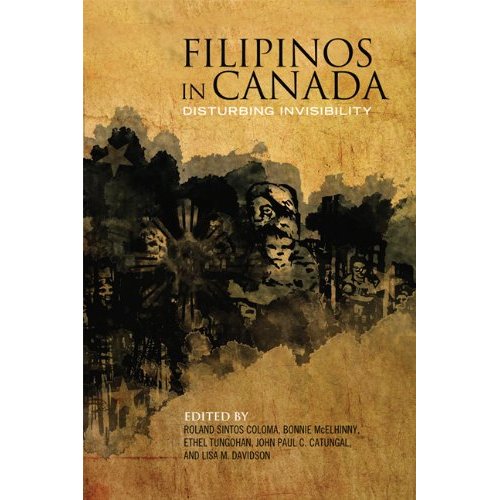
Filipinos in Canada: Disturbing Invisibility


Filipinos in Canada: Disturbing Invisibility
Edited by Roland Sintos Coloma, Bonnie McElhinny, Ethel Tungohan, John Paul C. Catungal, and Lisa M. Davidson
Toronto: University of Toronto Press

The book is available in hardcover and paperback on Amazon.ca and the University of Toronto Press website.

Composed of papers presented at “Spectres of In/Visibility: Filipina/o Lives in Canada” in Toronto, Ontario, Canada, on 23 October 2009 (plus a few more added after the conference), this book is the first academic publication to bring together the works of Filipino, Canadian, and Filipino-Canadian scholars about the experiences of Filipinos in Canada.

[Disclosure: One of its chapters, "Borrowing Privileges: Tagalog, Filipinos, and the Toronto Public Library," is a paper I wrote not because it was directly related to the dissertation I was writing at that time, but because I wanted the field of library and information science (LIS) represented in this groundbreaking work.]

Below are some of the articles about the book and its launching that have appeared in print and online, followed by the press release about the book, and its table of contents.

"Prof. Roland Sintos Coloma on disrupting invisibility of Filipino-Canadians" by Dyan Ruiz
"Big crowd welcomes book on Filipinos" by Hermie Garcia
"Academia and Activism" by Ethel Tungohan
"The invisible Pinoy" by Joe Rivera


Filipinos in Canada: Disturbing Invisibility

The Philippines became Canada’s largest source of short- and long-term migrants in 2010, surpassing China and India, both of which are more than ten times larger. The fourth-largest racialized minority group in the country, the Filipino community is frequently understood by such figures as the victimized nanny, the selfless nurse, and the gangster youth. On one hand, these narratives concentrate attention, in narrow and stereotypical ways, on critical issues. On the other, they render other problems facing Filipino communities invisible.

This landmark book, the first wide-ranging edited collection on Filipinos in Canada, explores gender, migration and labour, youth spaces and subjectivities, representation and community resistance to certain representations. Looking at these from the vantage points of anthropology, cultural studies, education, geography, history, information science, literature, political science, sociology, and women and gender studies, Filipinos in Canada provides a strong foundation for future work in this area.


Part I
Difference and Recognition


Chapter 1
Spectres of In/visibility: Filipina/o Labour, Culture, and Youth in Canada
Bonnie McElhinny (University of Toronto), Lisa M. Davidson (University of Toronto), John Paul C. Catungal (University of Toronto), Ethel Tungohan (University of Toronto), and Roland Sintos Coloma (University of Toronto)

Chapter 2
Filipino Canadians in the Twenty-First Century: The Politics of Recognition in a Transnational Affect Economy
Eleanor Ty (Wilfrid Laurier University)

Chapter 3
Filipino Immigrants in the Toronto Labour Market: Towards a Qualitative Understanding of Deprofessionalization
Philip F. Kelly (York University), Mila Astorga-Garcia (Community Alliance for Social Justice), Enrico F. Esguerra (Community Alliance for Social Justice), and the Community Alliance for Social Justice, Toronto

My Folks
Carlo Sayo (Sinag Bayan (Light of the Nation) Cultural Arts Collective) and Jean Marc Daga (SIKLAB Ontario)

Part II
Gender, Migration, and Labour


SCRAP
Reuben Sarumugam (Magkaisa Centre) and Bryan Taguba

Chapter 4
The Recruitment of Philippine-trained Healthcare Professionals to Canada in the 1960s
Valerie G. Damasco (University of Toronto)

Chapter 5
The Rites of Passage of Filipinas in Canada: Two Migration Cohorts
Josephine Eric (Migrant Workers Family Resource Centre)

Chapter 6
(Res)sentiment and Practices of Hope: The Labours of Filipina Live-in Caregivers in Filipino Canadian Families
Lisa M. Davidson

Chapter 7
Debunking Notions of Migrant “Victimhood”: A Critical Assessment of Temporary Labour Migration Programs and Filipina Migrant Activism in Canada
Ethel Tungohan (University of Toronto)

Chapter 8
Toronto Filipino Businesses, Ethnic Identity, and Place Making in the Diaspora
Cesar Polvorosa, Jr. (York University)

Chapter 9
Between Society and Individual, Structure and Agency, Optimism and Pessimism: New Directions for Philippine Diasporic and Transnational Studies
Leonora C. Angeles (University of British Columbia )

Part III
Representation and Its Discontents


Balikbayan Express
Celia Correa (University of Toronto)

Chapter 10
Meet Me in Toronto: The Re-Exhibition of Artifacts from the 1904 Louisiana Purchase Exposition at the Royal Ontario Museum
Bonnie McElhinny

Chapter 11
From the Pearl of the Orient to Uptown: A Collaborative Arts-Based Inquiry with Filipino Youth Activists in Montréal
Marissa Largo (University of Toronto)

Chapter 12
Borrowing Privileges: Tagalog, Filipinos, and the Toronto Public Library
Vernon R. Totanes (University of Toronto)

Chapter 13
Abject Beings: Filipina/os in Canadian Historical Narrations
Roland Sintos Coloma

Chapter 14
Between the Sheets
Geraldine Pratt (University of British Columbia)

Part IV
Youth Spaces and Subjectivities


Colour Correction
Eric Tigley (Youth Education through Interactive Arts)

Chapter 15
Scales of Violence from the Body to the Globe: Slain Filipino Youth in Canadian Cities
John Paul C. Catungal

Chapter 16
Kapisanan: Resignifying Diasporic Post/colonial Art and Artists
Christine Balmes (University of Toronto)

Chapter 17
Educated Minorities: The Experiences of Filipino Canadian University Students
Maureen Grace Mendoza

Chapter 18
“Mas Maputi Ako sa ‘yo” (“I’m lighter than you”): The Spatial Politics of Intrarracial Colorism among Filipina/o Youth in the Greater Toronto Area
Conely de Leon (York University)

Chapter 19
The Social Construction of “Filipino Studies”: Youth Spaces and Subjectivities
Jeffrey P. Aguinaldo (Wilfrid Laurier University)

Part V
Afterword


Chapter 20
Contemplating New Spaces in Canadian Studies
Minelle Mahtani (University of Toronto) and David Roberts (University of Toronto)

Read More...

The 9/11 Memorial


In 2006, I linked to a website (now defunct) that indicated that at least 15 individuals of Filipino descent died at the World Trade Center towers on 11 September 2001. In 2007, I linked the same names to obituaries that first appeared in the New York Times and other newspapers, even though evidence they were Filipino was not always clear. Since then, the inauguration of the 9/11 Memorial has made it possible to confirm that most of them were born in the Philippines, as well as identify other individuals not previously listed as Filipino.

Unless otherwise indicated, the basis for concluding that the 21 individuals named below were Filipino is the 9/11 Memorial.
Cesar Amoranto Alviar (NYT)
Marlyn Capito Bautista
Cecile Marella Caguicla
Grace Alegre Cua
Jayceryll Malabuyoc de Chavez

Benilda Pascua Domingo
Judy Hazel Santillan Fernandez
Ronald L. Gamboa
Ramon B. Grijalvo
Gerald Francis Hardacre

Frederick Kuo, Jr. (NYT)
Arnold Arboleda Lim (Filipino heritage remains unconfirmed)
Manuel L. Lopez, 54
Cynthia Motus-Wilson
Ruben S. Ornedo

Carl Allen B. Peralta, 37
Maria Theresa Concepcion Santillan (cousin of Judy Fernandez, probably Filipino)
Rufino C.F. Santos III
David Marc Sullins
Hilario Soriano Sumaya, Jr. (NYT)

Hector Rogan Tamayo
Please remember them and the others who died on 11 September 2001 in your prayers.

Read More...

Outstanding Librarian 2012:
Pablo Muyano de Vera

Pablo Muyano de Vera
Coordinator of Libraries
San Beda College Library

The Professional Regulation Commission conferred the Outstanding Professional Librarian of the Year Award on Pablo Muyano de Vera on 22 June 2012. The citation reads:
For his outstanding achievements as Professional Librarian as exemplified by his utmost competence and integrity as Chief Librarian, SBC Alabang, Administrator and Abbey Dean, Director of Libraries, Manila, Adviser SBC Junior and Senior Library Clubs and coordinator of libraries in Mendiola, Alabang, and Rizal Campuses; for his significant contribution to the advancement of the profession by sharing his knowledge and expertise to his peers as speaker on various topics such as Current Trends and Practices in the Workplace, Library 2.0 Enhancing Competencies, Enriching the Culture Collaboration among Educational Institution and Libraries, Meeting the Challenges of Librarianship Access and the ABCs of Librarians Success in the Workplace to mention a few; for his extensive travel and study tours in numerous libraries in California, National Library of Korea, Toronto, Vancouver Canada Libraries, US Libraries, Spain Library and Museum, Vatican, British and Biblioteque Nationale du Paris; for the numerous awards he received such as the UST Library Science Alumni Association Outstanding Award, PAARL Lifetime Achievement Award, PLAI Special Meritorious Service Award, PLAI-STRLC Distinguished Librarian Award and PLAI Hall of Fame.

Thanks to Elvie Lapuz for providing the photo and citation.


Category: Librarians—Awardees

Read More...

Librarians' Licensure Examination 2011: Results

Congratulations to the new librarians!

The passing rate for the Librarians' Licensure Examination is 28 percent (211 out of 764), up slightly from 27 percent in 2010.

Below are the list of the Top 11 and the list of all successful examinees. Both were taken from documents downloaded from the official website of the Professional Regulation Commission, which is now much more user-friendly, features all documents released to newspapers since 2009, and makes Verification of Professional Licenses possible. My only suggestion for improvement for the last one is that instead of just stating that a person is "listed in the LIBRARIAN Registry Books of PRC," the year of expiration of the person's license should also be indicated.

"Library science" (take note: not LIS) was recently identified in "PRC lists in demand college courses" (Philippine Daily Inquirer, 18 November 2011) as a degree that can get students "hired immediately upon graduation." It would be interesting to know the basis for PRC's assertion, but perhaps the best way of testing the inclusion of "library science" on the list is to verify how many of those who took the exam for the first time (and were not working in libraries before they graduated) were hired as librarians (and not contractuals or call center agents) upon graduation. I will be happy if my skepticism is proven unfounded, but if LIS graduates are not in fact "in demand," I think a correction needs to be made.

I have heard it said that there is a librarian shortage in the Philippines because many public schools, for instance, do not have a librarian, but how many of these schools actually have a library or are even looking to hire a librarian? Every now and then, legislators issue press releases on their efforts to amend Republic Act No. 7743, which provides for the establishment of "public libraries in every congressional district, city and municipality, and reading centers in every barangay throughout the Philippines," but aside from not having any specific provisions on where the funding will come from, there is also no mention in these draft bills for the hiring of librarians. I don't want to sound so pessimistic, but it would be good to see some hard data to back up optimistic projections.

Top 11
LORRAINE CLAIRE KEE SALVE 87.20
MARTIN JULIUS VILLANGCA PEREZ 86.95
JOSE MARI LONTOK FLORES 86.70
CATALINA BACOCO OLOAN 86.50
MARIA JUDITH FAYE TONGSON GOROSPE 86.30
MELYSSA LAUREN MARIANO MANUEL 86.25
ROSHEN MEJOS LOMOCSO 85.75
JENA VALEZA TALAN 85.60
LYCA DIALINO ORAYA 84.50
YHNA THERESE PALAYA SANTOS 84.50
LAARNI VIVAS MARCIANO 84.45

Successful Examinees
ABAO, MIRIAM YAMIT
ABELLANOSA, GEMMA MAGSINO
ABIQUE, JEMMA LYN TRAYFALGAR
AGCAOILI, KAREN ANGELICA SISANTE
AGUSILA, MA GINA VALENCIANO
ALBALOS, JOAN CUISON
ALDUEZA, ANNE KRIZELLE DE LUNA
ALMERIZ, GERLYN DAYRIT
ALUYEN, ESTER PALAGPAG
AMANO, MARIE ANN MABANAN
AMONCIO, CRISTY AVILA
ANGCAO, RONALICE CLARE GARCIA
ANOS, ANNE SHERINA DE JESUS
ARCE, MARIA RICA BAÑARES
ARGENTE, MADEL LABIANO
ASUG, CYNDY ORBITA
BAGTANGAN, JANICE CAWAING
BAJOYO, LILIBETH ARGUELLES
BALANGCOD, ROXANNE KANTALA
BALBALIN, LENNY PACALSO
BANDONG, JENNYLYN SALUT
BARRIENTOS, ALLAN QUISOR
BATO, FATHA RAMOS
BATOON, CHILOU PILARTA
BAUTISTA, JAMEILA ANGELI SOLOMON
BAUTISTA, KARMELA DAWN JORVINA
BAÑARES, MA NOIDA VIDAL
BELICARIO, MARK ANTHONY CO
BERNABE, JOYCE ANNE SILVERIO
BUYOCAN, KATHERINE MALITAH
BUYUCCAN, LAILANIE PUGUON
CABADING, PROMENTHUS KEHM GERRI MANABAT
CABANGAL, JACKIELYN SABIDALAS
CAGAS, ALFREDO CADENAS
CAGUITE, DENNIS KELVIN MANALO
CANTIGA, CATHY REMEDIO
CAPIL, SHANE BL CERVANCIA
CARABALLA, JEROME MIGUEL
CARIAGA, ESTHER CATANGAY
CASTILLO, RAMON JR GUIBEJAR
CASTRO, JOVILYN REYES
CAY-AN, ERICSON SAB-IT
CENA, BERNALYNN FERNANDEZ
CONCEPCION, RODELYN MANLANGIT
CONCORDO, MARIA THERESA BAROL
CONSTANTINO, JOANNE CHUA
CORPUZ, PETER JOHN REYNOSO
COSSID, MARIA RINA MARANG
CRUZ, RICARDO III DE GUZMAN
CUALES, RACHELLE ANN MONDEJAR
DAMORKIS, EDITHA NICOLAS
DANGLE, JOSHUA JONES PE
DANGO, TERESITA MANDIN
DARDO, JEANYBETH BACULNA
DEL ROSARIO, ALLIENE THAMIE ABELLANA
DELA CRUZ, ESTRELLITA GARCIA
DELA CRUZ, RACHEL PARAISO
DELGADO, DONNA JOY QUITOR
DIAZ, RICA REGINA BADUA
DIWATA, MARI TONI LESACA
DIZON, JELLYN RUFINO
DONGGA-AS, JOVEN DANGLA
DUCAS, RALEEN JOY GABINO
DUMADARA, LEA GUILLEN
DY, GAUDENCIO JR CRUZ
DY, IZZA MAE DALALO
EBALLE, ROSE MARIE AÑORA
ELLOSO, CRIS KEVIN GLORIOSO
ENERO, KARRISA ESTILLES
ERAZO, ANNA LISA MALAPITAN
ESGUERRA, KRISTINE QUIQUE
ESPINO, JEYLIN FAUSTINO
ESPINOSA, ROSE ANN BRAVO
ESTIGOY, RIZALINA HALAMAN
ESTRELLA, JUVESSA VENTURA
FERNANDEZ, JHO-ANN RASOS
FERNANDEZ, RONNIE SALUSOD
FLORES, JOSE MARI LONTOK
FRANE, ANALIZA ACUZAR
FUERTE, CHRISTINE RUGERIA
FUTALAN, JONATHAN PAGAWISAN
GABITANO, RAMIL GOMONAN
GADIT, JUANITA BANTIYAN
GAITAN, MARY JOESETTE GONZAGA
GALINDO, GLENN ORQUILLAS
GAOIRAN, ROWENA ANUNG
GASPAR, AUREEJEL VALDEZ
GASPAR, HELEN MORANTE
GATAN, JASMIN MARANAN
GESTO, KEVIN RUSTILA
GILLO, LADY HANNAH COSTUNA
GIRASOL, GLADY BARTOCES
GO, NOELYN LIBAO
GONZALES, GLADYS ANN CABARSE
GOROSPE, MARIA JUDITH FAYE TONGSON
GREY, IVY SAJONIA
HALLIG, SHARON VALERIANO
IMPLICA, MERRY JOY SALVADOR
INSO, VILMA MICULOB
JACINTO, ANADEL TILLANA
JAVIER, PAULITA ARELLANO
JAWILI, LURAMIE NAYSAY
JUMAMOY, EFJOHN APARECE
LACAMBRA, LAURENE ULSINO
LALUNA, JENNIFER JUPSON
LAXAMANA, GLORIA ANTONIO
LIM, VIRGINIA SUN
LOMOCSO, ROSHEN MEJOS
LOPEZ, MA VINA SHIELA MANUEL
LUCERO, MARY JANE OLIVERIO
MACACHOR, RITA LAD
MACALINGGANG, ALFIE AMER
MACURO, CHRISTINE DIANNE TUMALAY
MADALAG, SONIA GANTES
MAGLAQUE, LORDY MERO
MAMURI, MADONNA CAMILLE MAGLAMBAYAN
MANAOIS, GILBERT GARCIA
MANUEL, MELYSSA LAUREN MARIANO
MANZO, NOVA RAMOS
MARAGGAY, JESTONIE ALTEZ
MARCIANO, LAARNI VIVAS
MARIBAO, CHARITY BAIS
MARILLA, GRACE QUITORIA
MARIQUINA, CLARISSA DIANNE SEVILLA
MAROHOMSALIC, ALEAH LARGO
MARRON, JELLEN ATIGA
MAXIMO, GLADYS TUMAYAN
MAÑGALILE, EDUARDO JR GAYAS
MEFANIA, ALLEN DALE MANLIGUEZ
MERCADO, KIARA KEREN RONCESVALLES
MOICO, ARNEL BARTOLOME
MONTAÑO, MA REDEN NICOPIOR
NARVAEZ, LAURENCE ANTHONY GONZALES
NEMIAGA, CHONA MARIE BAJENTING
NEYRA, JO ANNE DELA CRUZ
NICERIO, JESSEL CATALBAS
OCIER, JOEL DELA CRUZ
OLILA, RIZA CALAMBO
OLOAN, CATALINA BACOCO
ONDE, MARK FRANCIS GABUYA
ORAYA, LYCA DIALINO
PADERNAL, CHARLIEMAGNE FERRER
PADILLO, PERLA MAY ALCOSEBA
PALEN, MARY GRETCHEN GLORIA
PALENG, ROJAN AYAN
PAMAN, RYAN ARNEL LALLEN
PASION, DAN OLIVER CRUZ
PEORO, ROLLY FRANCIS CANLAS
PEREZ, CHRISTINE BERMUNDO
PEREZ, MARTIN JULIUS VILLANGCA
PRADO, DARREN OSTAN
PRECILLA, PETER JOSEPH ACENAS
RAMOS, BRYAN RAYMOND GARCIA
RAMOS, GUIZZELLE SOLIZA
RAMOS, MAYBELLE PUDUCAY
RAMOS, NERRIZA PICHON
RAPSING, AIZA DEMDAM
RAZO, EMELYN DEGOMBIS
RELADO, SHEILA MAY TALAVERA
RETARDO, ROBINA TILAR
REYES, JENEEN YANGCO
REYES, ROWENA LAUCILLO
RICONALLA, RONILO ESCOREAL
RODERNO, PRINCESS NABLO
RONDERO, CHARMINE ANN GALENDEZ
ROQUE, JUDITH URIAN
ROSALES, RONA PATRICIA GERONIMO
SABRIDO, RHEA ORTIZ
SALES, LENNIN YU
SALVADOR, RIEN ROSE VALENZUELA
SALVE, LORRAINE CLAIRE KEE
SAMONTE, JEAN LUCIANO
SAMSON, IRENE TAYCO
SANTIZO, PAMELA DAWN CALOPEZ
SANTOS, PAUL LALIMARMO
SANTOS, RAYMOND ROBERT LUNA
SANTOS, RICA JANE SANTIAGO
SANTOS, YHNA THERESE PALAYA
SARITA, EMELITA CANOY
SARMIENTO, RICARDO JR ALMORO
SIADOR, JOEY BUSIKAW
SILVESTRE, CAMILLE JOL PEREZ
SIMBAJON, ROSELYN CARAGA
SIMON, GEORGE MARCELL PEREZ
SINDAY, ROMILYN AQUINO
SION, ROSELIETA TOMANGONG
SUBILLA, CLARENCE COBSILEN
SUROT, JAN JOELSON DOCTOLERO
TABORA, MARGARET UY
TACAY, SHILO ROSE PAGNAS
TAGUIC, MARY CRIS BUNGLAY
TALAN, JENA VALEZA
TANUDRA, MARIA ANGIE ALCUIREZ
TINGSON, LEANNE PEARL DREO
TOLENTINO, DONALD GENTUGAO
TUBIS, ROBERTO RAMOS
TUMALAY, GELYN MAE TRAVILLA
TUMALAY, J-ANN GUASIN
ULPINDO, TERENCE RAMIREZ
UNDA, KAMILAH SHARIEF
UNSON, DANTE PAOLO VALLE
UY, CARLO MARTIN HALDOS
VALDEZ, EMMYLOU LEAÑO
VALERA, FRANCISCO JOSE SALAZAR
VELASCO, BERNADETTE BEREDO
VERDAD, AIDALOU OGATIS
VILLAFUERTE, LEONARDO II GALVEZ
VIRAY, ANNE MADELIN EUGENIO
YBAÑEZ, SISLY MENDOZA
ZAMORA, MA FRANCES THERESE BONILLA
ZARAGOSA, CARLO MANALO

Read More...

Academic Librarianship: A Crisis or Opportunity?


UPDATE (2 Jan 2012): An article (PDF | HTML) about the conference has been published in Partnership: the Canadian Journal of Library and Information Practice and Research.

This post reproduces the notes taken by Harriet Sonne de Torrens, as well as some slides shown, at "Academic Librarianship: A Crisis or Opportunity?" held at University of Toronto on 18 November 2011. If you're wondering why this conference was convened, take a look at "McMastergate in chronological order, or, Do libraries need librarians?" and "UWO Librarian Strike Ends As Both Sides Ratify New Agreement." A pdf file showing most of the tweets (#futurelibs) posted during the event in chronological order may be downloaded here. A few photos are available here, and here.

Below are the notes for the first three sessions, slides, and links to a blog and statements that were posted after the conference. If you can't see the Scribd documents after clicking on "Read More...," click here.

The first session was on "Faculty Associations and National Labour Associations in Defense of Academic Librarianship," with Constance Adamson (OCUFA / Queen's University) and Francesca Holyoke (CAUT Librarians’ Committee / University of New Brunswick) as speakers, and Diane Granfield (Ryerson University) as moderator.

1st Session


The second session was on "Current Trends in Library Education and Curriculum," with Gale Moore (University of Toronto), Seamus Ross (University of Toronto), Siobhan Stevenson (University of Toronto), and Sam Trosow (University of Western Ontario) as speakers, and Harriet Sonne de Torrens (University of Toronto) as moderator.

2nd Session

2nd Gale Moore


The third session was on "The Roles of Professional Associations & Professional Accreditation," with Karen Adams (CLA / University of Manitoba), Robert Johnston (Progressive Librarians Guild London Ontario Chapter / University of Western Ontario), Janice Mutz (OCULA / Lakehead University), and Michael Ridley (University of Guelph) as speakers, and Mary Kandiuk (York University) as moderator.

3rd Session


The fourth session was on "Academic Librarians on the Front Lines," with Kristin Hoffmann (University of Western Ontario), Marc Richard (McGill University), and Nick Ruest (McMaster University) as speakers, and Diane Granfield (Ryerson University) as moderator. Due to the nature of the discussion, no notes were taken, but Marc Richard's statement is here (doc), and Nick Ruest's statement is here.

Read More...

"We have the most awesome library. EVER."


The title of this post is from a tweet posted two days ago, after the photos above appeared on tumblr, along with the comment "This is just too funny. Good job Rizal Lib." The original post has been shared 285 times on tumblr as of this writing, and who-knows-how-many times on Twitter and Facebook (where Tin Lao, a friend, tagged me, and that's how I found out about the posters).

Awesome? Funny? What's going on? This is a library they're talking about, right? Well, it's not just any library. It's the Rizal Library, which apparently has figured out how to communicate with students in the language they use. And so, even though the messages on the posters are essentially the eat-your-vegetables kind, the manner in which these are conveyed has caught the attention—and aroused the interest—of the audience for which they were intended... something that not many library signs I've seen have ever done.

If you'd like to see the posters above—plus two more—up close, click on the images below.


The posters were conceptualized by Karryl Sagun, assistant to the director and a former student of mine (and now I feel so... old!). The images used were taken from Know Your Meme. The posters are reproduced here with the permission of Lourdes David, director of the Rizal Library.

I have written about this library before (see "Ateneo's Rizal Library"). In 2005, I dubbed it "probably the best-marketed Filipino library today." Now, I should probably just drop the "probably" =)

Read More...

The Aswang Phenomenon


Happy Halloween!

The Aswang Phenomenon is the first in-depth documentary regarding the aswang myth - discovering where manifestations of the creature came from and how they evolved and embedded themselves in Filipino society. Learn how Filipinos have been transformed by the myth and are now evolving the aswang to fit into their developing cultural identity.
The YouTube video above features the full 77-minute documentary, not just a few minutes. If you would like to obtain a free copy of the DVD for your library, please email your mailing address (with information about your institution) to info-at-aswangmovie-dot-com.

The documentary is written and directed by Jordan Clark and features Maricel Soriano and Peque Gallaga.

Read More...

The History of Reading - 50% off


"Filipino Blogs as Evidence of Reading and Reception," a revised version of a conference paper I delivered at the 2009 SHARP conference in Toronto, has been published in the third volume of The History of Reading: Methods, Strategies, Tactics.

Copies of the 3 volumes of The History of Reading (London: Palgrave Macmillan, 2011) will be sold at a 50% discount at the book launch in London on Tuesday, 25 October 2011. If you happen to be in London and would like to attend, send me an email at von-dot-totanes-at-gmail-dot-com. There may still be time to get you on the guest list.

If you are based in the Philippines (or anywhere "outside Australasia & North America"), you can also avail of the 50% discount, provided you order directly from Palgrave Macmillan before 31 December 2011 using the flyer below. Note that only individuals may avail of the discount. So if you would like to order the books for your library, I suggest you ask your "Friends of the Library" group—or any generous friend—to order the books and donate it to the library.

The History of Reading - 50% off

Read More...

Related Posts Plugin for WordPress, Blogger...