
In "Learning and teaching through the Internet" (Philippine Daily Inquirer, 30 January 2006), Manuel L. Quezon III writes that "Schools are increasingly incapable of adequately investing in books, and even when they have decent libraries, students tend to go to the Internet rather than books for information."
Quezon suggests that teachers should meet their students where they are, instead of forcing them to learn the way their parents did. He gives examples of websites and blogs that teachers and students can use (some were even created by students!) and provides links on his own blog.
Incidentally, he refers to this blogger's profession in his column and even includes this blog among the examples of “unleashed thinkers” in his blog. I'm speechless =)
Category: Internet
Internet Learning
"Brokeback Mountain" by Annie Proulx
 The movie Brokeback Mountain is expected to garner the most mentions when nominations for the 78th Academy Awards (a.k.a. "Oscars") are announced on January 31.
The screenplay for the movie was based on a short story by Annie Proulx that was published in the New Yorker on 13 October 1997. The story was eventually published as part of Close Range: Wyoming Stories
If you would like to read the short story on which the movie is based, the full text is available here. Just in case the New Yorker asks those who posted the story to take it down, you can always check the cached version (Google, Yahoo; what's a cache?). And then if you like the story so much, I suggest you Furl It, so that you'll always have your own copy even if the webpage disappears.
You can watch the movie's trailer on the official website or on YouTube.
[Updated 25 June 2006: The links don't work anymore. But see
"'Brokeback Mountain' - One More Time" and "Broken Links," maybe I can still help you.]
Category: Books and Movies
Philippine Libraries as Museums?
In "'Science Culture' Needed in Philippine Science Education" by Rexcel John Sorza, Dr. Josette Biyo—probably the only Filipina after whom a planet has been named—says that, "The Philippines does not have a research culture... Thus, it does not have a scientific culture." Dr. Jurgenne Primavera, a world-renowned marine scientist, adds that,
we can have a scientific culture, but we need support systems such as libraries and supply houses. Libraries must be user-friendly retrieval systems for published information so researchers do not re-invent the wheel, so to speak. Unfortunately, most Philippine libraries are like museums—you can see but you cannot touch. (emphasis mine)I'm not really supposed to be posting now, but this was too good to save for later. What do you think? Do you agree with Biyo and Primavera? How many libraries in the Philippines have you visited? Are our libraries, in fact, more like museums? I suppose Primavera was referring to the libraries that are open, but that's another issue altogether...
Category: Libraries
Asia-Pacific Conference on LIS
The Asia-Pacific Conference on Library & Information Education & Practice (A-LIEP) will be held in Singapore, 3-6 April 2006, a week after the General Conference of the Congress of Southeast Asian Librarians (CONSAL) is held in Manila, 25-30 March 2006. A-LIEP is quite possibly "the first LIS conference focusing on the Asia-Pacific region." Speakers and participants will be coming from North America, Europe and, of course, Asia.
Filipino librarians presenting papers at A-LIEP include Emmy Ballesfin, Lleuvelyn Cacha, Lourdes David, Dante Perez and this blogger. Incidentally, I will not be actively blogging until the end of January because I need to finalize my paper for A-LIEP, among other things.
Online registration for the conference is not yet available, but it is expected to be up by February 1. Registration fees are SGD 400 (approx. USD 247) on or before February 15, and SGD 450 (approx. USD 278). Pre-conference workshops are also available for a separate fee.
By the way, if you've been following the firestorm started by Jenny Levine on the other side of the Pacific regarding speakers' conference registration fees, it's interesting to note that CONSAL will waive registration fees for all speakers, while A-LIEP will provide complimentary registration only for invited speakers and a few others.
I mention this, however, not as criticism. I always just assumed that speakers got in free. But after all that I've read on the subject, I guess that there are many different ways of dealing with conference speakers. For more about the controversy, please see Library Journal's summary.
Category: Events
Pacquiao KOs Morales
If you're not Filipino, you will, perhaps, not understand the tremendous pride that Filipinos attach to this victory. But if you are Filipino, you may wish to watch the fight (in case you missed it) or check out everything that's being written about Pacquiao right now all around the world:
- Videos: YouTube
- News: Google News, Yahoo! News, Topix.net
- Blogs: Google Blog Search, Technorati
Category: The Philippines
Believe It or Not: Boxing Librarian
In a few hours, the result of Pacquio vs Morales will be known. (If you're in North America, please remember that we're on the other side of the world.) There's not really much that can be done now, except hope that the best man wins. Not that I could've done anything before... or at any time, for that matter =) In the meantime, allow me to do some stereotype-busting by calling your attention to Dutch Engelbrecht—a.k.a. Librarian Barbarian (that's him in the black shirt)—who actually challenged a US Marine in a boxing match. He still seems to have all his marbles intact (and has the award to prove it), but if you look at the interview he conducted with himself (!), you'll see that there's a moral to this story: "Never plan events while drinking."
If you'd like to see a librarian take matters—and not just books—into his own hands, download the videos: Round 1 2 3 Wrap-up (right click on your mouse and choose "Save target as"; from Michaelcosm's post on 2 January 2004). Other accounts of the match are here and here.
Category: Stereotypes
Are You Really a Librarian?
Is it what you know that makes you a librarian? Or is it how you behave?
If you think it's the former, then take the "Are You a Librarian" test. If you think it's the latter, check out "You know you're a librarian when..."
The latter I believe is a better "test" because I smiled a lot. And if you don't understand what I mean by that, I suggest you check out the second link.
Category: Librarians
Abigail Capitin-Principe — Filipino Librarian
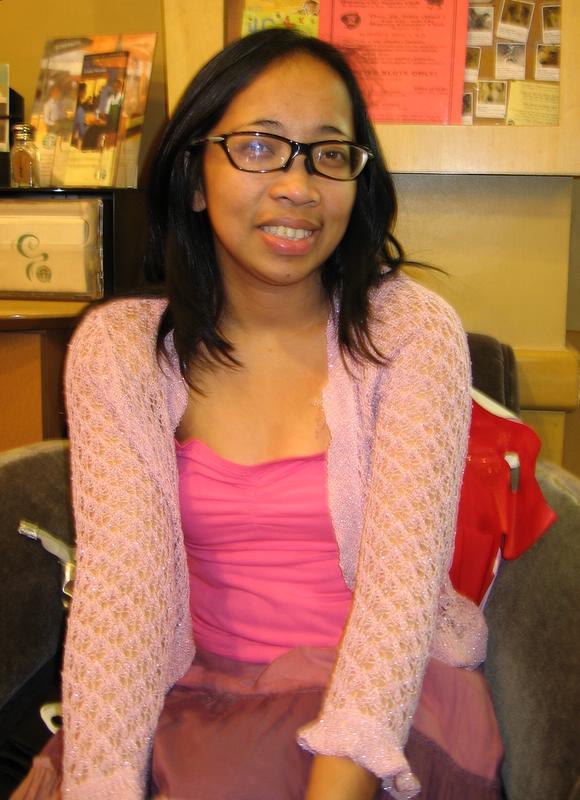 Abie is a Filipina, a librarian, an MBA-holder, and a black belt in aikido. She obtained her MLIS in Japan, where she is also now finishing her PhD. Her mother is a librarian, her sister is a librarian, and her husband is a librarian!
I first "met" Abie through the Filipino Librarians Googlegroup. But it was not until she came to visit last Christmas that we finally met in person. The most interesting story she told me was about the time when she was still the chief librarian of a public library in Manila.
When she took over the small library, she found out that the library had so many employees whom she had never met. It turns out they were actually "15-30" employees—those who showed up only to collect their salaries on the 15th and 30th of every month. Well, she put them all to work. And when the 15-30 employees realized that they had to work for their salaries, they all eventually asked to be transferred to other departments. They all returned when Abie left for Japan.
Why are public libraries in the Philippines in such a sad state? There are many reasons, of course. But I wish we had many more librarians like Abie.
Category: Librarians
Why I Choose To Live in the Philippines
Rick is an American living in the Philippines who just learned to blog. The following are the reasons why he chooses to live here:
- I can afford to live here and help people at the same time.
- I'm married to a Filipina who doesn't want to move to the states.
- I like the people here also.
- I also love the weather.
Meanwhile, Rickey uses his sidebar to direct readers to Google's search results for the phrase "Filipinos are known for..." Check it out.
Category: The Philippines
Library 2.0: A View from the Third World
The author is my student. I considered editing the paper, but decided that it would be better to leave it as is, except to add the links to the original paper.Do libraries matter in the world of Google and Amazon? Basically, this is the question in Ken Chad's and Paul Miller's paper “Do Libraries Matter: The Rise of Library 2.0” (pdf, html). They answered yes, libraries matter. There is, however, a hitch. In order to continue being relevant, the library must keep up with the way Internet-based services provide information – to offer ready-access from any place, at any point in time.
“Access to information from anywhere at any time.” Apparently, this is the guideline or motto for Library 2.0 that Chad and Miller proposes in their paper. At the point of need, information seekers can access the library through the Internet. They would not have to physically be in the library in order to gain a desired information – minimizing the problem of limited library hours.
The question for us is, “Does the UP Main Library need this type of service?” Library 2.0 is applicable and useful for libraries in rich countries like the UK. But for libraries in a third world country like ours, I don't think we need to employ this type of service.
As mentioned above, our patrons are students. From a scale of 1 to 10, how many student have access to the Internet? How many have their own computers? And for those who have computers, how many have a connection to the World Wide Web? How many students access the Internet through computer shops?
Considering the questions above, we must note their financial capabilities if we are indeed thinking providing for a service like Library 2.0. Not all students will be able to access an on-line type of service. Not all students will be able to fully utilize and take advantage it.
Cost and maintenance is also another factor we need to look into in employing Library 2.0. How much will the library spend in order to implement this type of service? How much will its maintenance cost and how often will it be done? Who will be responsible for maintenance?
Even if Library 2.0 uses a mash-up of free applications available through the Internet and the library can avail this type of service and its maintenance, we will go back to the topic of misdirected goal. We might be able to employ this type of service but will it serve its purpose of providing information to a larger population, or even to all, of our patrons? I believe not. Not in the UP academic library setting.
Category: Libraries


